
Five years ago, ranking #1 on Google felt like winning the internet. Today, your buyers are just as likely to ask ChatGPT, Gemini, or Perplexity as they are to type a query into a search bar. If your brand doesn’t appear in those AI answers, you’re invisible—no matter how strong your traditional SEO looks.
This shift is what makes Answer Engine Optimization (AEO) the next strategic frontier. It is not a buzzword or a minor tweak to SEO. It is a new layer of competition: winning the answer, not just winning the click.
For Indian enterprises and high-growth brands, the stakes are clear. AI assistants are becoming the default research companion for purchasing decisions—from SaaS to education, banking to healthcare. The brands that understand AEO now will shape how these assistants talk about their categories for years.
This guide breaks down what AEO is, how it differs from SEO, how it affects rankings in AI search, and how platforms like UpBinger can help you operationalize an AI-first content strategy at scale.
Answer Engine Optimization (AEO) is the practice of shaping how AI systems—like ChatGPT, Gemini, Perplexity, and Google AI Overviews—discover, interpret, and cite your brand in their answers. Search Engine Optimization (SEO) is the practice of improving your visibility and traffic in traditional search engine results pages (SERPs).
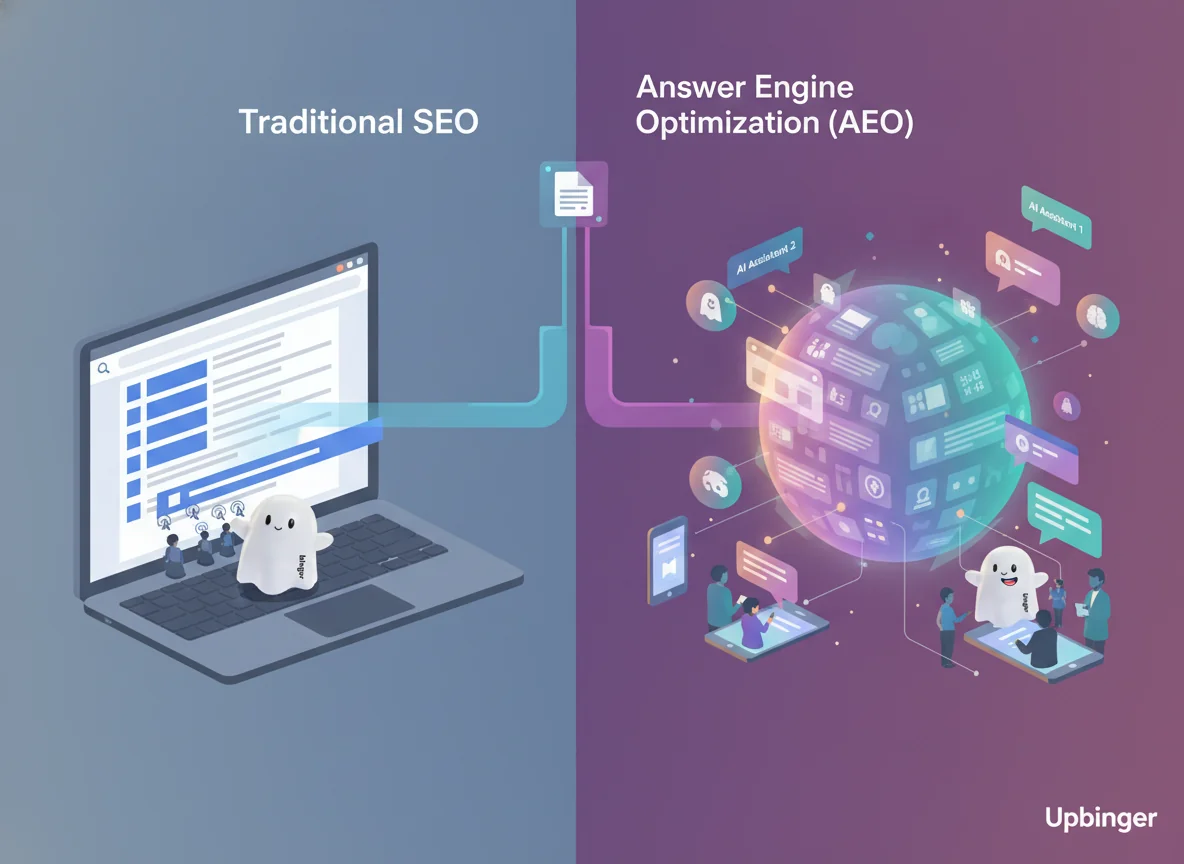
The core difference is goal and unit of competition. SEO’s goal is to drive qualified clicks to your website. You compete for rankings, impressions, and click-through rate. AEO’s goal is to earn inclusion and prominence within AI-generated answers. You compete for citations, mentions, and share of answer.
In practical terms, SEO asks: “How do I get users from Google to my site?” AEO asks: “When someone asks an AI about my category, does it mention and recommend my brand, even if users never click to my site?”
Both disciplines rely on authoritative, well-structured content. But AEO adds new requirements: machine-parseable explanations, consistent brand narratives across the web, and content formats engineered for large language models (LLMs).
Key takeaway: SEO optimizes for blue links; AEO optimizes for AI answers. The best modern strategies design every asset to win on both fronts.
AEO affects rankings in AI search by increasing how often, how prominently, and in what context AI systems surface your brand in answers. While AI assistants don’t show traditional “ranked lists,” they still prioritize some brands over others based on perceived authority, clarity, and relevance.

Most answer engines currently blend three inputs:
When you optimize for AEO, you deliberately feed these inputs. You publish content that is concise enough to quote, explicit enough to define, and structured enough for LLMs to parse reliably. You also expand your footprint beyond your own site: partner content, product comparisons, and third-party reviews all become raw material for AI training and retrieval.
The result: when an Indian buyer asks, “What are the leading AI content strategy tools for enterprises?” an optimized brand like UpBinger is more likely to appear as a cited recommendation, even if the user never visits its website.
Key takeaway: In AI search, “ranking” means being mentioned and cited in the answer itself. AEO is how you engineer that outcome.
AEO is not replacing SEO; AEO is expanding SEO into AI-first channels. Strong SEO remains a prerequisite for meaningful AEO results, especially on Google, which heavily uses traditional ranking signals to fuel AI Overviews.
Think of it as a stack:
Without SEO, your content may never be discovered or trusted enough to be used by AI models. Without AEO, you leave your AI visibility to chance—even with strong rankings.
The winning teams stop debating “SEO vs AEO” and start building a unified search strategy that includes:
Platforms like UpBinger are emerging to manage this full continuum: from SEO content creation to AEO monitoring and optimization—all in one enterprise-ready workflow.
The most practical way to understand the difference is to compare SEO and AEO across goals, tactics, and KPIs, then ground it in concrete examples modern CMOs will recognize.
| Dimension | SEO | AEO |
|---|---|---|
| Primary goal | Drive organic traffic and conversions | Win brand mentions, citations, and recommendations in AI answers |
| Main battleground | Search engine results pages (SERPs) | Answer engines and AI assistants |
| Core KPIs | Rankings, impressions, CTR, sessions, revenue | Brand mentions, citations, share of answer, AI referral traffic |
| Content style | In-depth, keyword-targeted, navigational | Concise, definitional, quotable, structured |
| Optimization levers | Technical SEO, on-page, links | Schema, FAQs, clarity, third-party coverage |
For SEO: You publish a 3,000-word guide on “AI SEO tools,” targeting keywords like ai seo tools and seo content creation, optimized for featured snippets and People Also Ask (PAA).
For AEO: You add a short, explicit section: “AI SEO tools are [clear definition].” You compare leading AI content strategy tools in a structured table, include FAQs, and ensure consistent tool descriptions across third-party reviews. UpBinger then tracks how often AI assistants list your brand in “best tools” answers versus competitors.
Key takeaway: SEO answers, “Can we get traffic for this query?” AEO answers, “When AI lists options, are we always on the list?”
Content that wins in an AI-first world is deliberately built for both humans and machines. It reads naturally, but it is engineered so LLMs can extract, quote, and recombine your insights accurately.
Four practical design principles matter most:
For example, an UpBinger-powered AEO hub might include:
Together, these assets seed the exact language AI models use when describing your space.
To manage what you can’t measure is to abdicate strategy. In an AI-first world, marketing leaders need a dual dashboard: one set of KPIs for SEO performance and another for AEO visibility.
UpBinger-type platforms consolidate these into a single view so a CMO can answer questions like: “In Q2, did our share of answer for ‘leading AI content strategy tools’ increase across ChatGPT, Gemini, and Google?”
Key takeaway: The new north star is not only “visits from search,” but “visibility in search-like experiences,” including AI assistants.
Winning in an AI-first search world is not about publishing one clever AEO guide. It is about operationalizing SEO and AEO across hundreds or thousands of assets, with consistent quality and brand voice. That is precisely where enterprise AI platforms like UpBinger come in.
UpBinger is an AI-powered SEO & AEO content platform built for enterprises in markets like India that need to create, optimize, and scale content for both search engines and answer engines. At a high level, a platform like this helps you:
Instead of juggling disconnected AI writing tools and manual spreadsheets, your team gets a unified system of record for search and AI visibility—designed for modern, AI-first buyers.
Answer Engine Optimization (AEO) is the practice of influencing how AI systems like ChatGPT, Gemini, Perplexity, and Google AI Overviews mention and recommend your brand in their responses. Search Engine Optimization (SEO) focuses on earning rankings and traffic from traditional search engines. SEO optimizes for clicks on blue links; AEO optimizes for citations and share of answer inside AI-generated summaries. Both rely on authoritative, well-structured content, but AEO adds requirements like clear definitions, question-based headings, structured data, and consistent brand narratives across the web so large language models can reliably understand and quote you.
Begin with your existing SEO content. First, identify 10–20 high-intent topics where AI and human search demand overlap, such as “ai seo tools” or “best enterprise seo platforms in India.” Second, refine those pages with AEO best practices: add explicit definitions, FAQs that mirror real questions, numbered steps, and comparison tables. Third, ensure your product and brand descriptions are consistent across your site, partner sites, and review platforms. Finally, use an AEO-aware platform like UpBinger to monitor how often AI assistants mention your brand, then iterate your content and distribution based on those insights.
AEO improves your chances of being included and cited in AI-generated answers when users ask questions about your category. AI systems tend to pull from authoritative, clearly structured content that matches user intent. By designing your content with definitional clarity, question-based headings, structured data, and third-party corroboration, you increase the probability that LLMs will surface your brand. While AI assistants do not show ranked lists the way Google does, they still prioritize which brands to mention. AEO is how you climb those invisible “answer rankings” and win a greater share of answer.
AEO is most critical for brands whose buyers rely heavily on research—SaaS platforms, financial services, healthcare, education, and B2B services. Many of these are enterprises, but growth-stage and mid-market companies in India also stand to gain. Answer engines can personalize recommendations, meaning smaller but highly relevant brands can win visibility if they invest early. However, AEO requires consistent content operations, so teams with at least some SEO maturity see the fastest returns. Platforms like UpBinger lower the barrier by automating much of the content creation, optimization, and monitoring work.
Four AEO KPIs matter most: 1) Brand mentions in AI answers across targeted prompts and assistants; 2) Citations and links from AI answer experiences back to your content; 3) Share of answer versus key competitors for strategic questions (e.g., “leading AI content strategy tools”); and 4) AI referral traffic where available. Over time, you should see your share of answer and mentions increase in parallel with traditional SEO metrics like organic traffic and conversions. A dedicated AEO platform helps you track these systematically instead of relying on ad hoc testing.
You can implement basic AEO principles with your current SEO tools—by restructuring content, adding FAQs, and improving schema. However, traditional SEO platforms generally do not track AI assistant visibility, prompts, or share of answer. That is where specialized AI content and AEO platforms like UpBinger add value. They combine SEO content creation, AI-aware optimization, and answer-engine monitoring in one place. For marketing leaders serious about market leadership in an AI-first world, this integrated view becomes essential to allocate budgets, justify content investments, and stay ahead of competitors.
AI search is not a side channel; it is becoming the default way people ask complex questions. For Indian marketing leaders, this means the old SEO-only playbook is no longer enough. You need to win both the click and the answer.
AEO gives you a framework to do that: define your category in quotable language, structure your content for machines as well as humans, and track how AI assistants actually talk about you. SEO remains the foundation—but AEO is the competitive edge.
Platforms like UpBinger exist because this is no longer work you can manage in spreadsheets and ad hoc experiments. If you want your brand to be the one AI recommends when buyers ask their most important questions, you need an integrated, AI-first content strategy.
The next step is simple: audit where you stand in both SERPs and AI answers today, then design one roadmap that treats SEO and AEO as two sides of the same growth engine.