
Global brands aren’t struggling with content ideas. They’re struggling with scale. Hundreds of markets, thousands of SKUs, millions of micro-moments—while search engines and AI assistants keep rewriting the rules of visibility. Traditional content operations simply can’t keep up with the volume, speed, and precision now required to win both SEO and AEO (Answer Engine Optimization).
This is where enterprise AI platforms such as UpBinger change the equation. The question is no longer, “Can AI help us write faster?” but rather, “What systemic scaling bottlenecks can AI remove that humans alone never could?”
This article maps eight recurring pain points—across velocity, quality, governance, and discoverability—and shows how AI-driven content platforms solve them for global brands. If you’re an enterprise leader in India or beyond, evaluating AI for SEO and AEO, treat this as your practical blueprint.
Most global brands are stuck in the velocity trap: demand for content grows exponentially; budgets and headcount do not. Launching a new product line might require hundreds of landing pages, localized blog posts, FAQs, and social assets. Manual creation and approval workflows stretch timelines from weeks to months, turning marketing calendars into wish lists instead of reality.

Meanwhile, search behavior is fragmenting. Users search in long, conversational queries; AI assistants answer in real time. To stay visible, brands need fresh, structured, and intent-matched content continuously—not quarterly bursts. Even sophisticated agencies struggle to hit this cadence across dozens of markets and languages.
Enterprise AI platforms tackle velocity at the system level. Instead of brief → writer → editor → SEO specialist, a single AI content engine like UpBinger can:
Human teams shift from “typing factory” to high-level review, refinement, and strategy. The result isn’t just more content; it’s responsive content velocity—the ability to align output with real-time market opportunities.
Speed without quality is a liability. Early AI tools flooded the web with generic, templated prose that users bounced from and search engines learned to devalue. For global brands, this isn’t just a performance problem; it’s a reputational risk. Poorly written or factually shaky content erodes trust, especially in regulated or high-consideration categories.
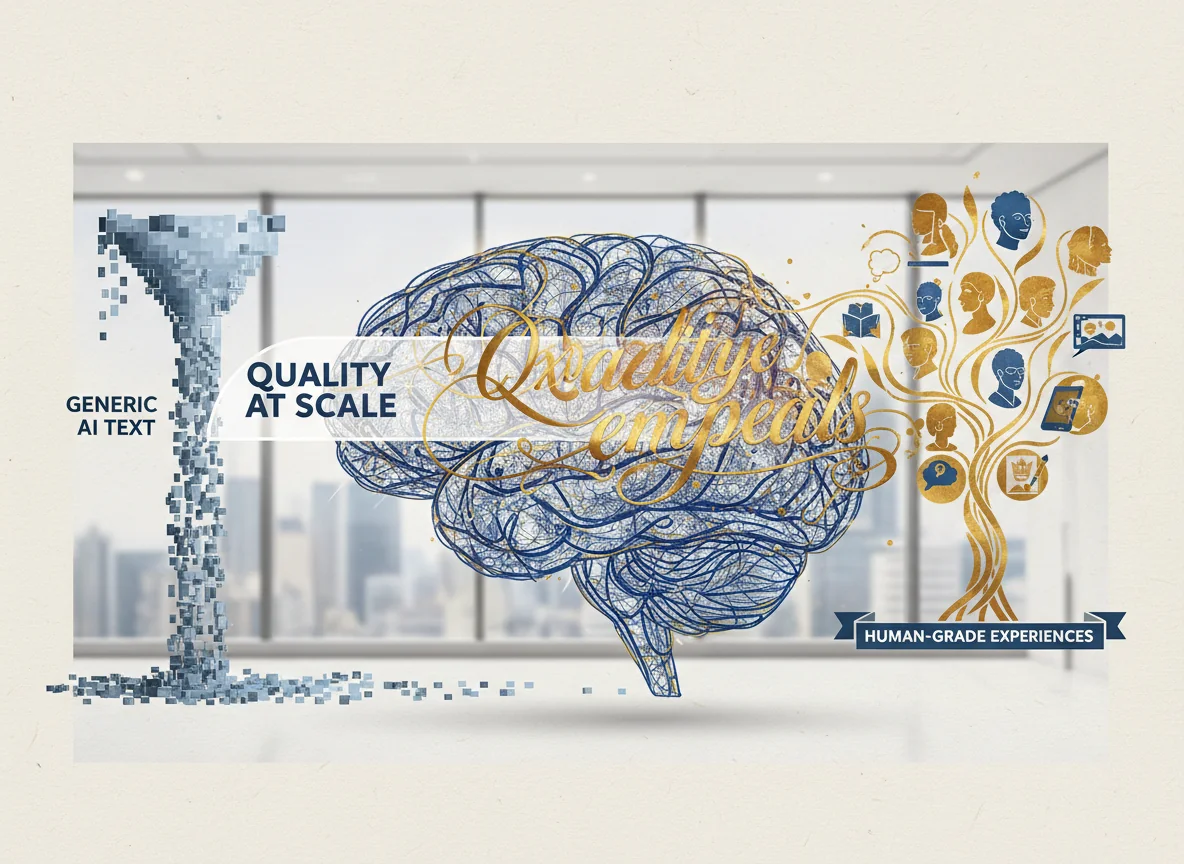
Quality at scale requires consistency in four dimensions: accuracy, depth, voice, and usefulness. Traditional workflows rely on senior editors to enforce these standards—an approach that collapses under enterprise volumes.
Modern AI content platforms address this with domain-aware, brand-trained models. Instead of a one-size-fits-all chatbot, platforms like UpBinger can be calibrated on:
The AI becomes a first-line quality gate: flagging vague claims, enforcing structure, and maintaining tone across thousands of assets. Humans still own judgment—verifying sensitive facts, adding original insights, and refining narrative flow—but they start from a strong, on-brand baseline rather than a blank page. This blended model flips the equation: quality is no longer inversely correlated with scale.
For global enterprises, the hardest scaling problem isn’t volume—it’s governance. How do you ensure that a blog post in Mumbai, a landing page in Berlin, and a help article in Toronto all:
In traditional setups, governance lives in PDFs: brand books, compliance checklists, and tone-of-voice documents that busy teams skim or ignore under deadline pressure. The result: content drift, inconsistent claims, and compliance fire drills.
Enterprise AI platforms turn governance from documentation into execution logic. With systems like UpBinger, brands can embed rules directly into generation and review workflows:
AI also provides auditability. Central teams can monitor which assets, markets, or teams deviate from guidelines, and correct systematically rather than reactively. Over time, the model learns from approved content, tightening alignment without adding human overhead. This is particularly powerful in India’s complex regulatory and linguistic landscape, where governance needs to be both centralized and locally adaptable.
Localization is where global aspirations often stall. Translating content word-for-word is easy; adapting it for cultural nuance, local search behavior, and regulatory specifics is not. Brands either overspend on translation agencies or underinvest and ship tone-deaf, underperforming assets.
The real challenge is threefold:
AI platforms can radically compress this bottleneck. Instead of translating finished English content, tools like UpBinger can generate source-neutral, structured content templates aligned to intent and then localize at generation time:
Human reviewers in-region refine and approve, but they no longer start from scratch. For Indian brands expanding globally—or global brands targeting India’s tiered cities and languages—this means localization is no longer the slowest part of the go-to-market plan. It becomes a parallel, AI-accelerated stream.
Many enterprises quietly face the same embarrassing reality: hundreds or thousands of pages, but near-zero indexed keywords or meaningful organic traffic. Legacy content doesn’t answer modern, conversational queries. Technical SEO is patchy. And emerging answer engines (from Google’s AI Overviews to ChatGPT, Gemini, and voice assistants) rarely surface the brand.
AI platforms like UpBinger attack this at two levels: traditional SEO and emerging AEO.
On the SEO side, AI can:
On the AEO side, AI structures content for machines, not just humans:
The shift is from “publish and pray” to intent-first, machine-readable content. For brands in competitive Indian verticals—finance, education, ecommerce—this can mean leapfrogging incumbents whose content libraries were built for a pre-AI search era.
Even with talented teams, most enterprise content operations resemble a Rube Goldberg machine. Ideas in one tool, briefs in another, drafts in email, SEO feedback in spreadsheets, performance data in analytics dashboards no one opens. The friction isn’t just annoying; it directly caps output and obscures what’s working.
AI alone doesn’t fix chaos. What does is using AI within an orchestrated platform that centralizes workflows end to end. Systems like UpBinger are evolving from “writing assistants” into content operating systems that connect:
Because the AI sees the whole lifecycle, it can close loops humans rarely do. Underperforming pages can trigger rewrite prompts. Topics that win SERP features can seed adjacent content. Localization gaps surface automatically. Instead of juggling tools, teams work in one environment where AI nudges them toward higher-leverage decisions.
The result is compounding efficiency: every asset produced teaches the system—and your teams—how to create the next one better and faster.
Most content strategies are built like campaigns: create, launch, move on. In an AI-shaped search ecosystem, that mindset is obsolete. Rankings fluctuate faster; answer engines learn continuously; competitors ship at unprecedented speed. Static content, however well written, decays.
AI platforms enable an always-on optimization loop that few enterprises can sustain manually. Connected to analytics and search data, tools like UpBinger can:
Crucially, this isn’t only about SEO. AEO signals—what questions users ask, what snippets answer engines favor, which formats appear in SERP features—can all inform content refreshes. Over time, your library shifts from a static archive to a living asset, continuously tuned to how humans and machines actually discover and consume information.
For leadership teams, this unlocks a new kind of visibility. Instead of vanity metrics (page views, likes), you can track how AI-augmented content contributes to pipeline, customer education, and support deflection—market leadership measured in impact, not output.
AI doesn’t just make writers faster; it removes structural bottlenecks. For global brands, AI platforms address eight recurring challenges: slow content velocity, inconsistent quality, weak governance, localization delays, poor SEO and AEO performance, fragmented workflows, limited personalization, and lack of continuous optimization. By embedding brand rules, SEO logic, and workflow automation into one system, platforms like UpBinger help enterprises create more content, with higher quality and better discoverability, without linearly adding headcount or agency cost.
Begin with a controlled pilot, not a full rollout. First, centralize your best-performing content, brand guidelines, and messaging frameworks. Use these to train or configure the AI on tone, terminology, and do/don’t rules. Next, pick one or two content types—such as blogs and FAQs—and one market. Have AI generate drafts while editors rigorously review and annotate what’s acceptable. Feed those edits back into the system. Within a few cycles, the AI will converge on your voice, and you can safely expand to more formats and regions.
Traditional SEO focuses on ranking web pages in search results. AEO focuses on being the answer that AI systems surface directly—inside Google’s AI Overviews, voice assistants, chatbots, or enterprise search. As users increasingly ask questions in natural language, they often consume information without clicking through to a site. Structuring content with clear questions, concise answers, schema markup, and snippet-ready summaries increases the odds that your brand becomes the canonical answer, even when there’s no traditional click involved.
Yes—this is where AI platforms can have outsized impact. Start with a technical and content audit to identify crawl issues, thin pages, and missing topics. Then use AI to build a focused content architecture: cornerstone pages, supporting articles, and FAQ hubs mapped to high-intent keywords and questions. Because AI can generate these at scale, you can move from a handful of ad hoc posts to a structured library quickly. As search engines see comprehensive, internally linked, intent-matched content, indexing and traffic typically improve.
Generic AI tools are optimized for individual productivity: one-off blog posts, emails, or ads. Enterprise platforms like UpBinger are optimized for systems-level performance. They integrate with your CMS and analytics, encode governance and compliance rules, support multi-language localization, and prioritize SEO/AEO structures by default. They also provide reporting, collaboration, and approval workflows suitable for large teams. In short, they’re not just about generating text; they orchestrate the entire content lifecycle at scale.
Global brands that treat AI as a side experiment will keep winning small efficiency gains and losing the larger race. The real opportunity is to reimagine content as a strategic, AI-orchestrated system—where velocity, quality, governance, SEO, and AEO all reinforce each other instead of competing for attention and budget.
Platforms like UpBinger are emerging as the backbone of this new model, particularly for fast-growing enterprises in India looking to compete globally. The practical path forward is clear:
In a world where both humans and machines are your audience, content scaling is no longer optional—and AI is no longer a nice-to-have. It’s the infrastructure that will quietly determine which brands lead the next decade of organic growth.