
People Also Ask (PAA) is no longer just a curiosity box in Google. It is one of the clearest windows into how search and answer engines understand intent. Enterprises that can mine, cluster, and act on PAA questions at scale are quietly building a durable moat in both classic SEO and Answer Engine Optimization (AEO).
This is where AI moves from “content assistant” to content intelligence agent. Instead of writing one article at a time, you deploy AI to read millions of user questions, organize them into topic maps, and feed your editorial pipeline with AEO-ready content briefs that routinely 3–5x production throughput.
This article breaks down how that system works, why PAA is uniquely powerful, and how platforms like UpBinger turn raw question data into enterprise-grade strategy. Along the way, we’ll answer high-intent queries like “what are the key differences between SEO and AEO?” and show concrete workflows for aeo content optimization and ai for SEO.
Key takeaway: The real competitive edge is not scraping PAA—it’s using AI to transform chaotic PAA questions into structured topic maps that fuel scalable, answer-ready content.
The key difference between SEO and AEO is who you are optimizing for. SEO is optimizing content so search engines rank your pages. AEO is optimizing content so AI assistants (answer engines) retrieve, summarize, and cite your pages.
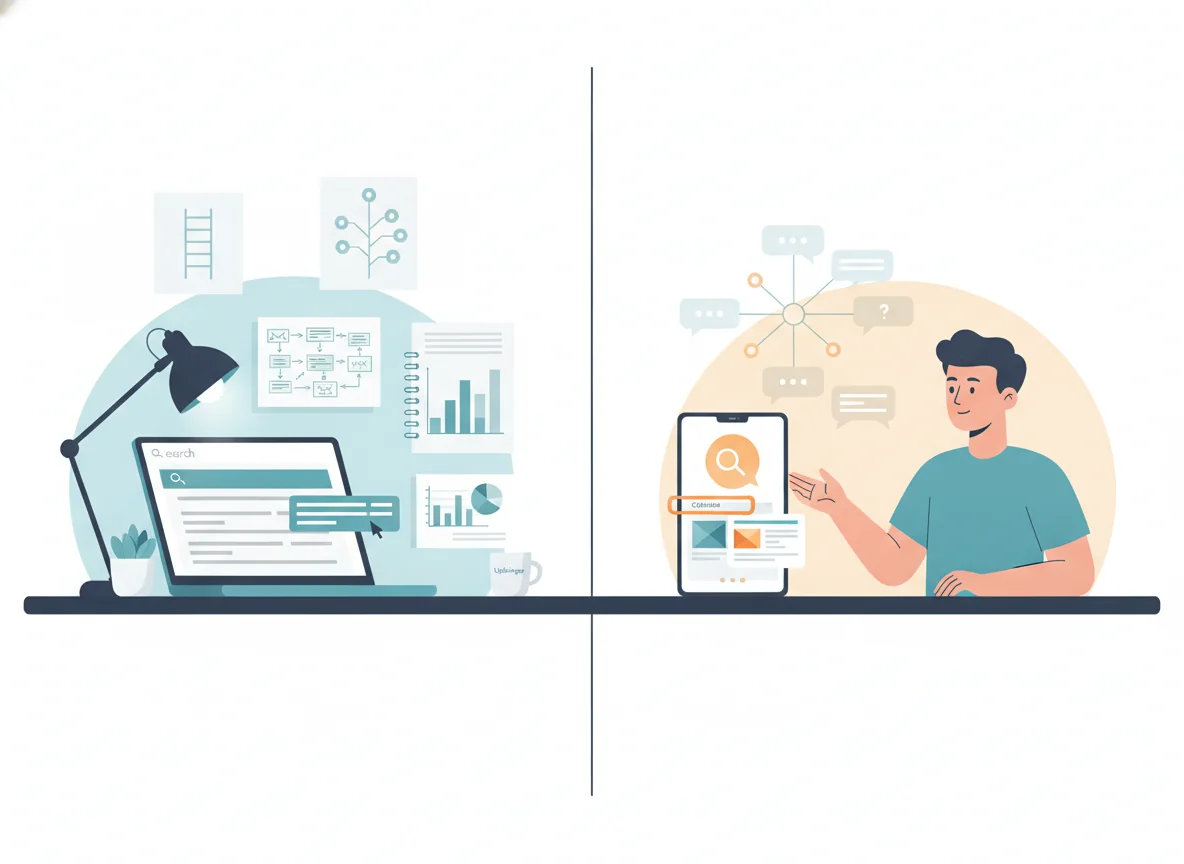
SEO is the practice of earning visibility in ranked search results. It focuses on signals like crawlability, backlinks, keyword targeting, and on-page structure so algorithms can evaluate and rank pages for specific queries.
AEO is the practice of structuring and enriching content so AI systems such as Google AI Overviews, ChatGPT, Perplexity, and Gemini can confidently quote or reference it in synthesized answers. It emphasizes clarity, unambiguous definitions, evidence, and coverage across entire topics.
In a PAA-driven world, the distinction sharpens:
Practically, this means your ai seo platform must do more than generate rankable articles. It must map the question space around a topic and orchestrate content coverage at the cluster level, not just page level.
Quotable insight: SEO answers “Can we rank for this query?” AEO answers “When an AI explains this topic end-to-end, will it rely on us?”
People Also Ask is valuable because it is machine-curated human curiosity. Google surfaces PAA questions by analyzing billions of searches, click patterns, and co-occurring intents, then chaining related questions as users expand the box. At scale, this forms a living knowledge graph of how humans navigate a topic.

For enterprises, this graph is a goldmine:
The challenge is scale. Across a single core topic like "ai content creation tool" or "ai for seo", you can easily collect hundreds of thousands of PAA questions across markets, devices, and languages. Manually cleaning, deduplicating, and interpreting this volume is impossible for human analysts.
This is where an ai content generation platform with embedded content intelligence—like UpBinger—shines. Instead of sampling a few dozen questions for inspiration, you treat PAA as a big data asset. AI models ingest millions of questions, cluster them, and expose the underlying structure: entities, intents, and journeys.
Key takeaway: PAA is effectively free market research. AI turns that research from a noisy list into a strategic map.
AI clusters PAA questions into topic maps by converting each question into a numerical representation (an embedding), then grouping embeddings that are close in meaning. This shifts you from keyword lists to semantic neighborhoods of intent.
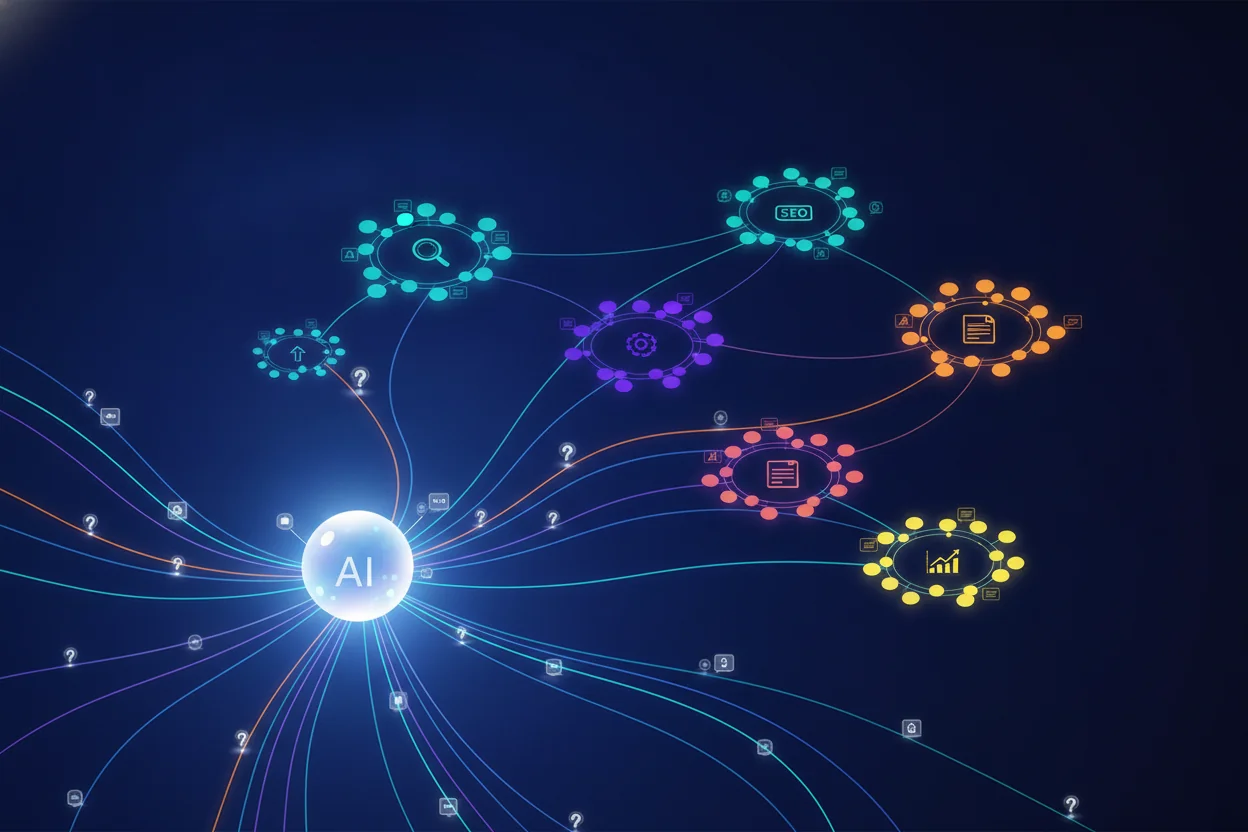
An enterprise-grade workflow typically looks like this:
The result is a topic map—a hierarchy of core topics, subtopics, and specific user questions. UpBinger’s AI agents then overlay metrics like search volume, difficulty, and current coverage to prioritize which clusters deserve fresh content or optimization.
Quotable insight: Clustering turns one million unmanageable questions into a few hundred strategic topics and a few thousand production-ready briefs.
The way AI multiplies output is simple: once you have clean clusters, generating briefs becomes a programmatic process rather than a manual craft exercise. Topic maps expose what to cover; AI agents then define how to cover it for both SEO and AEO.

Here’s how enterprises typically move from clusters to 3–5x more AEO-ready briefs:
UpBinger’s ai content creation tool does this automatically: the same AI that clusters questions also drafts structured outlines, suggests headings mapped to PAA, and recommends internal links within the topic map. Editorial teams move from starting with a blank page to reviewing intelligently pre-populated briefs.
Key takeaway: The throughput gain comes not from writing faster, but from removing human bottlenecks in research, clustering, and outlining.
AEO content optimization is the process of shaping content so AI systems can extract precise, trustworthy answers with minimal hallucination risk. On top of PAA-driven topic maps, this becomes highly systematic.
For each prioritized cluster, an AEO-optimized brief will specify:
UpBinger’s ai for SEO agents analyze both your drafts and competing content to ensure:
This approach aligns classic on-page SEO with AEO: the same structural clarity that helps Google rank you also helps generative engines cite you in AI Overviews and chat answers.
Quotable insight: AEO isn’t a new content format. It’s a discipline of making your existing content impossible for AI to misunderstand.
At enterprise scale, PAA mining must be embedded into workflows, not treated as a side project. The most effective organizations treat AI not as a monolith, but as a team of specialized agents, each owning part of the PAA-to-content pipeline.
A practical UpBinger-style agent architecture might look like:
Because UpBinger is built as an ai seo platform for India-first enterprises, it can also factor in regional nuance: Hindi and regional-language PAA questions, local examples, and market-specific regulations that global tools often ignore.
The outcome isn’t just more AI content generation. It’s a durable operating system for content intelligence that can be rolled out across product lines, business units, and languages.
Key takeaway: Without workflow design, PAA mining is a spreadsheet hobby. With AI agents, it becomes a core capability.
Implementing AI-driven PAA mining is best done as a staged rollout over 60–90 days. A typical enterprise roadmap with UpBinger looks like this:
By the end of this cycle, most enterprises see a 3–5x increase in the number of AEO-ready pieces they can plan and brief each month, without increasing headcount. More importantly, coverage is no longer random; it is grounded in what users actually ask and how answer engines actually think.
Quotable insight: The business case isn’t just more content. It’s less wasted content because every piece is anchored to validated user questions.
SEO, or Search Engine Optimization, is about improving your pages so search engines rank them higher for relevant queries. It focuses on factors like crawlability, keyword targeting, backlinks, and user engagement. AEO, or Answer Engine Optimization, is about optimizing your content so AI-based systems—Google AI Overviews, ChatGPT, Perplexity, Gemini—can confidently retrieve, summarize, and cite it in their answers. While SEO works at the level of ranked URLs, AEO works at the level of discrete answers and topic coverage. In practice, modern strategies need both: SEO to win classic SERPs and AEO to win AI summaries and conversational search.
Begin by defining 20–50 seed keywords that matter most to your business, such as “ai for seo” or “ai content generation”. Use an ai seo platform like UpBinger to automatically pull PAA questions for those seeds at scale. Next, let the platform clean and cluster those questions into topic groups. From there, prioritize clusters using metrics like potential traffic, business relevance, and current content gaps. Finally, generate structured content briefs for your writers, ensuring each brief includes PAA-derived headings and explicit questions to answer. Within a few weeks, you’ll have a repeatable pipeline from raw PAA data to production-ready briefs.
AEO content optimization is the process of structuring and enriching content so AI systems can easily extract accurate, quotable answers. It typically involves adding clear definitions, question-based headings, concise summaries, and structured lists. This is important because AI assistants are rapidly becoming a primary discovery channel; users often see AI-composed answers before they see classic blue links. If your content isn’t optimized for answer extraction, you risk disappearing from these new surfaces—even if your SEO fundamentals are strong. AEO ensures your brand remains visible and authoritative as search becomes more conversational and generative.
Yes—if it is guided by strong strategy and human oversight. AI content generation tools excel at turning structured briefs into first drafts, but quality depends on the inputs. When you start from PAA-driven topic maps and AEO-focused briefs, AI-written pages are far more likely to fully answer user questions and align with answer-engine needs. Platforms like UpBinger add another layer by analyzing drafts for coverage gaps, structural issues, and unclear definitions before publication. The combination of AI-assisted drafting and human editing has proven effective at earning both organic rankings and AI citations across enterprise deployments.
Generic AI writing tools mainly help you draft individual articles faster. UpBinger is an enterprise ai content creation tool designed as an AI content strategy platform. It doesn’t stop at text generation; it mines People Also Ask data, builds topic maps, identifies gaps, and generates AEO-ready briefs at scale. UpBinger’s agents are tuned for ai for seo and AEO workflows, from PAA ingestion through clustering to performance monitoring. This means you don’t just get more content—you get a coordinated content system that builds topical authority and maximizes your visibility in both traditional search results and AI-powered answer engines.
Enterprises that treat People Also Ask as background noise will remain trapped in a page-by-page SEO mindset. Those that treat PAA as structured intent data—and deploy AI agents to mine, cluster, and operationalize it—will own the topics that matter when AI systems explain the world to users.
UpBinger was built precisely for this moment in India’s digital market: an ai seo platform that turns unstructured question data into strategic, AEO-ready content systems. By aligning PAA mining, topic mapping, and ai content generation inside one workflow, it helps brands reliably produce 3–5x more answer-ready briefs without sacrificing quality.
The path forward is clear: start small, plug AI into your PAA dataset, and let topic maps reshape how you plan and prioritize content. In a world dominated by answer engines, the brands that best understand—and systematically answer—real user questions will win.