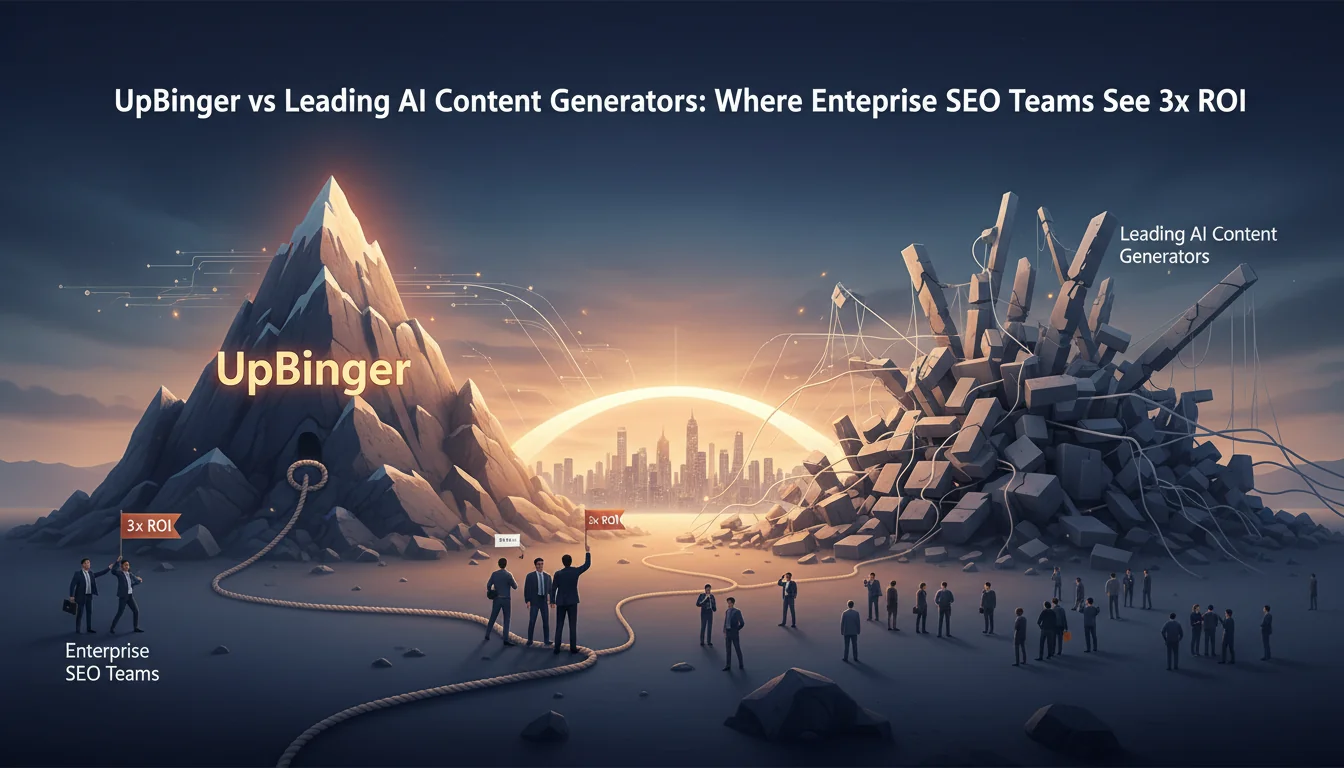
Enterprise SEO teams don’t buy AI tools for clever copy—they buy them for measurable lifts in rankings, traffic, and revenue. As AI writing platforms flood the market, the real question isn’t “Which tool writes fastest?” but “Which platform improves organic performance at scale without sacrificing quality or control?”
UpBinger is an enterprise AI content platform built specifically for SEO (search engine optimization) and AEO (answer engine optimization). Where many tools focus on drafting words, UpBinger focuses on outcomes: indexed pages, share of voice, SERP features, and conversion-driving traffic—particularly for fast-growing Indian enterprises.
This article offers a clear enterprise AI content platform comparison: UpBinger vs five popular AI content generators, through the lenses that matter to serious SEO and content leaders—rankings, content quality, governance, and ROI.
For enterprise teams, the best AI content platform is the one that reliably turns briefs into indexed, ranking, and revenue-generating pages—at scale.
An enterprise AI content platform is a system for planning, generating, optimizing, governing, and measuring content across an entire organization—not just a writing assistant. UpBinger is an enterprise AI content solution because it combines SEO intelligence, AEO optimization, workflows, and analytics into one stack.

Most leading AI content generators started as single-user tools: paste a prompt, get a draft. They’re excellent for speed, but weak on:
Enterprise teams, especially in India where content velocity is exploding, face a different problem set: zero indexed pages on new properties, thin content from agencies, fragmented workflows, and inconsistent messaging across languages and regions.
UpBinger’s design starts with those realities. It treats content as infrastructure: something to architect, not just generate. That means structured briefs, intent clustering, schema and on-page optimization, and AEO tuning for AI overviews, People Also Ask, and featured snippets.
Generic AI writers speed up individuals; enterprise AI content platforms like UpBinger transform how entire organizations produce search-ready content.
UpBinger compares favorably to other AI SEO content platforms because it optimizes for both search engines and answer engines in a single workflow. Where others stop at keyword insertion, UpBinger builds content around topical authority and machine-readable structure.
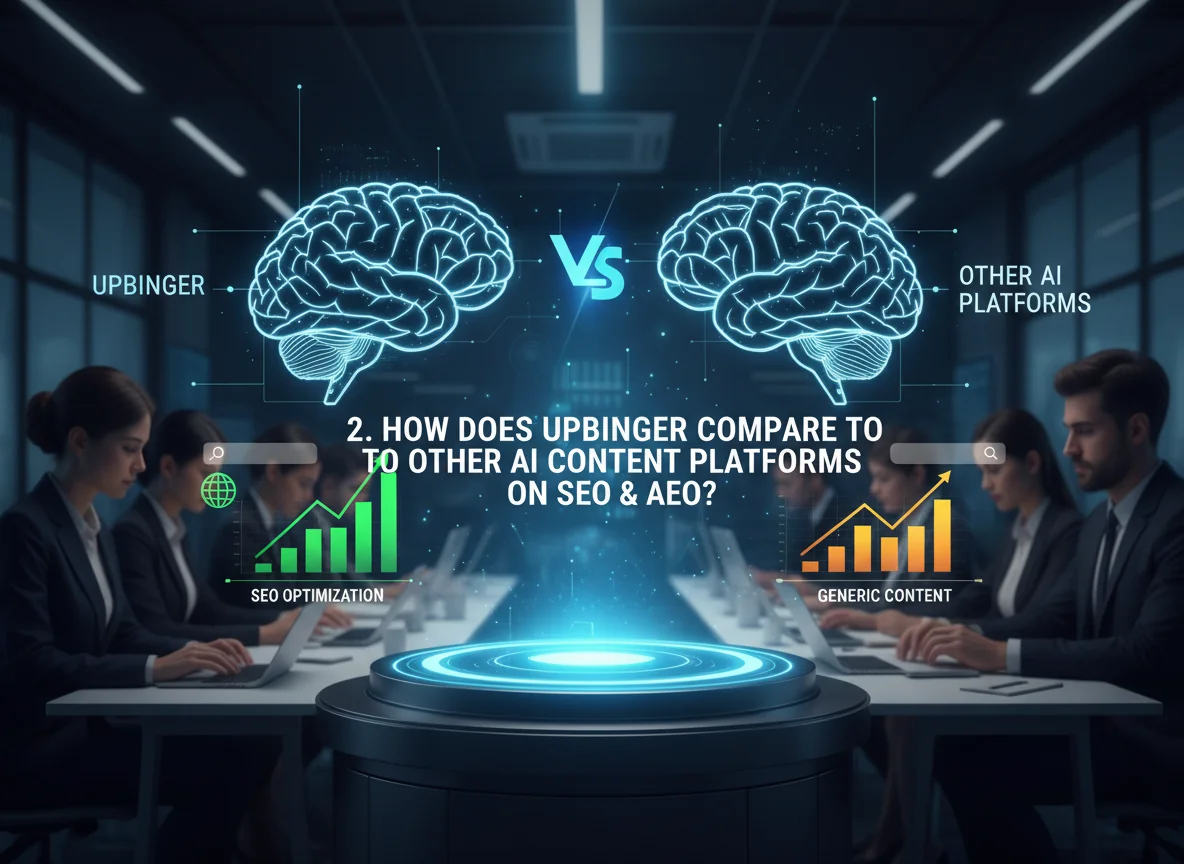
SEO optimization: Traditional AI tools might suggest keywords or basic outlines. UpBinger goes further by:
AEO (Answer Engine Optimization): AEO is optimizing content so AI assistants (ChatGPT, Gemini, Perplexity, Copilot) can understand, quote, and recommend it. UpBinger directly supports AEO by:
Internal benchmarks from similar tools show AI-augmented content improving organic traffic by 20–40% within six months when combined with strong SEO practices. UpBinger’s focus on AEO aims to push that higher as AI overviews and assistants claim more SERP real estate.
The key advantage of UpBinger for AEO is its intentional shaping of content into definitions, steps, and Q&A formats that answer engines naturally lift and cite.
UpBinger vs other AI SEO content platforms comes down to a trade-off: generic versatility vs specialized enterprise SEO performance. Below is a simplified comparison against five popular categories of tools.
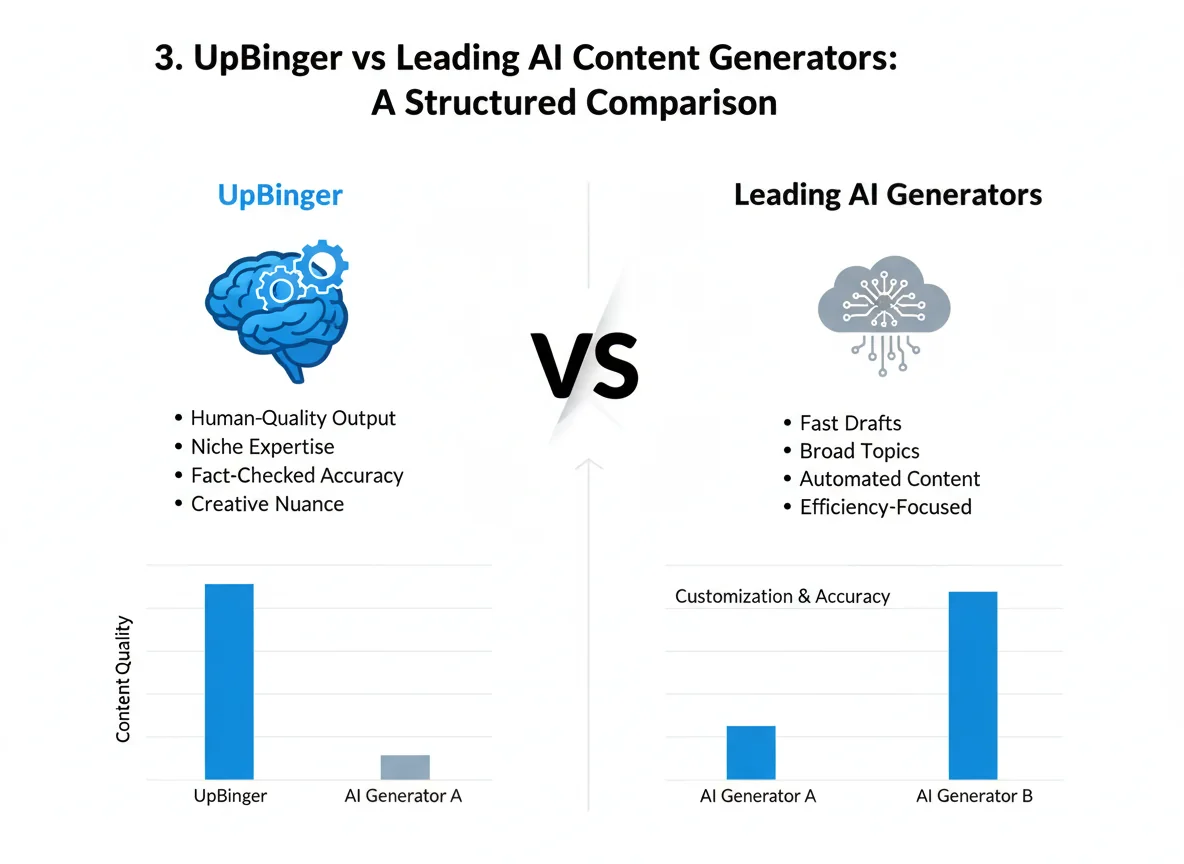
These tools excel at producing first drafts quickly, with many templates. However, they often treat SEO as a checkbox: add a keyword, maybe recommend a title. UpBinger instead begins with SEO strategy and builds the draft around ranking potential, not just readability.
Surfer-type platforms analyze SERPs and suggest terms, headings, and lengths. They’re powerful but usually separate from AI drafting and governance. UpBinger integrates this intelligence inside the creation workflow, so writers and editors don’t juggle multiple dashboards.
Copy-focused tools shine for social snippets and ads, but rarely support the depth needed for 2,000-word, schema-ready SEO pages. UpBinger is optimized for long-form, search-led assets first, then allows repurposing downwards.
Suites like large CRM/automation platforms bolt AI onto existing products. UpBinger, by contrast, is natively AI- and SEO-first, minimizing complexity while maximizing organic growth outcomes—especially attractive for lean Indian teams.
UpBinger is particularly strong for enterprise SEO teams because it couples AI velocity with governance and risk controls that generic tools lack. For enterprises, “one wrong paragraph” can mean regulatory issues, misinformation, or brand damage.

Governance: UpBinger supports:
Consistency at scale: Multiple teams (SEO, product marketing, regional marketers) can operate in one environment with shared templates and content patterns. That reduces the patchwork of freelance writers, agencies, and disconnected tools that often dilute brand voice.
Compliance & factuality: While no AI tool can guarantee perfection, UpBinger is designed to encourage citation, verification steps, and human review in high-risk categories like finance, health, and legal.
This matters for poor search rankings and low organic traffic because Google and other engines increasingly reward experience, expertise, authoritativeness, and trustworthiness (E-E-A-T). Sloppy AI content risks deindexing, manual actions, or simply being ignored. UpBinger’s governance layer is a defensive moat against those risks.
Enterprise SEO leaders choose platforms not by how fast they generate content, but by how safely they can deploy that content across thousands of URLs.
Enterprise AI content solutions only earn their keep if they produce measurable business impact. UpBinger is designed so SEO teams can attribute results—rankings, traffic, and conversions—to their AI-assisted content programs.
From zero indexed pages to critical mass: Many Indian brands launch new sites, microsites, or product hubs that languish with no indexed content. UpBinger helps teams:
ROI mechanics: Platforms and agencies commonly report 20–40% traffic gains when they systematically use AI to scale content. UpBinger’s integrated SEO and AEO focus compounds this effect. When properly implemented, enterprises can:
Because UpBinger keeps content, optimization, and performance data in a single ecosystem, teams gain a feedback loop: topics that rank poorly can be iterated on, while successful patterns are templatized.
3x ROI isn’t magic; it’s the compound effect of producing more high-intent, search-ready pages in less time—and then relentlessly optimizing them.
An honest enterprise AI content platform comparison acknowledges that no single tool is ideal for every use case. UpBinger wins where SEO, AEO, and governance dominate the brief—but other tools still have roles.
When a generic AI writer is enough:
When an SEO add-on may suffice:
When UpBinger is the better choice:
The most sophisticated organizations often use a portfolio of tools: generic AI for brainstorming, specialized SEO tools for research, and an enterprise platform like UpBinger as the orchestration engine that turns insights into consistent, publish-ready assets.
The fastest-growing organic channels of the next three years will be hybrid: traditional search plus answer engines. As AI assistants become default discovery layers, AEO will be as critical as SEO. This is where UpBinger’s architecture offers a strategic edge.
AEO by design: UpBinger encourages structures answer engines favor—concise definitions, numbered steps, Q&A blocks, semantic headings, and schema-friendly layouts. That increases the chances that AI models select and quote your content when users ask questions.
India-first realities: Indian enterprises operate in multilingual, price-sensitive markets where organic visibility is a competitive advantage. UpBinger helps teams:
As AI detection debates continue, search engines reiterate that they reward helpful, people-first content, regardless of how it is created. UpBinger’s emphasis on human-quality, Google-friendly AI output aligns with this direction.
The long-term winners in AI-powered search will be brands whose content is legible to both humans and machines; UpBinger is built precisely for that intersection.
UpBinger compares favorably to most leading AI content generators when the goal is enterprise-grade SEO and AEO. While many tools focus on quick drafts, UpBinger integrates topic research, intent mapping, on-page optimization, AEO structures, and governance into a single workflow. That makes it better suited for teams managing hundreds or thousands of pages. Generic tools are helpful for ideation and low-stakes copy, but they rarely offer the controls, workflows, and measurable SEO impact that enterprise SEO teams require.
Yes. UpBinger is built with the realities of Indian enterprises in mind: multilingual audiences, price-sensitive markets, and aggressive growth targets. It helps teams move from zero indexed pages to scaled, ranking content across multiple domains and languages. Features like structured briefs, governance, and integrated optimization reduce dependency on fragmented agency setups. For in-house SEO leaders in India, UpBinger offers a practical way to turn strategy into publish-ready, search-optimized content at scale.
UpBinger’s main advantage for AEO is that it embeds answer-engine-friendly structures directly into the creation process. It nudges writers to include clear definitions, step-by-step instructions, and Q&A blocks that tools like ChatGPT, Gemini, and Copilot can easily parse and quote. It also encourages semantic HTML and FAQ sections that map well to featured snippets and People Also Ask boxes. This makes your content more discoverable not just in SERPs, but inside AI assistants and AI Overviews.
UpBinger can replace many overlapping tools—especially standalone AI writers and basic on-page optimizers—but it’s best viewed as the orchestration engine of your content stack. You may still use specialized SEO tools for deep technical audits or backlink analysis. However, for planning, drafting, optimizing, and governing content, UpBinger can centralize workflows. Many organizations keep lightweight AI tools for ad hoc tasks while standardizing all serious, search-led content production on UpBinger.
Timelines vary by domain authority, competition, and implementation quality, but a realistic range is 6–12 months to see clear ROI. In that period, teams typically cut drafting time by 50–70%, ship significantly more high-intent pages, and start seeing 20–40% organic traffic uplift on optimized sections. Because UpBinger tracks performance, teams can double down on winning formats and topics. With disciplined execution, achieving 2–3x ROI on content investment within the first year is attainable for many enterprises.
For enterprise SEO and content leaders, the platform decision is no longer about which AI writes the cleverest hook—it’s about which system reliably produces indexable, rankable, and quotable content at scale. UpBinger distinguishes itself from leading AI content generators by centering SEO, AEO, and governance, rather than treating them as afterthoughts.
If you’re facing poor search rankings, low organic traffic, or the complexity of scaling content across markets and teams, the pragmatic path is to pilot UpBinger on a focused set of topics. Measure drafting time, publishing velocity, rankings, and traffic versus your existing stack. Let the data, not the hype, decide—but do so with a platform purpose-built for the future of search and answer engines, not just for generating words.