
Most teams already use some generic AI writer. They can crank out blog posts, product descriptions, even emails in seconds. But when the brief shifts from “write faster” to “win search and AI overviews,” those tools quietly hit a wall.
This is where platform-level SEO—and specifically UpBinger as an AI SEO content platform—changes the game. Instead of treating content as one-off text generation, it treats SEO, Answer Engine Optimization (AEO), and governance as a single, orchestrated system.
In the next few years, your visibility won’t just depend on blue links. It will depend on how often Google AI Overviews, Perplexity, ChatGPT Search, and Copilot quote you as an authoritative source. Generic AI writers were never built for that. UpBinger is.
Key takeaway: Generic AI writers speed up typing. UpBinger is an AI agent that plans, generates, optimizes, and governs content to win rankings and AI answers across your entire domain.
An AI content generator is a tool that converts prompts into text. An AI SEO platform is a system that plans, produces, optimizes, and measures content specifically to improve organic visibility. That distinction is the heart of UpBinger’s advantage.

Generic AI writers operate at the document level: one prompt in, one draft out. They rarely know your keyword strategy, your existing content, or what’s already ranking in India or globally. They also don’t track performance, so every piece is essentially a gamble.
UpBinger operates at the portfolio level. It connects keyword research, topical authority mapping, content briefs, on-page optimization, and AEO/GEO targeting into a repeatable workflow. Instead of “a better blank page,” you get an AI agent that understands:
Quotable: A generic writer helps you write content; an AI SEO platform helps you own a topic.
This shift—from document to domain, from text to strategy—is why platform-level SEO wins over time, especially for enterprises.
The essential features in an AI SEO platform are those that connect keyword intelligence, content generation, optimization, and governance into one workflow. Anything less is just a writing assistant with a search veneer.
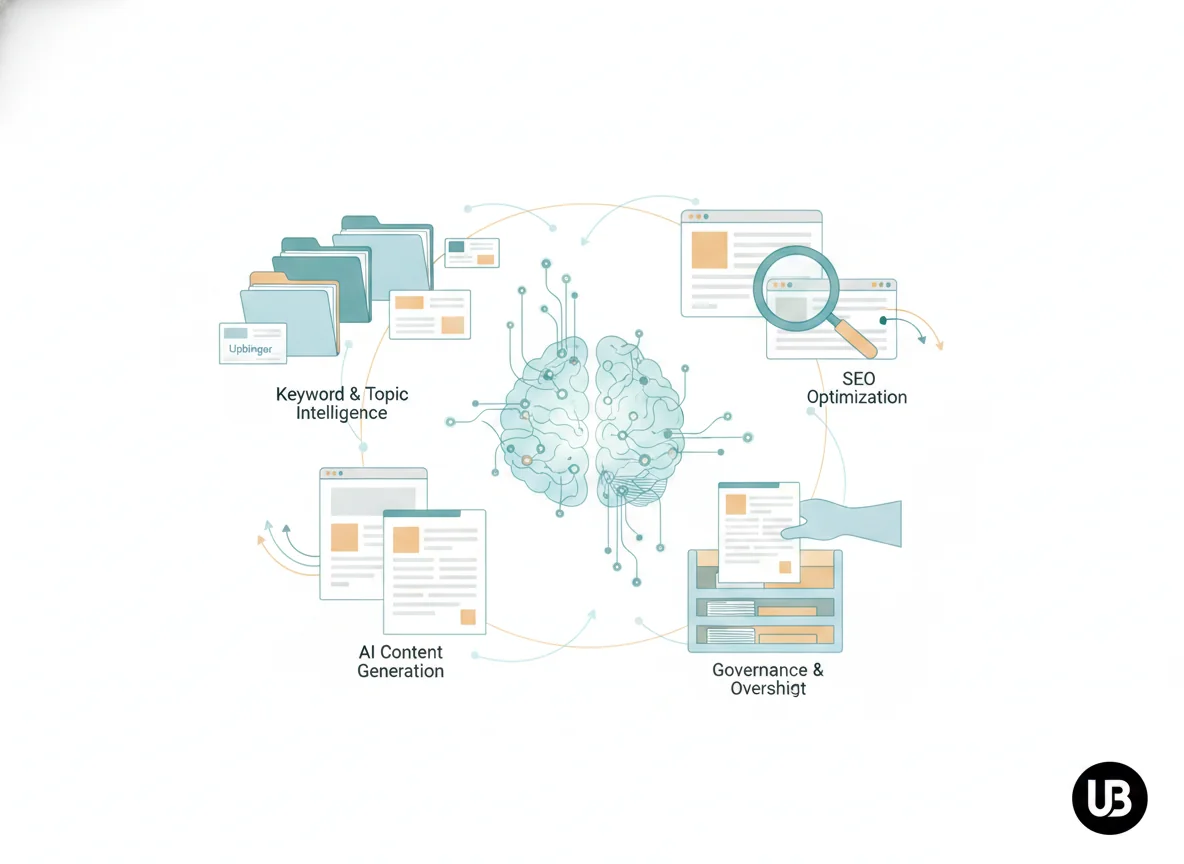
At minimum, a serious AI SEO content platform like UpBinger should offer:
Generic AI writers might approximate one of these features via plugins or manual work. UpBinger bakes them into a single platform so each step reinforces the next.
Key takeaway: If an “AI SEO tool” can’t research topics, structure for snippets, enforce guidelines, and report outcomes, it’s still just a writer with good intentions.
AI SEO software improves search rankings by making every stage of your content lifecycle data-driven and repeatable, instead of ad hoc and manual. UpBinger does this by acting as an always-on strategist, not just a copy machine.
Here’s how that plays out in practice:
Across enterprise implementations, systems like this typically deliver 20–30% more organic traffic within 6–12 months, not because they “game” Google, but because they align tightly with how modern search and AI engines evaluate quality.
Quotable: AI SEO software improves rankings by eliminating guesswork from your content pipeline—picking the right battles and executing them the same way, every time.
Answer Engine Optimization (AEO) is the practice of optimizing content so AI assistants and answer engines choose your pages in their responses. Generative Engine Optimization (GEO) extends this to generative search experiences like Google AI Overviews and Perplexity summaries.
Generic AI writers are blind to AEO and GEO. They don’t know what ChatGPT Search or Gemini prefer, how People Also Ask questions are structured, or which snippet patterns dominate your SERPs.
UpBinger, by contrast, is built for this new layer:
Think of it this way: SEO got you to page one; AEO and GEO decide if you’re the page AI actually cites.
Key takeaway: UpBinger doesn’t just optimize for search crawlers; it optimizes for AI readers. Generic writers only see words. UpBinger sees structured, machine-favored answers.
For enterprises, the biggest risk of generic AI writers isn’t bad grammar. It’s inconsistency, compliance exposure, and brand dilution across hundreds of pages and contributors.
Generic tools are built for individuals. Anyone can paste a prompt, tweak a tone slider, and hit generate. Multiply that by dozens of marketers, agencies, and product teams and you get an incoherent web presence that search algorithms and users instinctively distrust.
UpBinger approaches governance as a first-class feature set:
Search systems reward trustworthy, consistent brands. Governance isn’t “nice to have”; it’s a ranking factor by proxy because it shapes user signals: engagement, repeat visits, and brand queries.
Quotable: Generic AI writers scale words. UpBinger scales trust—across every market, product line, and stakeholder.
Operating in India’s search landscape presents a specific challenge: you’re competing in one of the fastest-growing digital markets, where both English and regional-language content are exploding, and AI adoption is leaping ahead.
Generic AI writers are largely trained and tuned on Western content patterns. They rarely understand Indian search behavior, mixed-language queries, or regulatory nuances. The result is content that feels slightly “off”—and underperforms in local SERPs.
UpBinger is built for the Indian market while meeting global enterprise standards:
As answer engines and AI summaries spread across India’s user base, the brands that have already optimized for these patterns will pull away. UpBinger is positioning its customers for that inflection, not just for last decade’s SEO.
Key takeaway: In India, the question isn’t whether to use AI for SEO—it’s whether you can afford to use only generic tools when competitors are moving to platforms like UpBinger.
You should outgrow generic AI writers the moment your goals shift from “publish more” to “own critical topics and AI answers in your category.” Certain signals make that clear:
Moving to UpBinger typically follows four steps:
Quotable: Switching from generic AI writers to UpBinger isn’t a tool swap; it’s a move from manual guessing to systematized growth.
An AI SEO content platform is a system that manages the full content lifecycle—research, planning, AI content generation, optimization, publishing, and measurement—with the explicit goal of improving SEO and AEO performance. UpBinger goes beyond basic text generation by integrating keyword intelligence, topic clustering, snippet targeting, and governance into a single AI-driven workflow. Instead of using separate tools for research, writing, and optimization, teams orchestrate everything inside one platform. This makes it easier to build topical authority, consistently follow best practices, and adapt content for both traditional search results and emerging AI-driven answer experiences.
AI SEO software improves rankings by systematizing what high-performing SEO teams already do manually—then scaling it. UpBinger analyzes search data to pick the right topics, converts those into structured briefs, generates content aligned to search intent, and optimizes pages for on-page factors, snippets, and AI overviews. It then monitors performance and suggests refreshes when rankings start to decay. This closed loop reduces guesswork, eliminates bottlenecks between SEO and content, and ensures every new piece is strategically chosen and technically sound. Over time, this consistency compounds into stronger topical authority and more page-one positions.
Generic AI writers are optimized for convenience, not competitive visibility. They create isolated documents, with no understanding of your keyword strategy, existing assets, or regulatory context. At enterprise scale, this leads to inconsistent tone, duplicated coverage, and missed opportunities in SERPs and AI summaries. They also lack governance features like approval workflows, brand voice enforcement, and compliance-aware templates. Enterprises need a platform that treats content as a strategic asset—connected, measured, and governed—rather than a collection of prompts and drafts. That’s the gap UpBinger is designed to fill.
UpBinger is best used as an AI strategist and accelerator, not a total replacement for humans. It automates repetitive work—researching queries, drafting outlines, generating first versions, and suggesting optimizations—so writers and SEO specialists can focus on judgment, creativity, and subject-matter depth. In practice, the strongest results come from hybrid teams: the platform handles volume and standardization, while humans refine storytelling, verify facts, and align content with nuanced business goals. This balance aligns with Google’s helpful content guidelines, which care about usefulness and expertise, not whether AI was involved.
Many “AI for SEO” tools bolt GPT-style generation onto traditional keyword research or on-page checklists. UpBinger is designed as an AI agent that runs the whole content pipeline: from topic discovery and cluster planning through generation, optimization for SEO/AEO, and post-publish measurement. It’s also tuned for India’s market realities—language, cost structures, and industry use cases—while still supporting global standards. Where other tools focus on individual features, UpBinger’s advantage lies in orchestration: every piece of content is produced in context of your broader strategy and continuously improved based on performance data.
Generic AI writers will always have a place—for quick drafts, internal docs, and ideation. But they were never built to defend or grow serious organic channels. Search and answer engines are now too sophisticated, and the stakes for visibility are too high.
Platform-level SEO, as embodied by UpBinger, is fast becoming the baseline for enterprises that treat organic as a strategic moat. It connects AI content generation to research, governance, and performance in a way no single-purpose writer can match.
If your content ambitions extend beyond “more posts” to “market leadership in search and AI answers,” the choice is simple: keep patching together generic tools—or move to an integrated AI SEO content platform built for where discovery is actually headed.