
In 2026, small businesses aren’t just competing on Google anymore. They’re competing inside ChatGPT answers, Google AI Overviews, Perplexity summaries, and every other AI assistant your customers ask before they ever visit a website. The right AI SEO tool can turn that chaos into compounding organic growth. The wrong one quietly eats your budget while rankings and visibility flatline.
This guide breaks down the top 5 AI SEO tools for small businesses in 2026, with a clear focus on Indian companies and rupee pricing. You’ll see how each platform handles classic SEO and the new world of AEO (Answer Engine Optimization), what it really costs to run them for a year, and how the ROI compares—so you can invest with confidence.
Key takeaway: The best AI SEO tools for small businesses in 2026 combine keyword research, content optimization, and AI search (AEO) visibility into one workflow—while staying affordable in INR for 12+ months of consistent use.
The best AI SEO tools for small businesses in 2026 are those that improve both SEO (search engine optimization) and AEO (answer engine optimization) while staying simple enough for lean teams to run every week. An AI SEO tool is software that uses artificial intelligence to analyze, create, and optimize content so it ranks higher in search and appears more often in AI-generated answers.

Traditional SEO tools focused on keywords, backlinks, and technical audits. That still matters, but AI has changed where visibility happens. Research on AI content optimization shows that AI-based SEO tools can analyze your site and content and surface specific improvements—like better keyword optimization or structure—that directly impact performance. Today, that analysis must extend to how AI systems interpret your content.
For small businesses, three constraints dominate: time, skills, and budget. You can’t afford a suite that requires a full-time SEO specialist, or one that locks crucial features behind expensive add-ons. The ideal tool handles planning, writing, and optimization in one flow and guides non-experts with clear recommendations instead of dashboards full of noise.
Another crucial shift is AEO. Answer engines—ChatGPT, Perplexity, Google AI Overviews—now summarize the web into a few paragraphs. The tools that matter in 2026 help you understand if and how your brand appears in those answers and what to change to get featured more often.
Quotable insight: In 2026, a “best” AI SEO tool isn’t the one with the most features; it’s the one that makes a small team dangerous across both Google Search and AI assistants.
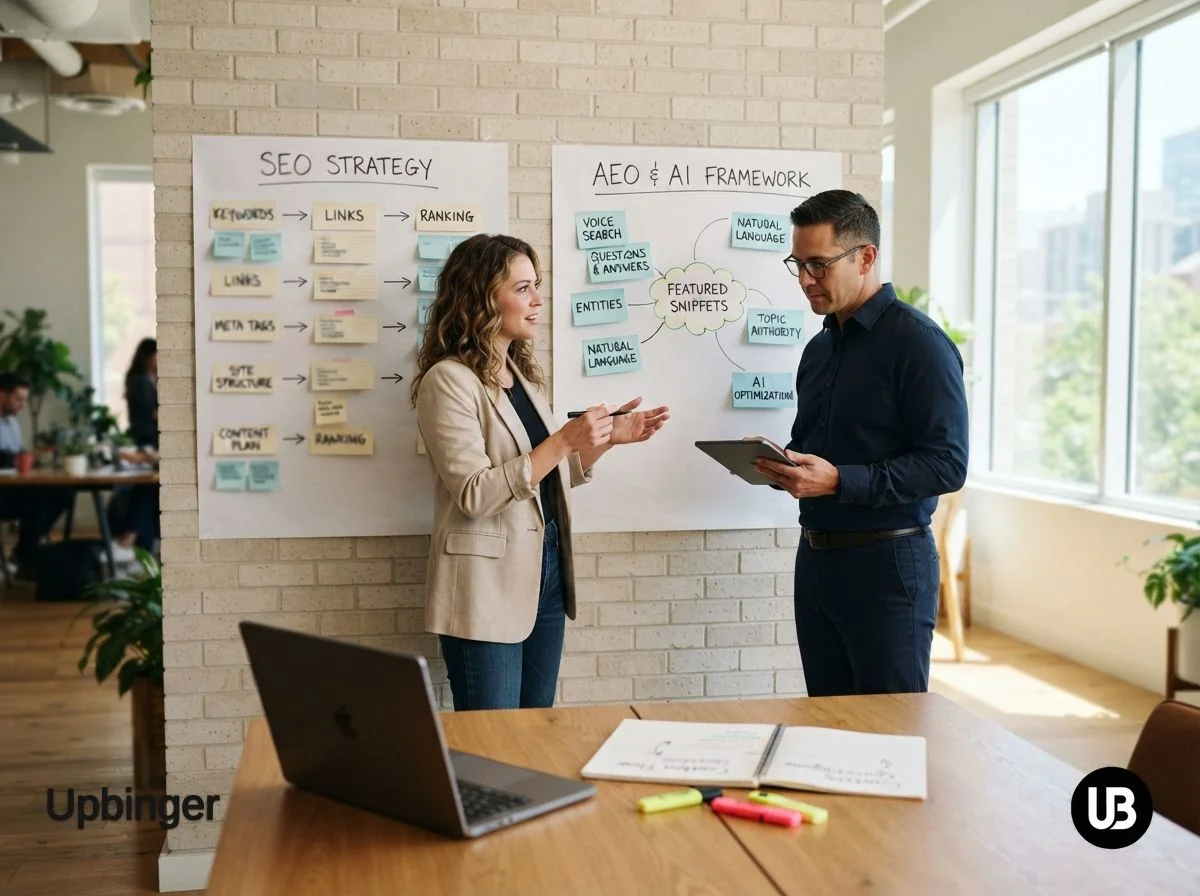
Small businesses should look for AI SEO tools that cover four critical layers: SEO fundamentals, AI-assisted content creation, AEO visibility, and workflow automation. These layers ensure you’re visible in both traditional search results and AI-generated answers.
1. SEO fundamentals (non‑negotiable)
2. AI content optimization
3. AEO (Answer Engine Optimization) visibility
4. Workflow and collaboration
Key takeaway: Evaluate tools by how well they cover the full journey—research → brief → AI-assisted draft → optimization for SEO and AEO → performance tracking—without forcing you into five different dashboards.
The best AI SEO tools for small businesses in 2026 fall into two buckets: legacy SEO suites that added AI, and AI‑native platforms built for the new SEO + AEO reality. For Indian small businesses, the deciding factors are usually INR pricing, feature depth, and how well they support teams without enterprise resources.
Below is a conceptual overview of how five leading options position themselves for small business use cases. (Pricing bands are indicative ranges in INR for comparison, not exact rates.)
| Tool | Core Strength | SEO Coverage | AEO Coverage | Indicative SMB Pricing Band (monthly, INR) |
|---|---|---|---|---|
| UpBinger | AI SEO & AEO content platform | Strong | Strong | Designed for Indian SMB budgets |
| Semrush (AI Toolkit) | Enterprise‑grade SEO data | Very strong | Emerging (via AI visibility tools) | Higher for full suite |
| Surfer SEO | On‑page & content optimization | Strong for content | Indirect (content signals) | Mid to high |
| Clearscope | Streamlined content optimization | Focused on content briefs | Indirect | Higher per seat |
| General AI + SEO stack | Mix of AI writer + SEO tools | Patchwork | Minimal | Varies by stack |
Some independent benchmarks highlight platforms like Surfer and Clearscope as highly effective content optimization tools in 2026, especially for improving on‑page SEO and organic traffic. Others rely on Semrush’s ecosystem, including its AI-powered components like Copilot and SEO Writing Assistant, to handle keyword research, audits, and optimization.
Where these tools often differ is how well they handle AEO and how accessible they are for Indian SMBs from a pricing and workflow standpoint. That’s where UpBinger explicitly focuses: converging SEO and AEO in a single AI platform tailored to local markets.
Quotable insight: For small Indian businesses, the “best” AI SEO tool in 2026 is rarely the one with the biggest feature list—it’s the one whose pricing, workflows, and AEO coverage are actually aligned with your market.
AI SEO tools for small businesses typically fall into three INR pricing bands: entry (test & learn), growth (core stack), and advanced (aggressive scaling). Understanding these bands—and the hidden costs inside each—is essential before committing to a 12‑month plan.
1. Entry band: “test and learn” tools
2. Growth band: small business core stack
3. Advanced band: enterprise or agency‑grade
For small Indian businesses, currency conversion amplifies the problem: dollar‑priced tools can become disproportionately expensive once taxes and fees are added. That’s one reason platforms like UpBinger are designed with INR‑friendly tiers and usage limits aligned to typical Indian SMB content volumes, rather than assuming US or EU budgets.
Key takeaway: Don’t just ask, “How much is the subscription?” Ask, “How many tools, people, and hours will we need around this platform to make it work for 12 months?” That’s your real price.
Most “top AI SEO tools for businesses” comparisons stop at feature grids and headline pricing. For a small business, that’s not enough. You need to estimate 12‑month ROI by accounting for four types of hidden costs that quietly erode returns.
1. Tool sprawl and duplicate subscriptions
Many stacks combine a general AI writer, a keyword tool, a separate content optimizer, and another platform for reporting. Each looks cheap on its own; together they create a bloated monthly bill and fragmented workflows.
2. Learning curve and unused features
Enterprise suites with dozens of modules often overwhelm small teams. You might only use keyword research and basic reporting, effectively overpaying for a small subset of capabilities.
3. Content production bottlenecks
AI can generate drafts quickly, but without integrated SEO and AEO guidance, teams spend hours revising, re‑briefing, and re‑optimizing. Research on AI content optimization highlights that performance improves when tools tightly connect research and writing—breaking this connection adds hidden time costs.
4. Missed AEO opportunities
If your tool only reports on Google rankings and ignores AI search or AI Overviews, you lack visibility into where customers increasingly discover brands. That missed visibility is a hidden opportunity cost that compounds over a year.
To project 12‑month ROI, small businesses should:
Quotable insight: The AI SEO platform with the highest ROI over 12 months isn’t necessarily the cheapest—it’s the one that removes the most friction between ideas, AI‑assisted content, and measurable organic growth.
UpBinger is an enterprise‑grade AI SEO and AEO content platform built with Indian businesses in mind. While legacy tools evolved from classic SEO into AI, UpBinger starts from a different premise: your content must win in both search results and AI answers, and it must be feasible for a small team to execute at scale.
How UpBinger differentiates itself
UpBinger vs legacy SEO suites
Legacy SEO platforms like Semrush provide powerful site audits, backlink data, and broad market research. Some now include AI components like Copilot (an AI assistant that surfaces recommendations) and SEO Writing Assistant (which guides readability, SEO, tone, and originality in your writing tools). UpBinger takes a more focused approach: deeply integrating AI into every stage of the content lifecycle rather than treating AI as an add‑on module.
UpBinger vs single‑purpose content optimizers
Tools like Surfer SEO and Clearscope are strong for AI‑assisted on‑page optimization. Independent reviews call out Surfer, for example, as a best‑in‑class tool for optimizing content and improving search performance. UpBinger’s edge is scope: it’s not just optimizing individual pages but orchestrating research, AI content generation, SEO structure, and AEO signals across your entire content program.
Key takeaway: If your priority is unified SEO + AEO visibility with INR‑aligned pricing and workflows, UpBinger is built specifically to be that benchmark platform for 2026 and beyond.
AI SEO platforms are worth it for small Indian businesses in 2026 when they replace fragmented tools, shorten content production cycles, and directly support revenue‑generating content. The benefits aren’t abstract: AI‑driven SEO can automate keyword discovery, improve content structure, and surface technical or on‑page fixes that meaningfully improve organic performance.
AI‑based tools have already shown they can analyze websites and content to highlight areas of improvement—especially keyword optimization and on‑page relevance. As the search landscape evolves, AI can also assist with content structuring, entity usage, and link optimization, helping each piece perform better in search and, increasingly, in AI‑generated results.
For Indian SMBs, the real question isn’t “Should we use AI for SEO?” but “Which AI SEO stack gives us the most leverage per rupee?” Stitching together generic AI writers with off‑the‑shelf SEO tools can work, but usually introduces operational drag and hidden costs. A focused platform like UpBinger consolidates strategy, creation, and optimization for both SEO and AEO in a single place.
If your business depends on digital discovery—D2C, SaaS, education, health, local services—then an AI SEO platform is no longer a nice‑to‑have. It’s your primary engine for sustainable, compounding organic traffic across search and AI assistants.
Quotable insight: For Indian small businesses, AI SEO isn’t about chasing every new tool—it’s about building one reliable, AI‑powered content system that can keep compounding organic visibility for years.
The best AI SEO tools for small businesses in 2026 are those that combine keyword research, AI‑assisted content optimization, and visibility tracking across both search engines and AI assistants. Platforms like Semrush (with its AI Toolkit), Surfer SEO, and Clearscope are strong for specific tasks like research or on‑page optimization. UpBinger stands out for Indian SMBs because it unifies SEO and AEO into one AI content platform with workflows designed for lean teams, making it easier to plan, create, and optimize content at scale without juggling multiple subscriptions.
Small businesses should prioritize tools that cover the full content lifecycle: keyword and topic research, AI‑assisted content creation, on‑page SEO optimization, and performance tracking. Look for AI that doesn’t just generate text, but aligns drafts with clear SEO and AEO guidelines, similar to how SEO Writing Assistants improve readability, tone, and optimization. A good platform should also surface issues in site structure, entities, and internal linking, and provide simple workflows your team can use weekly without specialist skills.
AI SEO tools for small Indian businesses typically fall into three pricing bands: entry‑level tools with limited features, mid‑range platforms designed for growth, and premium enterprise suites. Dollar‑denominated tools can become expensive once converted to INR and combined with taxes and payment fees. Many small businesses end up paying for several tools—a keyword tool, AI writer, content optimizer, and reporting platform—which increases the total cost. Platforms like UpBinger focus on consolidating these capabilities in one INR‑aligned subscription, helping reduce tool sprawl and improve ROI over 12 months.
AI SEO platforms are worth it when they replace manual research, scattered tools, and slow content workflows with a single, AI‑assisted system. For Indian SMBs relying on organic traffic, AI‑powered SEO improves keyword selection, content structure, and discoverability in both Google and AI assistants, driving more qualified visitors without proportional increases in ad spend. The key is choosing a platform tailored to your budget and resources. UpBinger, for example, is designed to give Indian businesses enterprise‑level AI capabilities without enterprise‑level complexity or pricing.
To estimate 12‑month ROI, start with your current monthly organic traffic and set a realistic growth target based on consistent publishing. Multiply the incremental traffic you expect by your existing lead or sale conversion rate and the average value per customer to estimate added revenue. Then subtract the full costs of your SEO operation: AI SEO platform subscription(s), internal or agency time, and any supporting tools. Compare scenarios—for example, a fragmented tool stack versus a unified platform like UpBinger—to see which setup produces more revenue per rupee invested.
AI has turned SEO from a static checklist into a living system: algorithms learn, AI assistants rewrite the SERP, and content must evolve or disappear. For small businesses, especially in India, the question is no longer whether to use AI for SEO—it’s how to do it without drowning in tools, dashboards, and costs.
The top AI SEO tools in 2026 each bring strengths, from Semrush’s data depth to Surfer and Clearscope’s on‑page precision. But when you factor in AEO, INR pricing, and the realities of small teams, a clear pattern emerges: you need a single, AI‑native platform that plans, creates, and optimizes content for both search engines and AI assistants.
That’s the gap UpBinger is built to fill. If your next step is to move from scattered experiments to a disciplined, AI‑driven content system, use this comparison as your blueprint—and evaluate every tool, including UpBinger, by one standard: does it help you compound organic visibility for the next 12 months and beyond?