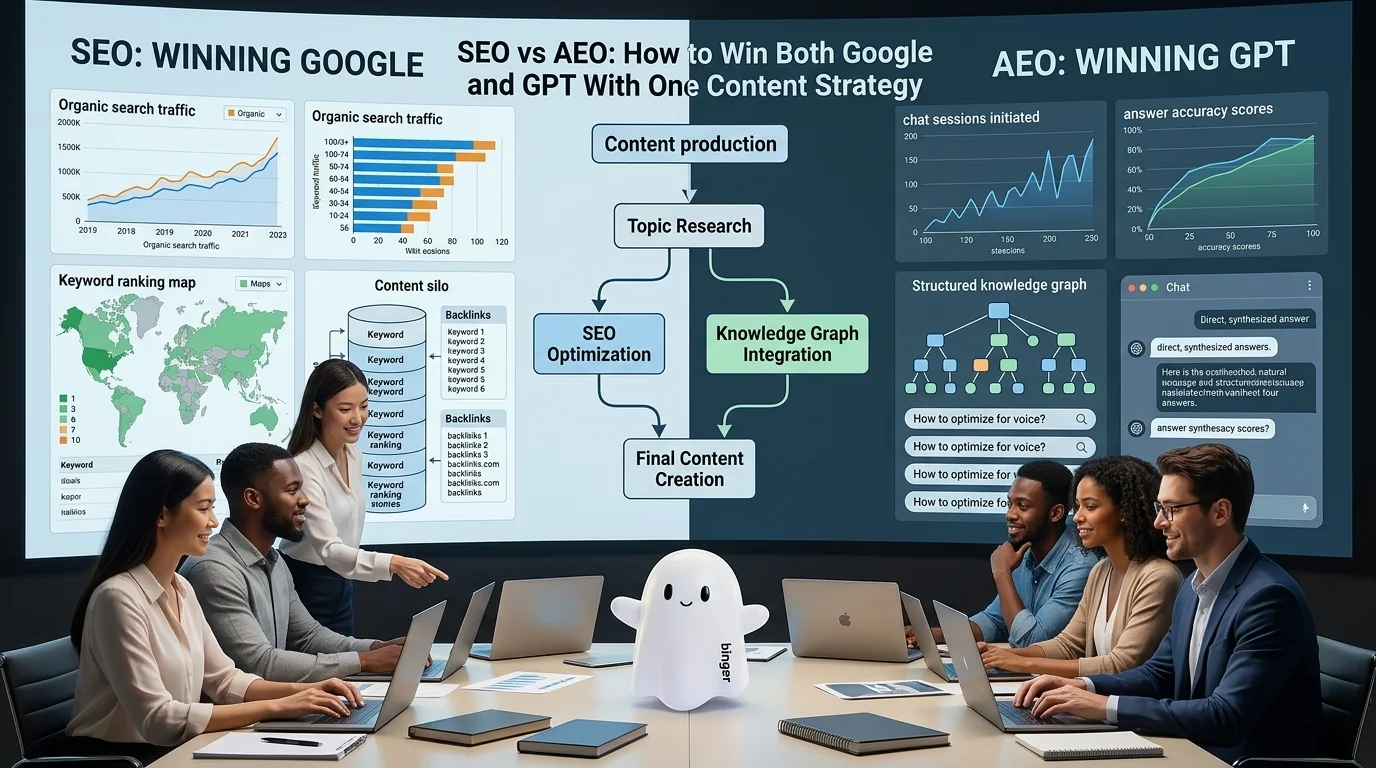
In 2015, your buyers started with Google. In 2025, many of them will start with ChatGPT, Gemini, or Perplexity. That single shift breaks a decade of SEO muscle memory. Ranking #1 on a SERP is no longer enough if an AI assistant never mentions your brand in its answer.
This is where SEO and AEO collide. SEO keeps you visible in traditional search. Answer Engine Optimization (AEO) keeps you visible in AI-generated answers. Treat them as rivals and you’ll underperform in both. Treat them as a single system and you can dominate the new discovery landscape.
This article explains the difference between SEO and AEO, shows the real pros and cons of each, and gives you a practical, reusable brief template to optimize for both in one workflow—especially if you’re using AI content platforms like UpBinger.
The difference between SEO and AEO is the objective and where visibility happens. SEO is optimizing content to rank in search engine results pages (SERPs). AEO is optimizing content to be cited, quoted, or recommended by AI assistants and answer engines.
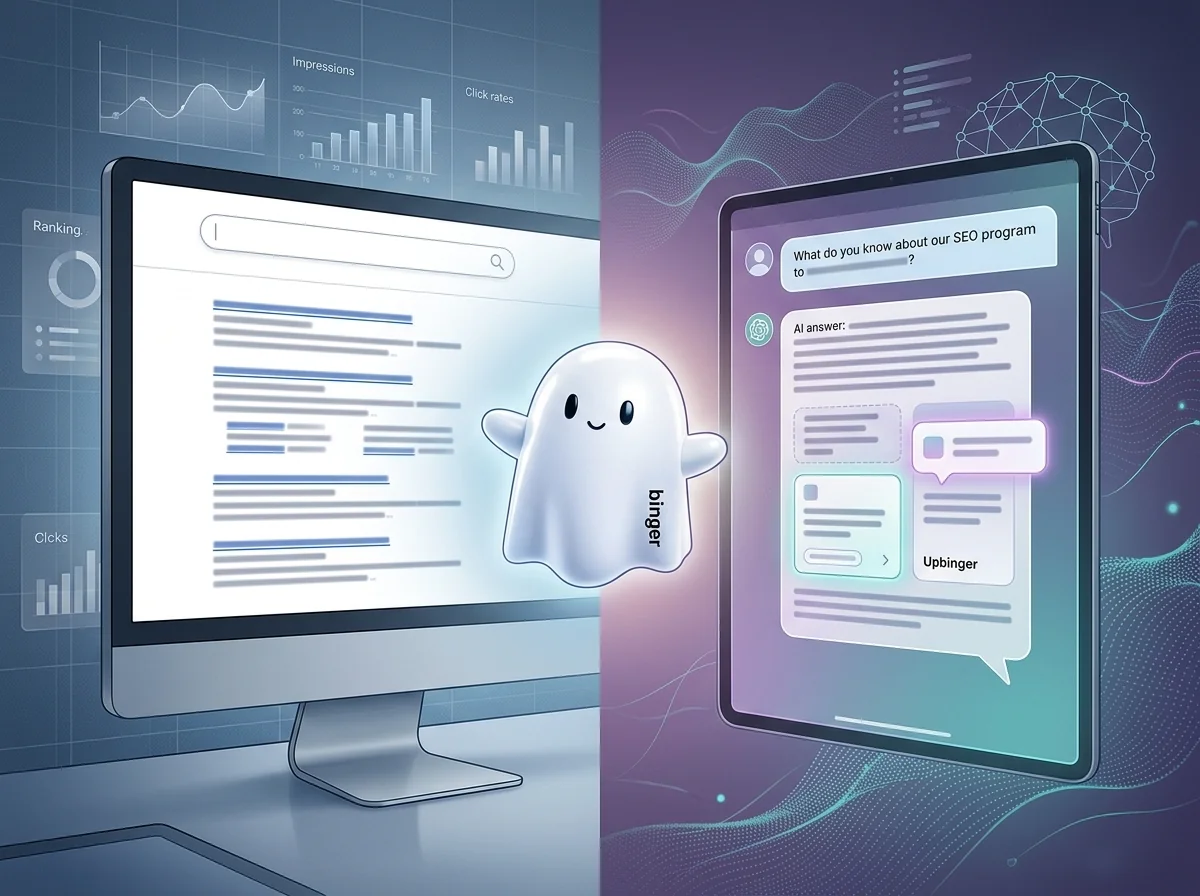
SEO is measured by impressions, rankings, click-through rate (CTR), and organic sessions from engines like Google and Bing. AEO is measured by brand mentions, citations, share of voice in AI answers, and AI-driven referral traffic (for engines that link out).
Practically, SEO asks: “How do I get my page to show up when someone searches?” AEO asks: “How do I get my brand to show up in the answer when someone asks an AI?” In India and globally, both behaviors now coexist: users Google broad research, then refine decisions with conversational queries to AI.
Key takeaway: SEO optimizes for clicks from search pages; AEO optimizes for inclusion in conversational answers.
Where SEO leans heavily on keyword targeting, technical health, and backlinks, AEO favors clear, structured answers, entity clarity (brands, products, people), and credibility signals AI models can parse and trust. The best strategies deliberately feed both ecosystems with consistent, machine-readable expertise.
SEO vs AEO pros and cons come down to how each channels demand and how you can measure impact. You need both because they capture different parts of the buyer’s journey.
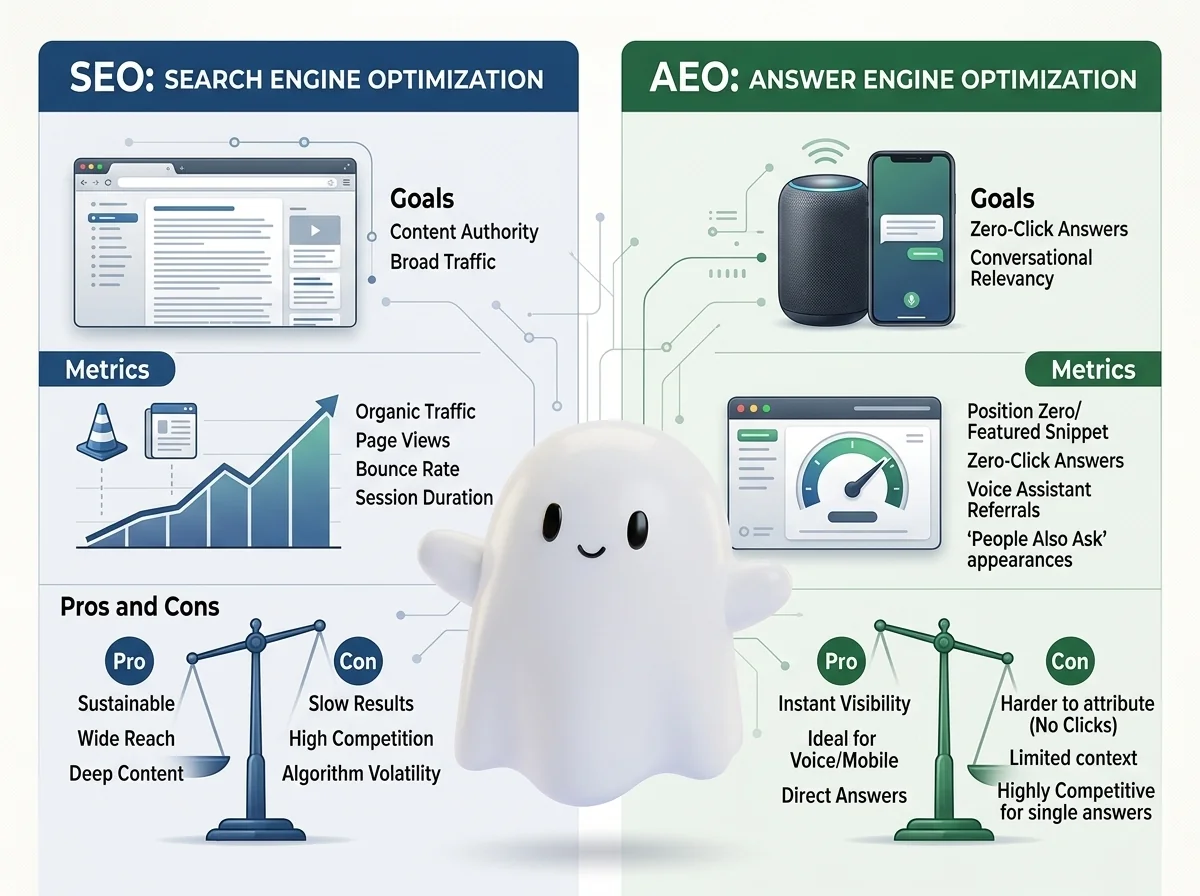
SEO goals: increase qualified organic traffic, grow non-brand visibility, and drive conversions from search. Core metrics include keyword rankings, organic sessions, CTR, bounce rate, and assisted revenue.
AEO goals: increase brand visibility inside AI answers, influence consideration, and become the “default” recommendation when users ask assistants for options. Core metrics include brand mentions, citation frequency, share of voice vs competitors, and AI-originated traffic.
| Dimension | SEO | AEO |
|---|---|---|
| Primary goal | Drive traffic from SERPs | Secure presence in AI-generated answers |
| Main surface | Search result pages | Chat-style answers, summaries, recommendations |
| Key metrics | Rankings, sessions, CTR | Mentions, citations, AI share of voice |
| Strength | Click-focused, direct attribution | Trust and preference shaping |
| Risk | Clickless results, AI overviews | Opaque models, fewer direct clicks |
Pros of SEO: mature playbooks, clear tools, and ROI tracking are well established. Cons: clickless SERP features and AI overviews can reduce traffic even if you rank well.
Pros of AEO: early-mover advantage, disproportionate influence on consideration, and long-term brand authority in AI systems. Cons: measurement is newer, and impact is more about visibility and preference than last-click conversions.
Think of SEO as capturing demand and AEO as shaping demand. Market leaders do both.
Yes, you need AEO even if you have strong SEO, because AI assistants increasingly mediate how people interpret and use search results. Solid SEO is a prerequisite for AEO, not a replacement.

Three shifts make AEO non-negotiable:
Brands with historically strong SEO often discover they’re barely mentioned in AI answers. That creates an opening for more agile competitors—especially in fast-growing markets like India, where AI adoption is leapfrogging older patterns.
However, AEO without SEO is also fragile. Answer engines still rely on crawlable, high-quality content and external signals—exactly what SEO builds. UpBinger’s thesis as an AI-powered SEO & AEO content platform is simple: future-proof visibility requires AEO layered on top of mature SEO fundamentals, not instead of them.
In practice, you invest in SEO to make your content discoverable and authoritative, and you invest in AEO to make that authority legible and reusable to AI systems.
AI for SEO is not just about using generative tools to write faster; it is about aligning your content with how AI systems interpret, summarize, and recommend information. AI search and answer engines reshape the SEO game in four critical ways.
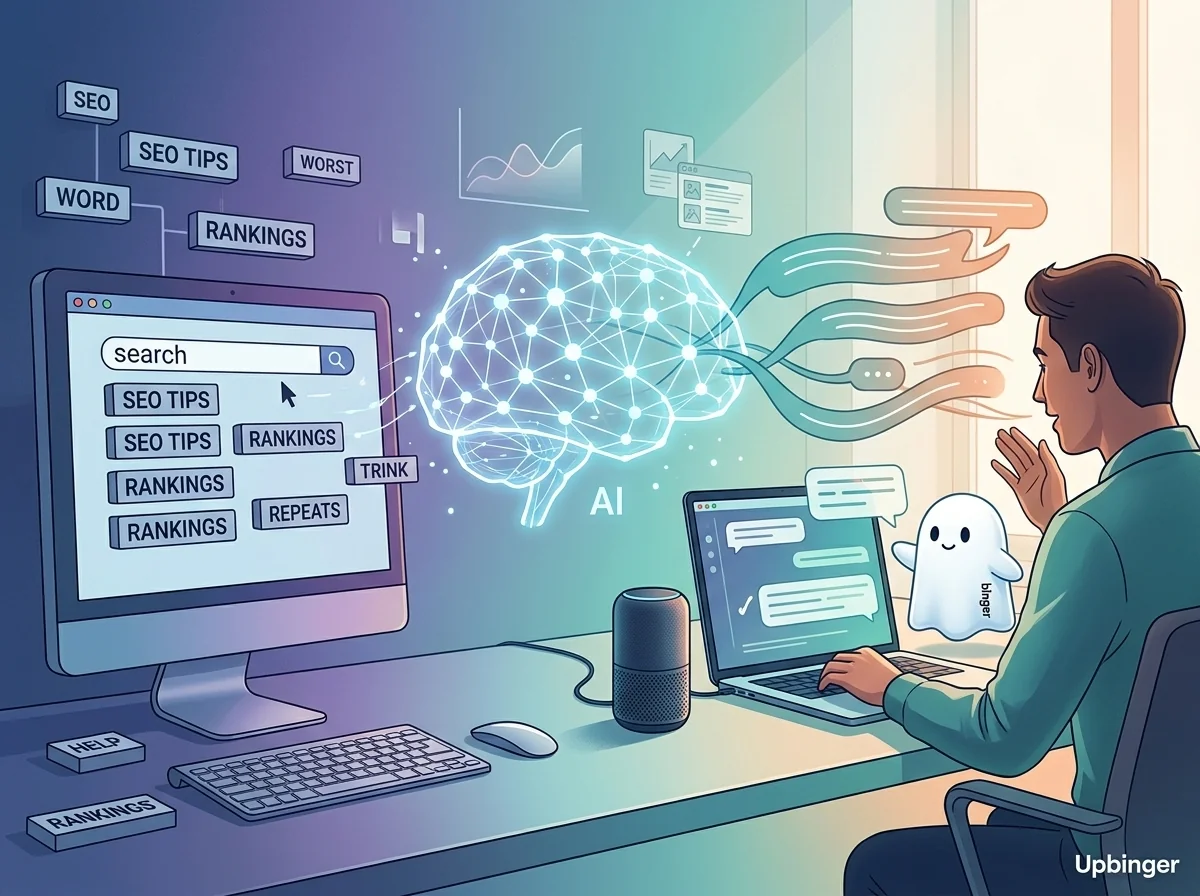
1. Query morphology. Instead of typing “best gst billing software india,” users ask, “Which GST billing software is best for small businesses in India and why?” These are long, conversational queries with embedded intent and constraints. Your content needs to anticipate and answer them explicitly.
2. Aggregated comprehension. AI models read across hundreds or thousands of documents and compress them into a single response. Thin, derivative content disappears. Original data, distinct POVs, and well-marked structure stand out.
3. Entity-first indexing. Large language models (LLMs) build internal graphs of entities and relationships: “UpBinger is an AI-powered SEO & AEO content platform in India.” Consistent, structured mentions across your site and the wider web strengthen that representation.
4. Evaluation of trust. AIs implicitly weigh consistency, recency, source authority, and corroboration. Clear author bios, citations, and evidence all contribute to being considered “safe to quote.”
AI doesn’t replace SEO; it raises the bar. The content that wins is deeply helpful, reliably structured, and easy for machines to parse.
Enterprise teams that treat AI as an assistant across research, drafting, optimization, and performance analysis—rather than a one-click content factory—will build compounding advantages in both SEO and AEO.
A dual SEO–AEO workflow means every piece of content is designed to rank in search and be quotable by AI. AI content generation platforms like UpBinger make this practical at enterprise scale by encoding both requirements into one workflow.
A high-level dual-optimization workflow looks like this:
UpBinger’s value proposition for Indian enterprises is to turn this multi-step process into a structured, repeatable system: a single platform where you plan, generate, and optimize for both search engines and answer engines, with AI doing the heavy lifting and humans providing judgment.
The fastest way to operationalize SEO vs AEO content platforms is to standardize your briefs. Below is a practical template you can adapt directly into UpBinger or your content stack.
Every content brief should ship with BOTH a keyword list and a list of AI-style questions. That’s the practical difference between SEO-only and SEO + AEO.
UpBinger is an enterprise AI content platform built for the era where SEO and AEO are inseparable. It is designed for companies that want to scale AI content generation without sacrificing quality, and to lead—not chase—the next wave of AI-driven discovery.
1. Unified SEO + AEO planning. Instead of juggling disconnected tools, UpBinger lets you plan topics, keywords, and AI questions in a single workspace. This aligns teams around one content roadmap.
2. AI-powered content workflows. UpBinger uses AI to generate, expand, and refine drafts that are structurally optimized for both SERPs and answer engines, including built-in patterns for definitions, step lists, FAQs, and quotable summaries.
3. AEO-aware optimization. Beyond traditional on-page checks, UpBinger can guide you toward clearer intent signals, entity definitions, and answer blocks that AIs can easily quote, helping increase AI visibility.
4. India-first, global-ready. For Indian enterprises and agencies, UpBinger understands local search behavior, regional terminology, and regulatory realities, while still aligning with global AI and SEO standards.
As AI assistants become a primary interface to the web by 2026, organizations that have systematically fed those systems with clean, structured, and authoritative content will own an outsized share of mind. UpBinger’s mission in the AEO Mastery space is to make that outcome deliberate, measurable, and repeatable—not accidental.
Answer Engine Optimization (AEO) is the practice of optimizing your content and brand signals so that AI assistants and answer engines—such as ChatGPT, Gemini, Perplexity, and AI Overviews in search—use you in their responses. Where SEO focuses on ranking web pages in search results, AEO focuses on being cited, quoted, or recommended inside conversational answers. This involves creating clear, structured responses to common questions, reinforcing key entities like your brand and products, and providing trustworthy, well-sourced information that AI systems can parse and reuse with high confidence.
Start by auditing how AI assistants currently talk about your brand and topics. Run 20–50 realistic prompts in tools like ChatGPT, Gemini, and Perplexity and note whether you are mentioned, how, and alongside which competitors. Next, adapt your SEO briefs to include AEO elements: a list of AI-style questions, direct 1–2 sentence answers, and explicit entity definitions. Add robust FAQ sections, how-to steps, and comparison tables to existing high-traffic pages. Finally, track changes in mentions and citations over time. Platforms like UpBinger can streamline this, embedding AEO goals into your standard content workflow.
AI adoption in India is accelerating quickly, especially on mobile. Many users now turn to assistants for quick recommendations—"Which credit card is best for travel?" or "Best HR software for 200-employee company in Bangalore." If AI engines don’t know or trust your brand, you’ll lose visibility at the exact moment of consideration. AEO helps ensure that when Indian buyers ask these questions, your brand is part of the short list. Combined with strong SEO, AEO lets you reach users across both classic search journeys and emerging conversational journeys.
Yes—if it is guided, reviewed, and optimized properly. AI for SEO and AEO is most effective when used inside a disciplined workflow: clear briefs, human-reviewed drafts, and structured optimization. Unguided, mass-produced AI text tends to be generic and may not stand out to search engines or answer engines. Platforms like UpBinger are built specifically to keep AI content on-brief, factually grounded, and structurally optimized for both ranking and being quoted. The combination of human strategy and AI assistance is what consistently wins in both SEO and AEO.
SEO success is typically measured with rankings, organic traffic, and conversions from search. AEO success focuses on visibility inside AI responses. Track how often your brand is mentioned or cited for key prompts, how your share of voice compares with competitors, and whether AI-originated traffic appears in analytics (from engines that link out). Over time, you should see more consistent mentions, more accurate descriptions of your offerings, and better positioning in AI-generated shortlists. Ideally, you report SEO and AEO together to see how they reinforce each other along the entire customer journey.
SEO vs AEO is the wrong framing. The real question is: How do I design one content strategy that wins in both traditional search and AI-driven discovery? The answer is a dual-optimized workflow that respects the strengths and limitations of each channel.
SEO ensures your content is discoverable, crawlable, and authoritative in the open web. AEO ensures that same authority is visible and usable inside AI-generated answers, where more buying decisions will be shaped every year.
The practical playbook is clear: upgrade your briefs, add question-first structures, define your entities, and measure both rankings and AI mentions. AI content platforms like UpBinger can help you industrialize this at scale—especially if you operate in dynamic, fast-growing markets like India.
Brands that start now will not just adapt to 2026 AEO standards; they will write them.