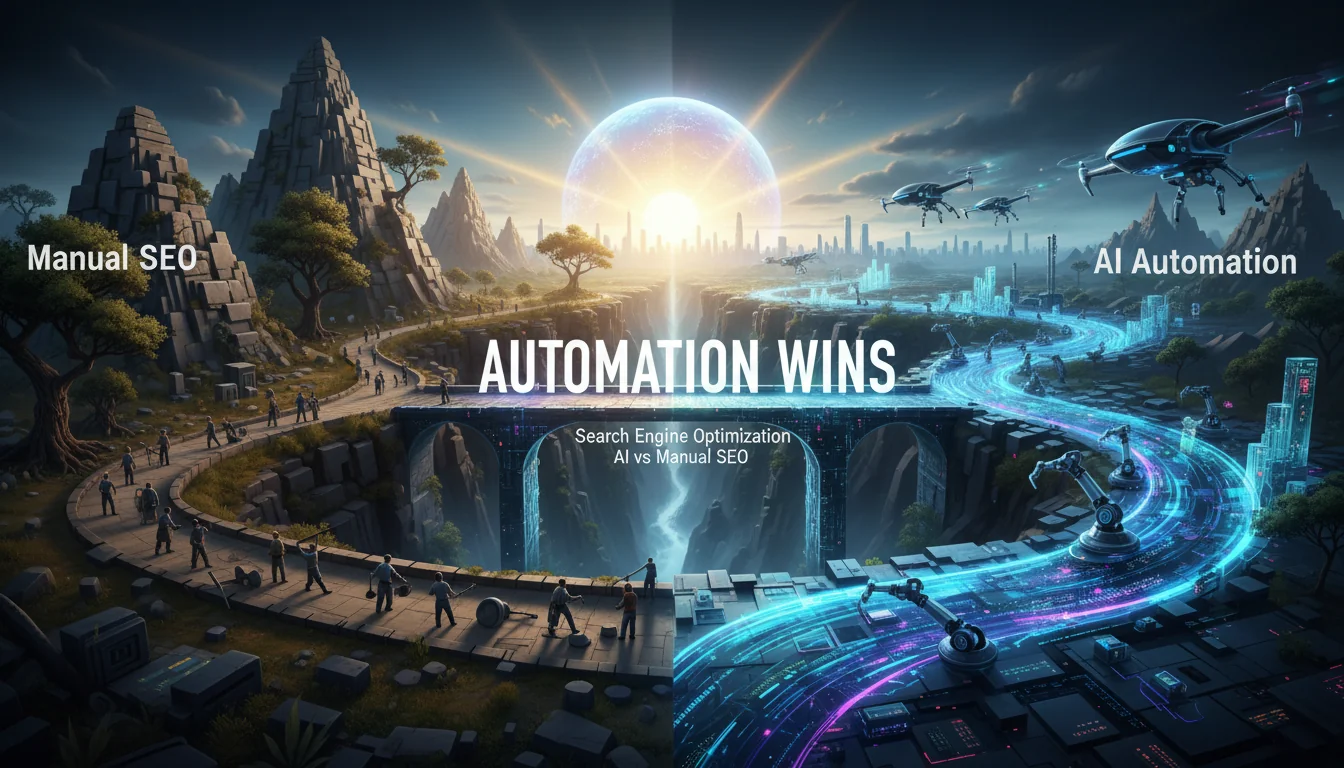
Most enterprise teams already know they should “use AI for SEO.” Fewer can answer a sharper question: exactly where does search engine optimization AI beat manual SEO—and where doesn’t it? When organic traffic, budgets, and brand reputation are on the line, vague answers are expensive.
This article cuts through the noise. We compare AI-assisted and purely manual SEO across three metrics that actually matter: time-to-execution, accuracy of decisions, and lift in organic traffic. We’ll show where automation truly wins, when humans should stay firmly in control, and how a platform like UpBinger turns theory into measurable results—especially for Indian enterprises trying to scale content across English and local languages.
For modern SEO, the right question isn’t “AI vs manual SEO?” It’s “What should be automated—and what must stay human—to win compounding organic growth?”
Let’s start by defining what we’re really comparing.
Search engine optimization AI is the use of artificial intelligence to research, create, optimize, and monitor content for search engines and answer engines at scale. Manual SEO relies on human specialists performing the same tasks with traditional tools and processes.

In a manual SEO workflow, people:
Search engine optimization AI platforms like UpBinger add an intelligence layer on top of this stack. They can:
Manual SEO is human expertise supported by tools. Search engine optimization AI is a machine intelligence layer that amplifies that expertise and automates repeatable work.
The comparison is not “humans vs machines.” It is AI-augmented teams vs overloaded teams.
Across time, accuracy, and organic traffic, AI-assisted SEO consistently outperforms purely manual SEO—especially once you exceed ~30–50 URLs. The gains aren’t theoretical; they’re operational.
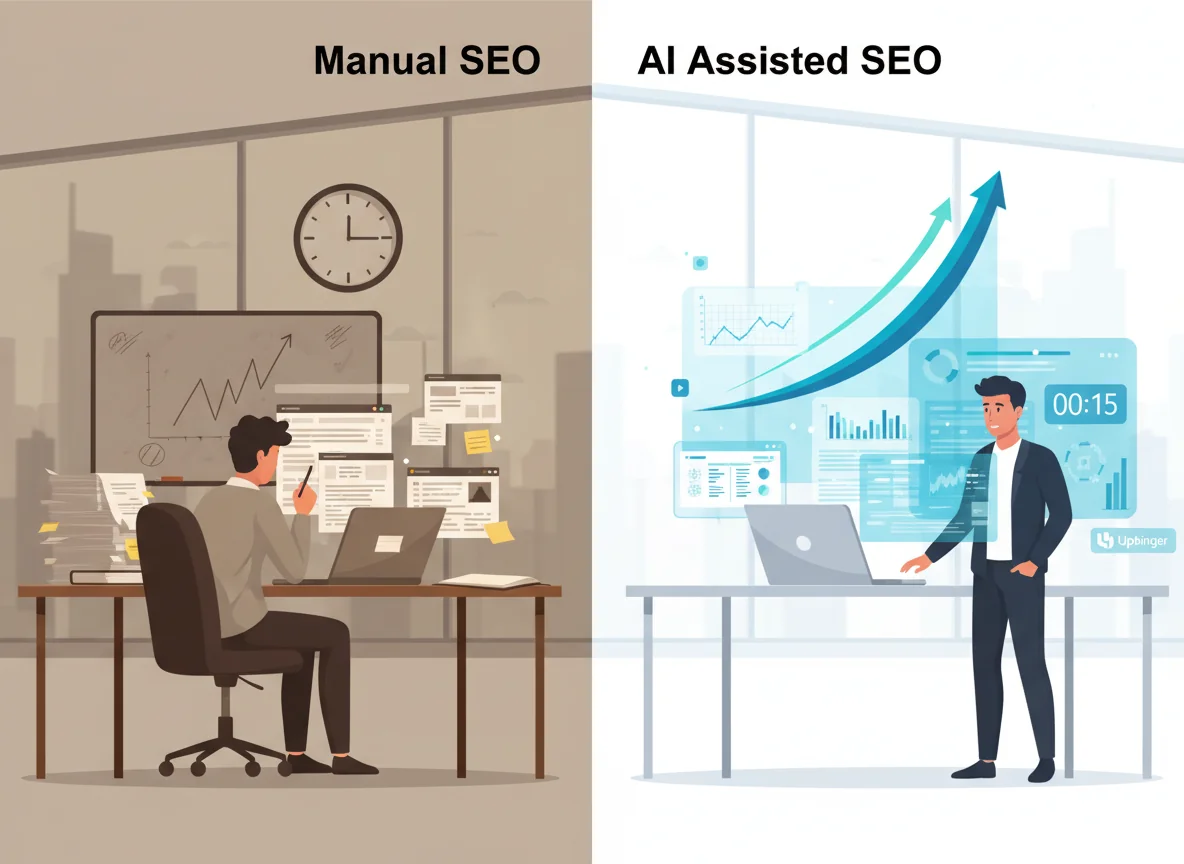
For a typical 1,500-word article:
That’s a 60–80% reduction in production time. Over 100 articles, you reclaim weeks of bandwidth.
Manual workflows often rely on intuition and limited sampling of SERPs. AI can:
This improves on-page relevance and topical coverage, reducing guesswork.
In practice, teams using AI judiciously (not blindly auto-publishing) often see:
Pure automation without strategy creates noise. AI aligned with human editorial judgment creates compounding traffic.
Yes, AI can measurably improve SEO performance—but only when it’s used to enhance strategy, not to flood the index with mediocre content.
The wrong way many teams use AI is simple: generate thousands of pages and hope some rank. This often leads to:
The right way—and the approach platforms like UpBinger enforce—is different:
Enterprise teams following these practices commonly report:
AI doesn’t guarantee better SEO performance. Structured, constrained use of AI aligned with human expertise does.
The outcome to measure isn’t “AI content volume.” It’s incremental traffic, qualified leads, and answer engine visibility.
Automate high-volume, rules-based SEO tasks; keep human control over judgment-heavy work like positioning, messaging, and final editorial decisions. That’s the practical answer to “when to automate SEO tasks.”
The most effective enterprise setups use AI as a force multiplier, not a writer replacement.
UpBinger’s workflows are explicitly designed around this division: automate the repeatable, spotlight the expert.
The best practices for leveraging generative AI to boost organic traffic focus on constraints, not creativity. You want reliable, Google-friendly, human-quality output—not generic AI prose.
Define topic clusters, funnels, and gaps first. AI should fill a structured plan, not improvise your strategy.
AI must respect:
UpBinger bakes these into templates, so every draft is search- and answer-engine ready.
Insist on:
Treat AI drafts as a strong baseline. Your experts layer in unique frameworks, stories, and data.
Feed rankings, CTR, and engagement back into your AI workflows. UpBinger uses these signals to recommend refreshes and new angles.
Generative AI doesn’t remove the need for strategy. It removes the friction between strategy and execution.
At enterprise scale—dozens of markets, thousands of URLs—purely manual SEO becomes a bottleneck. AI-powered content creation is the only realistic way to cover your addressable search and answer-engine surface.
Manual teams struggle with:
With a platform like UpBinger, you can enforce:
Many enterprises in India already have a silent crisis: zero indexed pages and thin content bloat. AI can help by:
AI-powered content creation is not about publishing more; it’s about publishing consistently better across a much larger footprint.
UpBinger is an enterprise AI & AEO content platform built to win in both SEO (search engines) and AEO (answer engines). That distinction is now critical.
Answer Engine Optimization (AEO) is the practice of optimizing content so that AI assistants (ChatGPT, Gemini, Bing Copilot, Perplexity, etc.) choose your brand as the source when users ask questions. It demands:
UpBinger is designed for this reality:
In the next five years, the winners in organic growth won’t be the brands that “used AI.” They’ll be the brands that systematically integrated AI, SEO, and AEO into one operating system.
That operating system is what UpBinger is building.
The key difference is scale and consistency. Manual SEO relies on specialists to research, write, and optimize each page individually. This works for tens of pages, but breaks at hundreds or thousands. AI-assisted SEO uses platforms like UpBinger to automate research, clustering, and first-draft creation, while experts focus on strategy and editing. The result is more high-quality, search- and answer-engine-ready content produced in less time, with stronger standardization across topics, formats, and languages.
AI can significantly improve SEO performance for sites with weak rankings, but only if you fix fundamentals first. You need a crawlable site, clean architecture, and a clear content strategy. Once that is in place, AI helps by identifying high-opportunity topics, generating optimized content for those topics, and continuously suggesting improvements based on performance data. Many teams see 20–30% lifts in non-branded organic traffic within 6–12 months when AI is used this way, rather than as a mass content generator.
Automate SEO tasks that are high-volume, repetitive, and rules-based: keyword clustering, SERP analysis, content briefs, meta tags, internal link suggestions, and content repurposing. Keep tasks manual when they require judgment and nuance: topic prioritization, messaging, expert insights, compliance, and final editorial approval. A platform like UpBinger is built around this split, letting AI handle the research and drafting while your team owns the decisions that shape brand and revenue outcomes.
AI-powered content creation is safe for Google if you prioritize quality, relevance, and user value. Google’s guidance focuses on helpful, original content—not the tools used to create it. Risks arise when teams publish unedited AI drafts at scale, leading to thin, duplicate, or inaccurate pages. UpBinger reduces this risk by embedding SEO and AEO best practices into templates and by supporting human review workflows. If you treat AI as a co-pilot rather than an autopilot, it can strengthen—rather than weaken—your organic visibility.
AEO expands your strategy beyond ranking in blue links to being cited by AI assistants. Practically, this means structuring content with clear definitions, direct answers near the top, concise quotable statements, and well-organized FAQs. It also means covering related questions users might ask in a conversational way. UpBinger bakes these patterns into its content generation so every piece is optimized for both classic SEO and emerging answer engines like ChatGPT, Gemini, and Perplexity, increasing your brand’s visibility wherever users search or ask.
The real debate isn’t AI vs manual SEO. It’s unstructured effort vs systematized, AI-augmented execution. Manual-only teams move too slowly and inconsistently. AI-only approaches flood the web with content that doesn’t deserve to rank or be cited by answer engines.
The winning model is clear:
If your organization is wrestling with poor rankings, low organic traffic, or zero indexed pages, this isn’t an academic conversation—it’s an operating problem. Platforms like UpBinger exist to solve exactly that: combining human-quality, Google-friendly AI with AEO-aware structures to help Indian and global enterprises scale content that actually wins.
The next step is simple: map the 10–20 tasks that slow your SEO team down today—and ask where AI can safely take the wheel.