
AI assistants have quietly become your new homepage. Prospects now ask ChatGPT, Gemini, or Perplexity what to buy—and often never click through. If your brand isn’t cited in those answers, you’re invisible, no matter how strong your traditional SEO looks.
Answer Engine Optimization (AEO) is the discipline of making your content easy for AI systems to find, understand, and quote. UpBinger, an India-based enterprise AI content platform, has built a repeatable AEO article blueprint designed for this new reality. It blends classic SEO with AI-native structuring so that every piece is ready to rank in Google and be cited in AI responses.
This article opens that blueprint. You’ll see exactly how UpBinger structures AEO-optimized articles, which heading patterns work best, how to design answer blocks, and how our platform automates what would otherwise be painstaking manual work. If you’re evaluating ai content optimization tools or scouting the next leading ai content optimization software, this is the operating manual we use internally—and the standard we believe answer engines will normalize by 2026.
Answer Engine Optimization (AEO) is the process of structuring and wording content so that AI assistants can accurately summarize, quote, and recommend it in conversational answers. UpBinger optimizes for AEO by turning every article into a machine-readable map of clear questions, direct answers, definitions, and structured data-friendly sections.
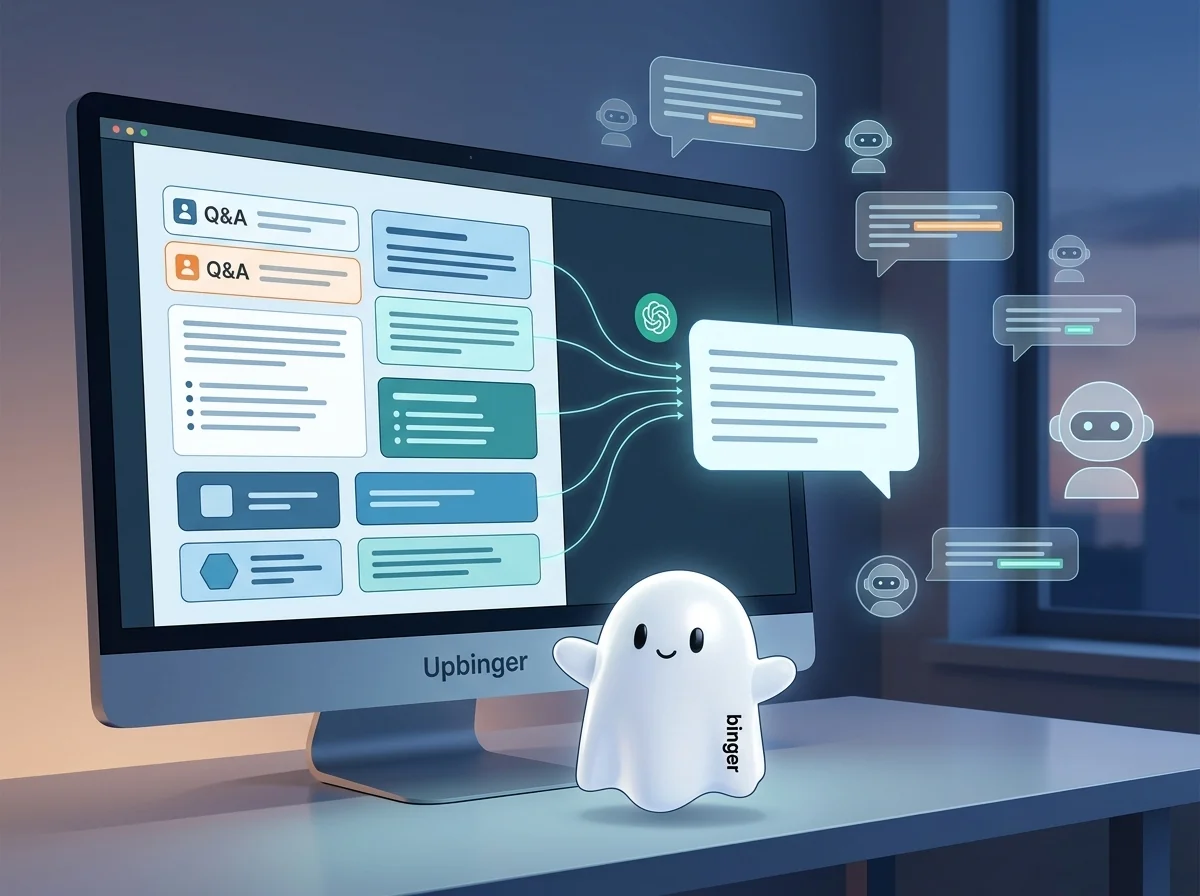
Where SEO focuses on rankings and clicks, AEO focuses on citations and visibility inside AI-generated answers. That means:
UpBinger’s platform bakes this into every workflow. It analyzes your draft against thousands of AI-style queries, flags ambiguity, and suggests rephrased intros so that the first 40–60 words of each section are immediately quotable. It also checks whether you’ve covered related user intents, People Also Ask-style questions, and core definitions the large language models rely on when compressing knowledge.
Key takeaway: AEO is not “better SEO.” It’s a parallel discipline: design content for how AI answers questions, not just how humans scan results pages.
UpBinger’s AEO article structure follows a disciplined 7-section blueprint because AI models favor content that is consistent, predictable, and semantically rich. The blueprint balances depth for humans with clarity for machines.

An ideal AEO article on UpBinger typically includes:
Each section starts with a crisp 2–4 sentence summary that answers the implied question of the heading. This is followed by detail: numbered steps for processes, bullet lists for options, and short blockquotes for quotable insights.
The result is a document that functions like a well-annotated API for AI models: predictable headers, clear scope per section, and self-contained paragraphs that can be safely extracted. UpBinger’s editor enforces this skeleton through templates, so even large, distributed teams publish with a consistent AEO shape.
Quotable snippet: “An AEO-optimized article should read like a set of precise, composable answers, not a stream of consciousness narrative.”
UpBinger’s AEO strategy starts from a simple premise: if your headings don’t match how people ask questions, AI will struggle to map your content to real queries. That’s why we design headings as explicit, user-intent-driven questions and definitions.
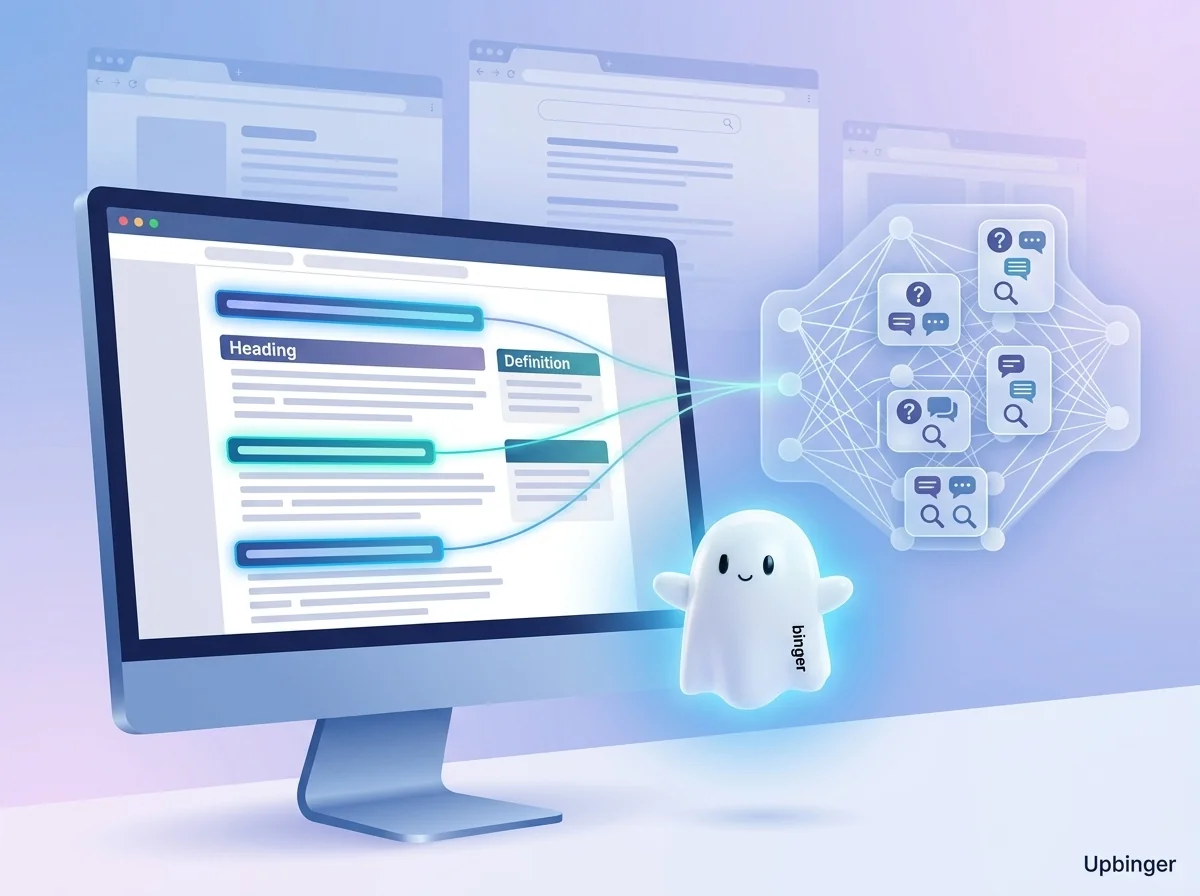
In practice, UpBinger recommends that every cornerstone article include:
For example, a definitional block might look like:
“AI content optimization tools are software platforms that use machine learning to analyze, generate, and improve digital content for better performance in search engines and answer engines.”
UpBinger’s AI checks that each key term in your topic cluster has at least one explicit definition block and that overlapping terms (e.g., “AI for SEO,” “AI SEO tools,” “AI content generation”) are disambiguated. This reduces hallucination risk for AI models and increases the likelihood they’ll quote your definitions directly when users ask basic explainer questions.
Key takeaway: Explicit definitions and question-based headings act as landmarks that help AI systems route user questions to your content.
The most powerful unit in UpBinger’s AEO framework is the answer block: a short, self-contained paragraph that cleanly answers a question before any nuance or storytelling. Every important heading gets one.
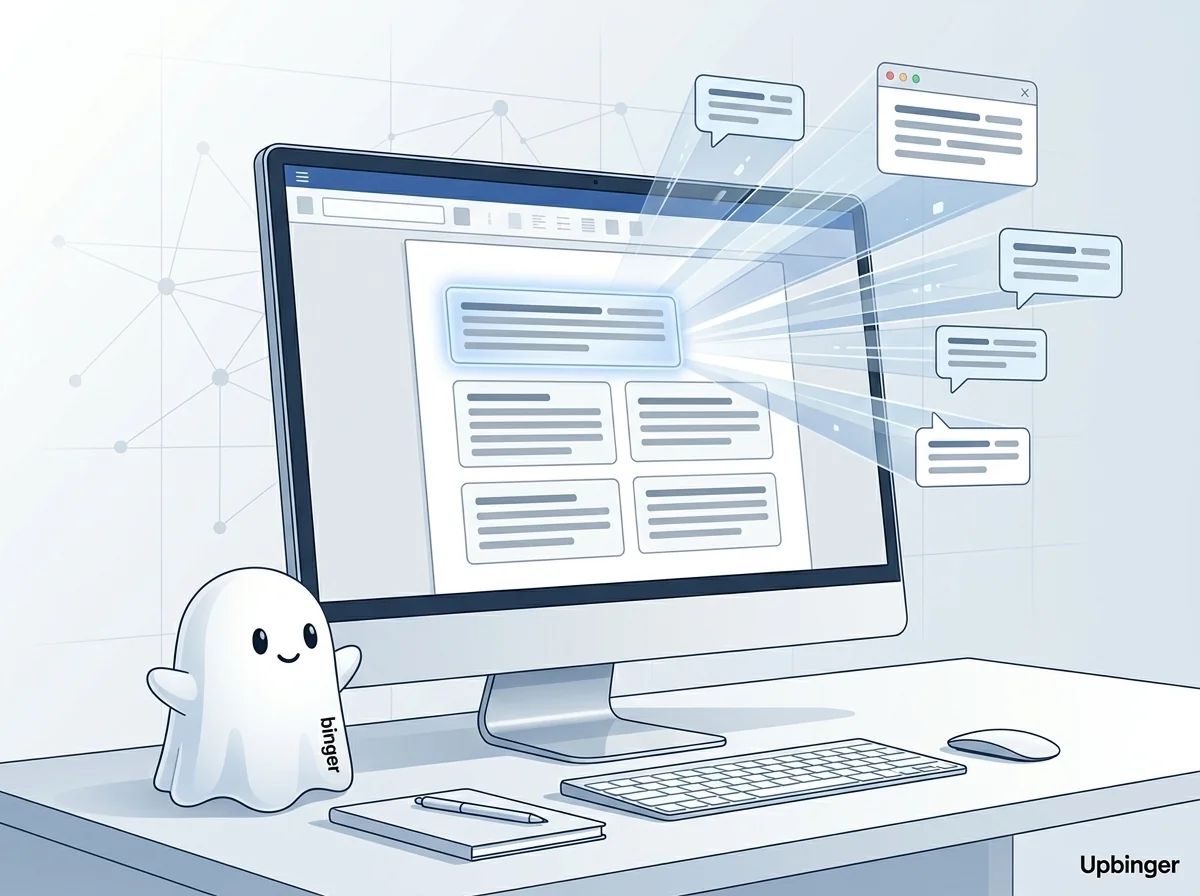
An answer block follows three rules:
For example, for the query “how does UpBinger optimize for AEO?” an answer block might read:
“UpBinger optimizes for AEO by enforcing a structured article blueprint of question-based headings, concise answer blocks, and rich FAQ sections, then analyzing each draft against AI query patterns. The platform flags weak answers, missing definitions, and low-clarity sections so your content is ready to be cited by leading AI assistants.”
Below the answer block, you can add nuance: process flows, pros and cons, case anecdotes. UpBinger’s editor visually highlights answer blocks and scores their clarity and extractability, nudging writers to lead with utility instead of suspense.
Quotable snippet: “If your first paragraph can’t stand alone as an answer, it’s not AEO-ready.”
Traditional SEO playbooks optimize for clicks. UpBinger’s AEO strategy optimizes for in-answer presence: being named, cited, or summarized inside AI responses, whether or not a click occurs. This shift fundamentally changes structure, metrics, and even tone.
Three key differences define UpBinger’s AEO strategy:
Best practices for AEO content platforms emerge from this approach: enforce structural consistency, make every section machine-quotable, and measure success by presence in AI conversations. UpBinger’s internal dashboards show that articles built on this framework see notably higher citation rates in AI answers within 60–90 days of publishing compared with legacy SEO content of similar length.
Key takeaway: AEO doesn’t replace SEO—but the content that wins both looks more like structured documentation than persuasive copy alone.
The best practices for AEO content platforms are clear: prioritize clarity, structure, and coverage over cleverness. UpBinger translates these principles into concrete product features and editorial rules that any team can adopt.
Our AEO-aligned best practices include:
UpBinger’s platform operationalizes this playbook. It scores drafts on “AEO readiness,” highlights missing FAQs, suggests schema-friendly structures, and surfaces related questions to close topical gaps. For enterprises in India and beyond scaling AI-first content, this opinionated guide rail is the difference between random blog output and a coherent, AI-visible library.
Quotable snippet: “AEO platforms win by being obsessively predictable: same patterns, same clarity, across thousands of pages.”
Turning this blueprint into reality at scale requires more than guidelines; it needs software that enforces and accelerates the process. UpBinger positions itself among the leading AI content optimization software platforms by combining generation, structuring, and measurement in a single workflow.
Here’s how a typical team uses UpBinger to produce AEO-optimized content:
Compared with generic ai content optimization tools, UpBinger is explicitly built for the era of answer engines, not just blue links. Its business model is simple: subscription access for enterprises that want consistent, AI-optimized content production with local support in India and standards aligned to the emerging 2026 AEO landscape.
Key takeaway: The advantage isn’t just AI-generated text; it’s a system that guarantees every article ships AEO-ready by default.
UpBinger is an enterprise AI content platform from India that specializes in creating and optimizing content for both traditional search engines (SEO) and answer engines (AEO). It provides templates, AI drafting, and optimization tools that enforce an AEO-ready structure: question-based headings, concise answer blocks, robust FAQ sections, and semantic HTML. Instead of leaving writers to guess what AI assistants need, UpBinger scores each draft for clarity, coverage, and quotability, then suggests improvements. The result is content that not only ranks but is also more likely to be cited and summarized by tools like ChatGPT, Perplexity, and Gemini.
To structure an AEO-optimized article with UpBinger, start by selecting the AEO article template, which provides a seven-section skeleton with prompts for each part. Fill in a clear introduction and then add H2 sections framed as questions or strong statements, ensuring each begins with a 40–80 word answer block. Use H3s for definitions and sub-questions, and end with a structured FAQ that mirrors real user queries. UpBinger’s analyzer will highlight weak headings, missing definitions, and opportunities for lists or blockquotes, helping you refine the structure until it reaches a high AEO readiness score.
AEO is important because user behavior is shifting from clicking through search results to consuming answers directly inside AI assistants. SEO teams that focus only on rankings risk losing visibility if they’re absent from those AI responses. By practicing AEO, teams design content that is easy for large language models to parse, trust, and quote. This strengthens brand authority, keeps you present in zero-click journeys, and future-proofs your content strategy as search results pages continue to evolve with AI overviews and conversational interfaces.
The best practices for AEO content platforms include enforcing consistent structures, prioritizing definitional clarity, and covering the full question space around a topic. Platforms should encourage question-based headings, short answer blocks at the top of each section, and comprehensive FAQ sections. They also need to support semantic HTML, schema-ready outputs, and measurement of AI-specific metrics like answer citations and brand mentions. UpBinger encapsulates these practices by combining guided templates, AI-assisted drafting, and analytics that specifically track AI visibility, not just traditional SEO performance.
AI SEO extends traditional SEO by optimizing content for how large language models interpret and generate text, not just how algorithms rank pages. In practice, this means focusing on natural language questions, structured explanations, and explicit definitions instead of keyword density and backlink tactics alone. Traditional SEO still matters for crawlability, authority, and rankings, but AI SEO—through AEO—adds an extra layer: making your content safe, clear, and comprehensive enough that AI systems are confident quoting you. UpBinger is designed to operationalize this dual focus in a single workflow.
Yes. Smaller teams often lack the time to manually research queries, structure long-form articles, and iterate content for both SEO and AEO. UpBinger automates much of this heavy lifting: it generates first drafts in an AEO-aligned format, surfaces relevant subquestions, and provides optimization suggestions within minutes. For India-based startups and mid-market companies, this means reaching enterprise-level content quality and AI visibility without building large in-house editorial teams—an especially valuable advantage in competitive categories like SaaS, fintech, and edtech.
AI assistants are fast becoming the first—and sometimes only—touchpoint between buyers and brands. To stay visible, you must write for models as carefully as you write for humans. UpBinger’s AEO blueprint offers a practical answer: a consistent seven-section structure, question-led headings, tight answer blocks, and FAQ-driven coverage, all enforced and accelerated by an AI content platform.
Whether you run a lean marketing team or a large enterprise function, adopting this blueprint now positions you as a reference point for how AI explains your category in 2026 and beyond. The next step is simple: audit a few of your core articles against these patterns. If they don’t look like a series of precise, composable answers, they’re not yet AEO-ready—and that’s exactly where UpBinger is built to help.