
Most teams now use AI to create content; very few can prove it actually moves the revenue needle. UpBinger was built to close that gap. Instead of treating AI as a copy machine, UpBinger treats it as an analytics-aware content agent that can show, in numbers, how each article, landing page, or FAQ impacts sessions, rankings, and revenue.
This article unpacks the measurement model behind UpBinger’s AI content optimization platform. It’s written for enterprise marketers, SEO leaders, and growth teams in India who need CFO-level answers to a simple question: “Is our AI content actually working?”
Key idea: UpBinger doesn’t just generate AI content; it instruments every piece so you can trace its impact from impression to assisted revenue across both search engines (SEO) and answer engines (AEO).
In UpBinger’s model, AI content optimization is the use of AI agents to plan, create, and continuously improve content with the explicit goal of increasing qualified organic sessions and revenue across SEO and AEO. It is not just about more pages; it is about measurably better traffic.
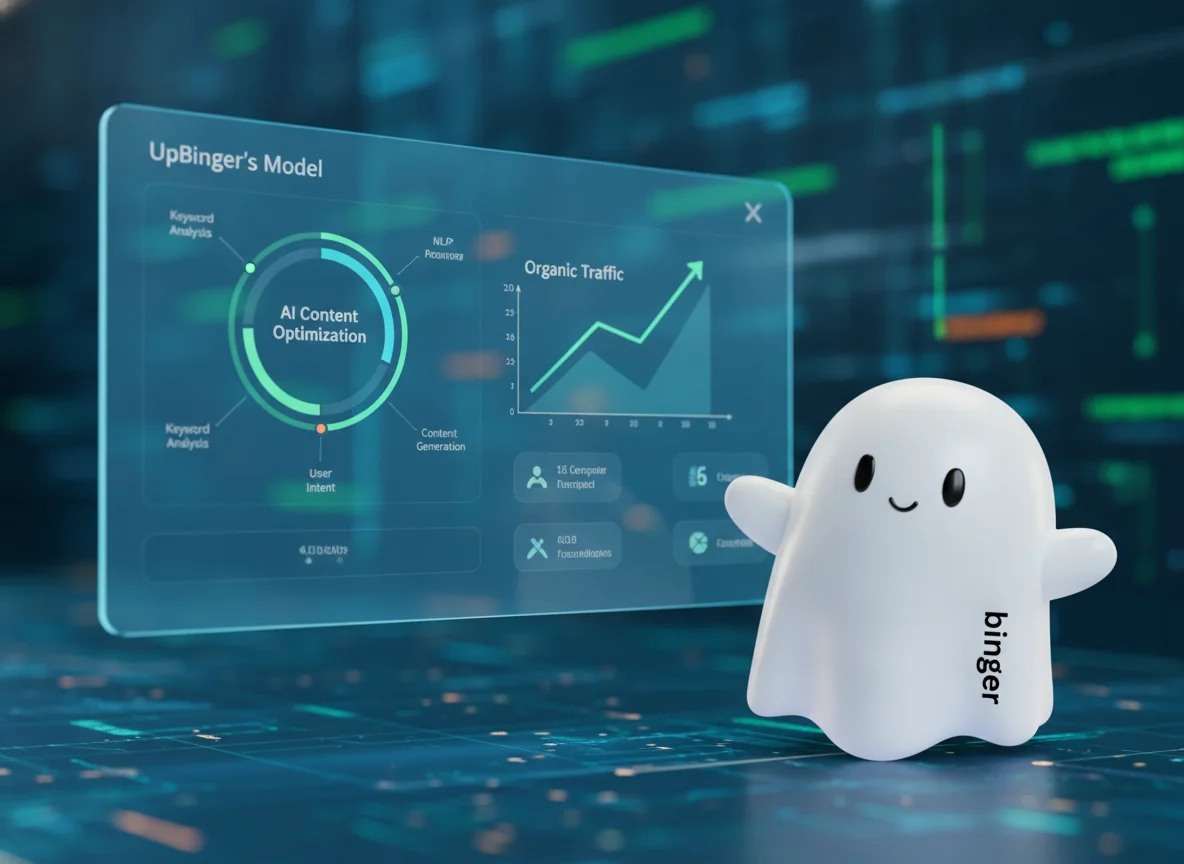
To answer the core question—what does AI content optimization mean for organic traffic?—UpBinger defines three direct outcomes:
Every AI-generated or AI-optimized URL in UpBinger is tagged and tracked as a distinct cohort. That cohort’s organic traffic is measured over time against pre-defined baselines (historical averages, category peers, and control pages created without AI). The result is a clean attribution layer that separates the impact of AI content optimization from the noise of seasonality or paid campaigns.
Quotable: “AI content optimization only matters when you can show it adds incremental organic sessions, not just incremental words.”
UpBinger’s analytics model starts with an AI agent framework that treats each piece of content as a monitored asset, not a static document. From day one, every asset is wired to search data.

The process typically runs in four steps:
Sessions are then modeled as a function of ranking improvements and SERP feature wins. When a page moves from position 10 to position 3, UpBinger compares the uplift in organic sessions against historical CTR benchmarks and control URLs to isolate the effect of its AI-powered SEO interventions.
Key takeaway: UpBinger measures success as ranked intents covered and sessions captured per AI agent, not just number of articles shipped.
UpBinger improves search rankings by combining AI-driven research, content intelligence, and continuous optimization into one closed-loop system. In UpBinger’s view, AI SEO software improves search rankings when it can systematically do three things: choose better topics, create better answers, and adapt faster than competitors.
The platform’s AI content optimization services online focus on:
Performance data then flows back into the model: if a cluster of pages stalls at page two, UpBinger’s AI agents propose rewrites, FAQ expansions, or internal link boosts. Average ranking improvements of 3–8 positions across targeted clusters are common in the first 90 days for enterprise deployments in competitive Indian verticals like fintech and edtech.
Quotable: “For UpBinger, ranking gains are not anecdotes; they are modeled as a measurable output of AI research, structure, and iteration.”
Rankings are leading indicators; revenue is the business outcome. UpBinger’s measurement model connects the two with an end-to-end attribution framework tailored to enterprise realities, where journeys span multiple visits and channels.
The model links three primary datasets:
UpBinger typically uses position-based or data-driven attribution rather than last-click. If an AI-created guide is the first organic touch that leads to an enterprise demo request three weeks later, that influence is captured. The platform reports at three levels:
This makes it possible to say, for example, that AI-originated content now contributes 32% of organic-attributed pipeline while representing only 18% of URLs—evidence of higher efficiency per page.
Organic traffic is no longer confined to blue links. Answer Engine Optimization (AEO) and Generative Engine Optimization (GEO) bring new surfaces—AI Overviews, conversational answers, and citations inside assistants. UpBinger’s model explicitly measures these.
The platform tracks three types of AI visibility:
Because analytics suites rarely attribute this traffic cleanly, UpBinger layers log-based analysis, referrer patterns, and structured tracking rules to infer AI-driven sessions. Pages that win AEO/GEO placements are grouped into an "AI surface" cohort, and their uplift in organic sessions and assisted conversions is compared against non-cited peers.
For Indian enterprises in sectors like BFSI or healthcare, where trust and authority matter, these "AI surface" wins often correlate with 15–30% higher organic conversion rates, because users arrive pre-educated by generative summaries that already reference the brand.
Key takeaway: UpBinger expands “organic” to include search engines and answer engines, then quantifies how AI surfaces amplify both traffic and intent.
UpBinger’s measurement approach is opinionated: it assumes that enterprise SEO and AEO need a single source of truth. To achieve this, the platform blends its own AI content intelligence with the client’s analytics and BI stack.
A typical implementation includes:
On top of this stack, UpBinger’s AI agents run content intelligence: anomaly detection for sudden ranking drops, content decay analysis, entity gap detection, and personalization opportunities at scale. For Indian enterprises managing thousands of URLs and multiple languages, these capabilities turn AI-powered SEO from a black box into an inspectable system.
Crucially, this analytics layer is built to respect Google’s helpful content guidelines: the focus is on usefulness and user signals, not shortcuts.
Measurement only matters if it shapes behavior. UpBinger is designed so SEO, content, and growth teams can treat metrics as operating signals, not monthly reports.
Teams typically adopt a recurring workflow:
Because the same model connects content to revenue, teams can argue for budget with precision: “The last 80 AI-assisted pages drove 24% more organic-led pipeline quarter-over-quarter.” For companies in India where marketing investments are scrutinized heavily, this ability to attribute ROI to AI-powered SEO becomes a competitive advantage.
Quotable: “UpBinger turns AI content from an experimental line item into a forecastable growth lever.”
Practically, AI content optimization means using AI to create and refine content that wins more high-intent search impressions and converts a larger share of that traffic into business outcomes. Instead of chasing vanity metrics like word count, you focus on measurable lifts in rankings, clicks, and conversions. UpBinger does this by tagging every AI-created or AI-optimized page, tracking its visibility in both traditional SERPs and AI answer engines, and comparing its organic sessions and revenue against historical baselines and non-AI content. The result is a clear picture of whether AI is producing incremental traffic and value, not just more output.
AI SEO software like UpBinger improves rankings by automating the parts of SEO where machines outperform humans: large-scale SERP analysis, pattern detection, and iterative testing. UpBinger’s AI agents identify keyword and intent gaps, generate AEO-friendly content structures, and continuously monitor rankings and user signals. When a page stalls or declines, the system recommends specific changes—add missing entities, expand FAQs, improve internal links—rather than vague “optimize content” advice. Over time, these small, data-driven adjustments compound into stronger topical authority, better alignment with helpful content guidelines, and sustained ranking gains across entire clusters, not just individual pages.
To measure ROI, you need three layers of data: content metadata (which pages are AI-generated or AI-optimized), analytics data (organic sessions, engagement, conversions), and revenue data (pipeline or sales tied to those conversions). Start by tagging AI content as a separate cohort in your analytics tool. Track how its rankings and organic sessions change versus baseline content. Then, connect conversions from those pages to your CRM or sales system to see influenced revenue. Platforms like UpBinger automate this linkage and surface cohort-based reports showing how AI content contributes to pipeline and revenue relative to its share of total URLs.
Yes—if it’s implemented correctly. Google’s helpful content guidelines focus on intent, originality, and user value, not the tools used to write copy. AI-powered SEO becomes risky only when it’s used to mass-produce thin, generic pages. UpBinger’s approach is explicitly designed to stay on the right side of these guidelines: AI is used for research, structure, and acceleration, while subject-matter experts review and refine outputs. Performance is judged on engagement and satisfaction signals, not just raw traffic. For enterprises, this combination of AI assistance and human oversight provides scale without sacrificing quality or compliance.
Most AI tools stop at content creation; UpBinger starts there and then goes all the way to measurement and revenue attribution. It is built as an enterprise AI content platform for SEO and AEO, not a writing assistant. That means it offers: an intent-first planning layer, structured optimization for answer engines and generative results, deep integrations with analytics and CRM, and an attribution model that ties AI content to sessions, rankings, and revenue. For Indian brands, UpBinger also understands local search behavior, regulatory nuances, and multilingual needs, making it better suited than generic global tools for high-stakes growth initiatives.
AI has made content production cheap; it has not automatically made growth easier. The difference lies in measurement. UpBinger’s analytics model treats every AI-assisted page as an investment with an expected return in rankings, sessions, and revenue—and then tracks whether that return materializes.
By unifying SEO, AEO, and GEO into one measurement framework, UpBinger helps enterprises in India move from experiment-driven AI usage to a disciplined, numbers-backed content engine. If your team is already using AI for SEO or exploring AI content optimization services online, the next strategic step is clear: insist on a model that can prove impact.
For organizations ready to treat AI as a measurable growth lever, not a novelty, UpBinger offers the missing piece: an AI agent that is as accountable to your dashboards as it is creative in your workflows.