
Most teams don’t have a traffic problem. They have a time problem. By the time a traditional SEO plan starts working, quarterly targets have already passed. What if you could compress a year of SEO work into 90 focused days—without burning out your team or sacrificing quality?
That’s where AI SEO tools, used correctly, change the game. Not as a content vending machine, but as an execution engine: mining opportunities, creating search- and AI-overview-optimized content, and iterating at a pace humans alone can’t match.
This article maps a 90‑day, AI‑driven sprint to attract more organic traffic and leads, tailored for growth-focused teams in India. We’ll combine classic SEO, AI search (AEO), and UpBinger-style workflows to turn quick wins into compounding assets—so you don’t just get more visits, you get more pipeline.
Google doesn’t owe you overnight rankings—but you can meaningfully bend your traffic curve in 90 days if you prioritize correctly and use AI SEO tools to remove execution bottlenecks.
Organic growth usually follows a power-law: a small set of pages drives a disproportionate share of traffic and leads. In most sites, 10–20% of URLs generate 80–90% of organic sessions. That means your first 90 days shouldn’t chase hundreds of keywords; they should ruthlessly focus on pages and topics with the highest upside and shortest time to impact.
AI helps in three ways:
The goal of a 90‑day sprint is not to "finish" SEO. It’s to build a foundation: baseline technical health, initial indexation, quick-win traffic from priority pages, and a content engine that compounds. From there, each additional quarter becomes cheaper and more predictable—because you’re optimizing, not reinventing.
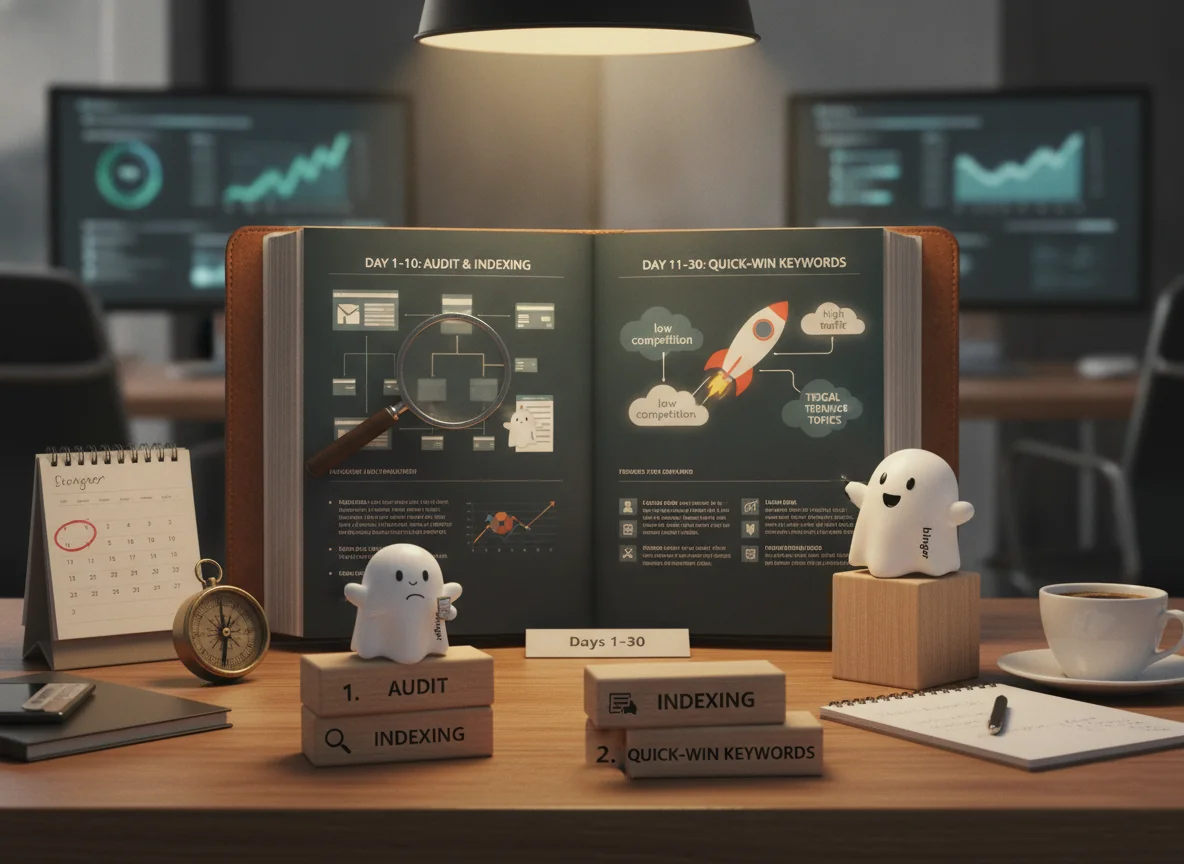
The first month is your setup and triage phase. If you skip this, no amount of AI content creation will save you.
1. Baseline audit and tracking
2. Identify quick-win pages
Use AI-powered analytics to surface URLs currently ranking between positions 5–20 for terms with decent volume and intent. These are your fastest traffic wins because you’re already on Google’s radar.
3. Ensure foundational content and indexing
AI can help draft or enhance:
Submit updated XML sitemaps, request indexing for priority URLs in Search Console, and ensure internal links from your homepage and navigation point to these pages. The objective for Days 1–30 is simple: every priority page is technically sound, indexable, and mapped to a clear keyword cluster.
Most teams treat AI like a faster copywriter. That’s a waste. The real leverage comes from using AI to design a system for SEO content creation and optimization.
1. Define your AI-enhanced content workflows
For each content type—blog, comparison page, product page, resource hub—design a repeatable workflow:
AI SEO tools like UpBinger can automate most of the first and last steps, turning strategy into shippable briefs and optimized drafts.
2. Codify your brand voice and value proposition
Generic AI outputs kill trust—and conversions. Feed your AI platform with:
3. Align content with revenue metrics
Map each content cluster to funnel stages and KPIs: traffic, demo signups, assisted opportunities. Your AI content engine isn’t successful when it publishes more—it’s successful when it makes sales calls easier and pipelines bigger.
With foundations set, the next 30 days are about focused production. You’re building three types of compounding assets: guides, hubs, and product content.
1. Foundational guides for high-intent queries
Create 3–5 deep, AI-assisted guides around core problems your buyers search for:
Use AI to:
2. AEO resource hub to win AI search
AI search (Google AI Overviews, ChatGPT, Gemini, etc.) rewards clear, structured answers. Build an "AI SEO & AEO Resource Hub" with:
3. Product-focused content that ranks
Develop or refine pages around high-volume terms like "AI writing tools", "AI content generation platform", and "enterprise SEO software"—tying them directly to UpBinger’s capabilities. AI can suggest semantic keywords, FAQs, and comparison angles to answer buyer questions before the sales call.
Traffic is nice. Buying intent is better. People searching "best AI SEO tools" or "UpBinger vs [competitor]" aren’t browsing; they’re shortlisting. Your 90‑day plan should explicitly target this review-intent traffic.
1. Create comparison and alternatives pages
Use AI tools to:
2. Optimize for snippets and PAA
Format key answers in concise paragraphs, lists, and tables so Google can easily pull them into Featured Snippets and PAA boxes. Structure H2/H3 headings as natural-language questions like "What are the best AI SEO tools for B2B?" and "How do AI SEO tools help get more organic leads?"
3. Connect to conversion
Every comparison page should include:
These pages often become top drivers of demo signups because they meet buyers at the moment of decision.
By Days 61–90, you have a critical mass of pages. The job now is to improve visibility per page, not just publish more. This is where AI SEO tools excel: they surface micro-opportunities humans miss.
1. Systematic on-page optimization
Use AI to scan your top 50–100 URLs and suggest improvements:
Batch-apply changes where safe; send edge cases for human review.
2. Featured Snippets and PAA targeting
For each priority query, have your AI SEO tool:
3. AI overview and AEO optimization
To win in AI-generated search results, content must be:
An enterprise platform like UpBinger can evaluate your pages against these criteria and generate prioritized recommendations, so your best content is more likely to be cited in AI answers.
The final phase is about closing the loop: measuring what worked, iterating fast, and connecting SEO performance to revenue outcomes.
1. Track the right metrics
Move beyond "rankings" as your only indicator. Use your AI SEO platform and analytics stack to track:
2. Run weekly AI-assisted optimization cycles
Every week, have your platform surface:
Use AI to propose changes, then implement the highest-ROI ones.
3. Turn insights into sales narratives
Marketing should feed sales with concrete SEO wins:
When your team sees organic content directly influencing pipeline, it becomes easier to secure budget, align stakeholders, and treat platforms like UpBinger as growth infrastructure, not a nice-to-have tool.
AI SEO tools help you prioritize keywords and topics with proven business intent—like comparison queries and solution-focused guides—rather than chasing vanity traffic. They analyze search behavior, competitor pages, and your existing analytics to identify which pages are most likely to attract buyers, not browsers. Then they streamline the creation of high-quality content and on-page optimization to improve rankings and click-through rates. When you connect this to clear CTAs and lead capture (demos, trials, consultations), your organic channel shifts from a branding asset to a measurable pipeline engine.
Use AI for the heavy lifting and humans for judgment. Let AI perform keyword clustering, SERP analysis, and outline generation based on top-performing content. Use it to create structured first drafts that match search intent and include schema-ready sections, FAQs, and snippet-friendly summaries. Then have subject-matter experts refine examples, add local context, and ensure accuracy and brand voice. Finally, apply AI again for optimization—titles, meta descriptions, internal links—so each piece is both editorially strong and technically sharp.
Timelines depend on your domain authority and competition, but a focused 90‑day sprint is enough to see leading indicators. In the first 30 days, expect better indexation and early ranking improvements for updated and new pages. By 60 days, you should see rising impressions and click-through rates on priority keywords, especially for quick-win pages. Around 90 days, strong pages can reach page one and start generating meaningful organic leads. The key is consistent execution, technical hygiene, and continuous optimization using AI insights.
AI overviews tend to pull from pages that already rank well and provide clear, trustworthy answers. Start with solid SEO fundamentals: fast loading, mobile-friendly pages, clean architecture, and strong backlinks. Then structure content with short paragraphs, descriptive headings, and direct answers to common questions. Use schema markup where relevant and provide citations, data, and author expertise signals. AI SEO platforms can audit your pages against these criteria and suggest improvements, increasing the chance that AI systems choose your content to summarize or reference.
Not if traffic and leads are core to your growth strategy. Smaller teams often have more constraints on time and headcount, making it harder to execute a consistent SEO roadmap. An enterprise-grade platform centralizes keyword research, content briefs, AI-assisted drafting, optimization, and reporting in one place. That means a lean team can behave like a much larger one—shipping more high-quality content, faster, and with clearer links to revenue. For Indian companies targeting both local and global markets, India-first support and regional insights can further amplify the platform’s value.
Improving organic traffic in 90 days isn’t about hacks; it’s about focus and leverage. Focus on high-intent topics, quick-win pages, and content formats that capture demand. Leverage AI SEO tools not as a shortcut to thin content, but as a force multiplier for insight, execution, and iteration.
In three months, you can move from scattered blog posts to a structured portfolio: foundational guides, an AEO-ready resource hub, product and comparison pages that attract buyers, and an optimization loop that keeps improving results. Done right, every new quarter builds on the last—more keywords, more features won, more organic leads.
If you want that kind of compounding growth without adding a dozen headcount, consider adopting an enterprise platform like UpBinger that unifies SEO and AEO content creation. The next 90 days will pass either way; the question is whether they leave you with another backlog—or a predictable engine for organic traffic and revenue.