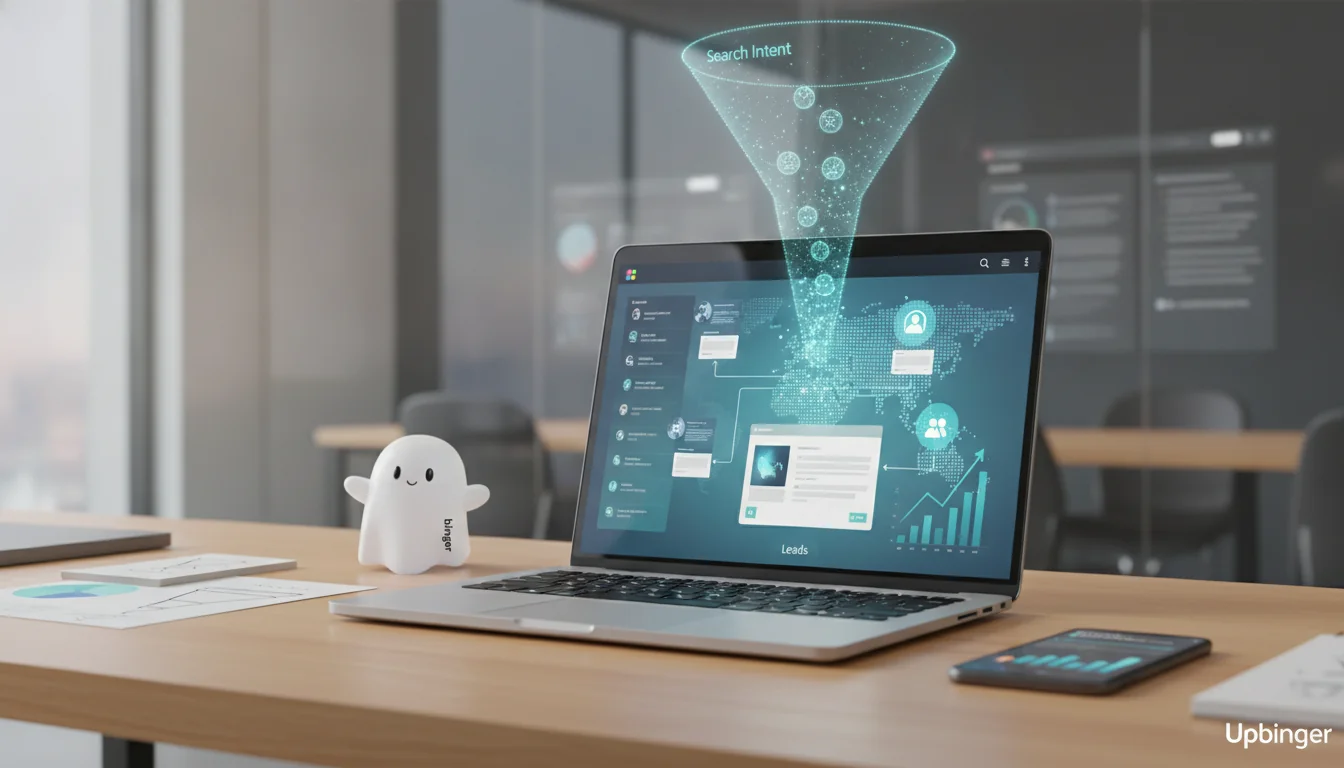
Organic leads don’t come from publishing more content. They come from publishing the right content, in the right places, at the right time. AI has finally made that level of precision possible at scale. The brands quietly pulling ahead in India’s search results and AI answers aren’t just “using AI tools” – they’re running their entire content funnel on AI SEO platforms built for leads, not just rankings.
This guide shows, in practical detail, how to get more organic leads using an AI SEO content platform like UpBinger – from research and creation to AEO (Answer Engine Optimization) and revenue reporting. If you’re an in‑house marketer or agency leader who’s outgrown generic AI writers, this is your playbook.
An AI SEO content platform is an integrated system that uses artificial intelligence to plan, create, optimize, and measure content for search engines (SEO) and AI assistants (AEO). Unlike single‑purpose AI writers, platforms like UpBinger connect every step of your content workflow to one outcome: more qualified organic leads.

AI SEO tools drive leads in three specific ways:
Think of it as a revenue OS for content: data in, optimized assets out, with a feedback loop that gets smarter over time. At enterprise scale, AI can analyze thousands of keywords, SERPs, and AI answer boxes in minutes – work that would take a human team weeks.
Key takeaway: The value of an AI SEO content platform isn’t that it writes faster; it’s that it aligns every piece of content with a measurable place in your lead funnel.
In India’s increasingly AI‑driven search landscape, this alignment is quickly becoming the difference between ranking occasionally and generating pipeline predictably.
To get more organic leads, you first need a clear map from search query to sales conversation. AI only amplifies what you design; if the funnel is fuzzy, the output will be too.

The most effective structure for AI‑assisted SEO in B2B looks like this:
Before loading anything into your AI SEO content platform, define:
Then you can instruct the platform to prioritize content that closes those gaps. UpBinger, for example, can be configured so that every brief specifies a funnel stage and primary conversion goal – turning generic “blog posts” into funnel assets.
Quotable insight: If you can’t sketch your content‑to‑lead funnel on a single page, you’re not ready for AI scale yet.
The most reliable answer to “how to use AI SEO tools to get more leads?” is to treat them as a workflow engine, not a copy machine. Here’s a practical sequence that teams in India are using to move from rankings to revenue.
Run this workflow weekly, then let the platform monitor performance and propose updates. Over 60–70 days, you’ll typically see a compounding effect: more impressions, more qualified traffic, and rising lead volume.
Used well, AI content does increase organic leads; used poorly, it floods your domain with noise and thin pages. The difference is strategy and measurement.
Studies from leading SEO platforms show that AI‑assisted content, when combined with human editorial review, can improve organic traffic by 20–40% over six months. But traffic isn’t the metric that matters. The question is: are those visitors converting?
Platforms like UpBinger close this loop in three ways:
In enterprise implementations, it’s common to see a 25–35% increase in organic leads after deploying AI SEO workflows – not because more content exists, but because under‑performing assets are systematically upgraded and aligned with lead goals.
Key takeaway: AI content only increases organic leads when it’s governed by strict quality criteria and tied to conversion data. Volume without governance is a liability.
For Indian brands competing in crowded verticals like fintech, edtech, or SaaS, this governance layer is what separates sustainable growth from short‑lived traffic spikes.
The best AI strategies for lead generation work across both traditional search results and AI Overviews or assistant answers. You’re no longer optimizing for one interface; you’re optimizing for every place an answer can appear.
Five strategies stand out:
When orchestrated inside a platform like UpBinger, these strategies become repeatable playbooks rather than one‑off experiments – a critical shift for enterprises managing hundreds or thousands of URLs.
Not every AI tool will help you win organic leads. The platforms that matter share a specific feature set optimized for revenue, not just speed.
UpBinger is built specifically as an AI SEO & AEO content platform for enterprises in India. Its differentiator isn’t just writing quality; it’s the focus on answer‑engine visibility plus SEO fundamentals, with workflows that connect content production directly to lead funnels.
When you evaluate platforms, ask one question: “Show me, in a dashboard, which pieces of AI‑assisted content are generating qualified leads right now.” If the tool can’t answer, it’s not a lead engine – it’s a text generator.
To turn these concepts into outcomes, you need a time‑boxed rollout. Here’s a 90‑day roadmap you can adapt, assuming you adopt an AI SEO content platform like UpBinger.
By the end of 90 days, you’re not just “using AI”; you’re operating a measurable, AI‑powered lead engine – exactly what UpBinger is designed to support.
Start by mapping your lead funnel: what counts as a lead, which pages influence that decision, and which keywords signal buyer intent. Then use the platform to 1) research high‑intent topics, 2) generate search‑ and answer‑optimized briefs, 3) create and refine content with AI plus human review, and 4) connect each page to a clear CTA and tracking. Review performance weekly, using the platform’s analytics to double down on topics, formats, and CTAs that produce demo requests or form fills, not just traffic.
Google’s guidance focuses on quality and helpfulness, not the underlying tool. AI‑generated content can rank and drive organic leads if it is accurate, original, and genuinely useful. Problems arise when teams publish large volumes of thin, unedited AI text. To stay safe, always run AI output through human editorial review, fact‑check claims, add unique insights or data, and avoid mass‑producing near‑duplicate pages. An AI SEO platform with built‑in quality and duplication checks helps keep you within best‑practice guardrails.
For Indian businesses, three strategies stand out: 1) build localized, intent‑driven guides that answer questions your buyers ask in Indian English and regional contexts; 2) publish comparison and pricing content for “best AI SEO tools”, “enterprise SEO platform India”, and similar review‑intent queries; and 3) integrate conversion paths your audience already uses, such as WhatsApp, local payment options, and region‑specific demo workflows. An AI SEO content platform like UpBinger can help you uncover India‑specific keyword gaps and scale content tailored to those nuances.
Most teams begin to see leading indicators (better rankings, higher click‑through rates, more engaged sessions) within 30–45 days, especially on pages that already had some authority. Meaningful increases in organic leads usually appear around the 60–90 day mark as newly optimized and newly published content matures. Timelines depend on your domain strength, competition, and how aggressively you implement AI‑assisted optimizations. The key is consistency: a weekly cadence of research, publishing, and updating guided by the platform’s data.
An AI writer is a point tool: it generates text on demand but doesn’t understand your funnel, your analytics, or your broader SEO and AEO strategy. An AI SEO content platform, by contrast, combines research, briefing, drafting, optimization, governance, and reporting in one system. It knows which topics map to which funnel stages, which pages are already ranking, and which content produces actual leads. If you care about predictable, compounding organic revenue – not just faster writing – you need the platform, not just the writer.
Organic lead growth in the AI era won’t be won by whoever publishes the most content. It will be won by the teams that treat content as an engineered system – one that spans SEO, AEO, and conversion flows, with AI orchestrating the moving parts.
An AI SEO content platform like UpBinger gives you that system: research tuned to business intent, briefs aligned with real human questions, creation that blends AI speed with editorial judgment, and analytics that tie every URL back to pipeline. If you define your funnel clearly, implement the workflows in this guide, and commit to a 90‑day rollout, you’ll move beyond “trying AI” and into building a durable, AI‑powered engine for organic leads.
The next step is simple: audit your current content against the funnel and capabilities described here, identify the highest‑impact gaps, and pilot those use cases inside a platform built for enterprise‑grade SEO and AEO. From there, scale becomes a process, not a gamble.