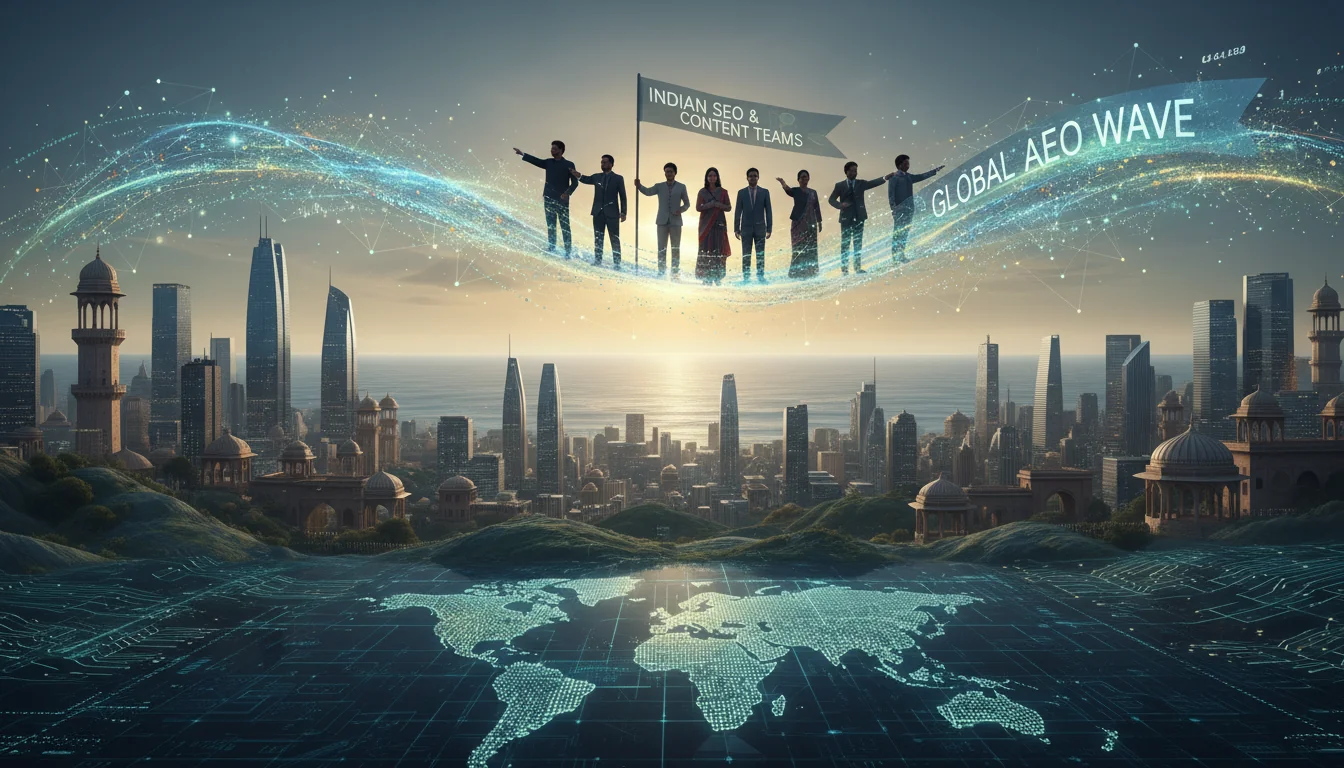
The SEO rulebook is being rewritten in real time—not by Google alone, but by AI-powered answer engines like ChatGPT, Gemini, Perplexity, and Search Generative Experience (SGE). Most global brands are still treating this shift as a curiosity. Indian SEO and content teams have an opening to treat it as a once-in-a-decade leadership opportunity.
India already powers global IT, analytics, and digital marketing. The same combination of technical depth, language diversity, and cost advantage now positions India to lead a new discipline: Answer Engine Optimization (AEO)—the art and science of creating content that ranks not just in blue links, but inside AI answers.
This article lays out a practical playbook for how Indian teams can move from back-office execution to front-line strategy in AEO, using enterprise AI platforms like UpBinger to build, optimize, and scale human-quality, Google-friendly content for both search engines and AI systems.
Traditional SEO was built around documents and links. AEO is built around questions and answers. Instead of asking, “How do I rank this page?”, leading teams now ask, “How do I make my brand the default answer when an AI system responds to this question?”
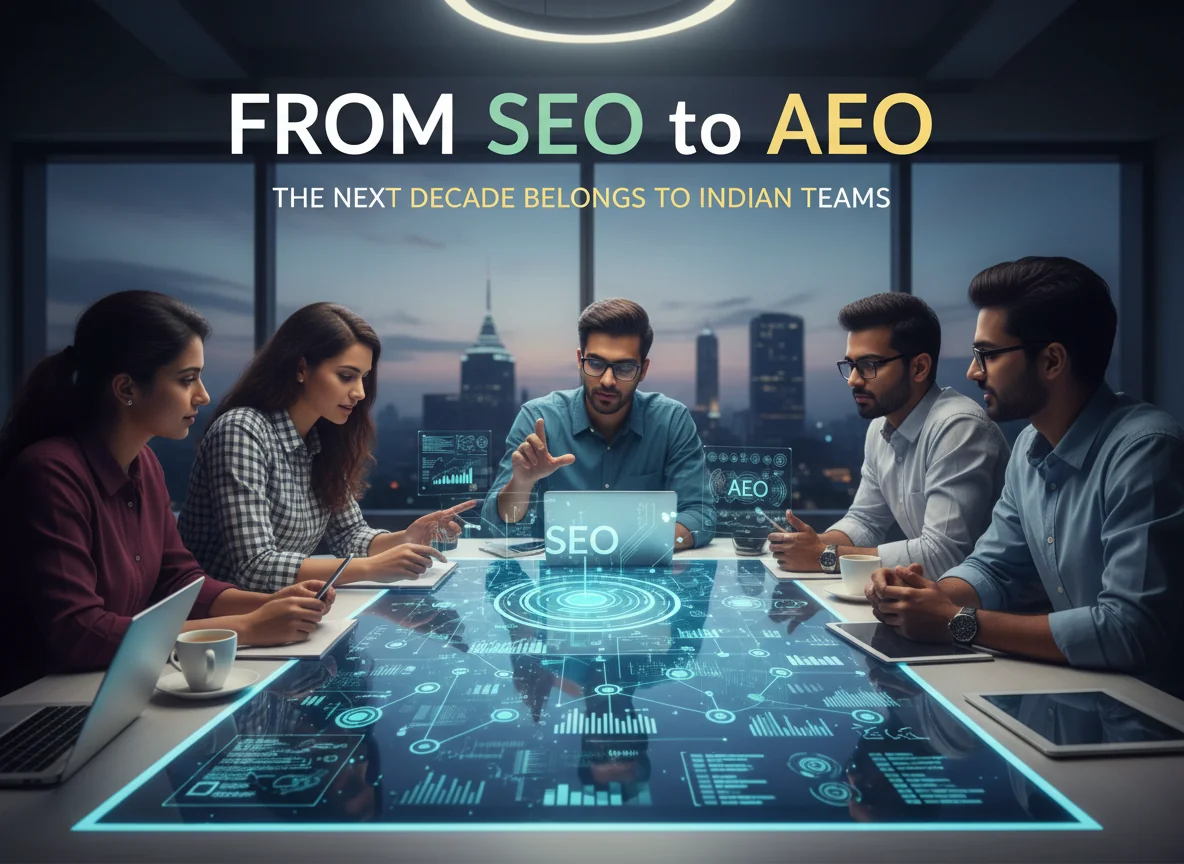
Answer engines synthesize information across the web, prioritize clarity and authority, and reward structured, unambiguous, up-to-date content. That makes AEO much closer to technical documentation and knowledge engineering than to old-school keyword stuffing—and that is exactly where Indian teams excel.
India has three structural advantages:
As AI reshapes discovery, global enterprises will need partners who can architect content systems, not just write articles. Indian agencies, in-house COEs, and content platforms that master AEO early can move from being order-takers to strategic orchestrators of organic growth worldwide.
Most brands still optimize primarily for Google.com, English, and a handful of markets. But answer engines operate across borders and languages from day one. They ingest content globally and surface sources that best match intent, structure, and clarity—regardless of where they were created.

Indian teams are unusually well-suited to this reality:
1. Talent density in digital and analytics. India’s digital ecosystem has produced hundreds of thousands of SEO specialists, content strategists, and performance marketers. Many are already comfortable with schema markup, analytics, and experimentation—capabilities that transfer directly to AEO.
2. Cost advantage at scale. AEO is a volume game: thousands of questions, variants, and contexts across regions and languages. Indian teams can afford to run more experiments, create more test content, and maintain more localized variants than high-cost markets, without compromising quality when equipped with a robust AI content marketing platform.
3. Natural multilingualism. Indian professionals frequently operate across English plus at least one regional language. This gives them an intuitive grasp of semantic nuance, translation challenges, and audience differences—critical when answer engines are prioritizing meaning over exact wording.
Combine these advantages with enterprise AI tooling like UpBinger, and Indian teams can build global AEO programs that are both economically sustainable and strategically differentiated.
Many Indian enterprises—and agencies serving global clients—are still grappling with basics: zero or few indexed pages, weak internal linking, poor crawlability, and thin content. The temptation is to jump straight to generative AI. That’s a mistake. Answer engines still depend heavily on the same quality and authority signals that drive Google rankings.
Before claiming AEO leadership, Indian teams should ruthlessly fix the foundation:
Platforms like UpBinger can scan existing domains for zero-indexed or low-performing pages, surface structural issues, and generate SEO- and AEO-ready content templates. The goal: turn a fragile, under-indexed site into a robust knowledge graph that answer engines can confidently cite.
In most organizations, SEO content and AI content experiments are running on separate tracks. That siloed approach wastes effort. The same asset can and should serve three masters simultaneously: users, search engines, and AI answer engines.
An enterprise-ready ai content platform for marketing teams like UpBinger enables a dual-optimization model:
UpBinger’s workflows can be tuned so every draft is checked not only for keyword coverage and readability, but also for answerability: Is this content quotable by an AI system? Does it resolve ambiguity? Does it reinforce brand and product as the solution?
To truly lead, Indian teams need more than writers and analysts; they need an operating system for large-scale, AI-native content. This is where an ai content solution for businesses like UpBinger becomes strategic infrastructure rather than a point tool.
AEO leaders will standardize on five capabilities:
UpBinger is designed as an ai content marketing platform for exactly this scenario: content teams orchestrate strategy; the platform handles drafting, optimization, and repurposing; and Indian execution teams iterate rapidly based on performance data. The result is a living AEO system, not a one-off campaign.
Consider three realistic scenarios where Indian SEO and content teams can lead global AEO programs using UpBinger as their backbone.
1. B2B SaaS category domination. An Indian hub team is tasked with winning “AI content creation tool” and related queries for a US-headquartered SaaS. They use UpBinger to build a matrix of definition pages, how-tos, and comparison posts (“best AI content platform for marketing teams”, “AI content solution for enterprises”) and rapidly test variants. Within months, they dominate featured snippets and become a primary source for AI answer engines.
2. Multi-country e-commerce. A global retailer centralizes AEO operations in India. The team uses UpBinger to generate localized, structured FAQs and buying guides for thousands of product categories, then monitors which questions surface in PAA and SGE. High-performing patterns are rolled out to new markets in weeks, not quarters.
3. Financial services thought leadership. An Indian content COE supports a bank’s global education hub. They publish deeply researched, regulation-compliant explainers, then use UpBinger’s optimization tools to align each article with likely conversational questions. Over time, their content becomes the backbone of AI-generated answers on complex topics like credit scoring, trade finance, and risk management.
In each case, the Indian team is not a cost center—it is the strategic core of the brand’s AEO presence.
Claiming AEO leadership isn’t about buying one more tool; it’s about reframing how Indian teams position themselves and how enterprises organize around content. A practical roadmap might look like this:
The opportunity is clear: in the 2010s, India became the world’s SEO execution engine. In the 2020s, Indian teams can become the world’s answer engine architects—if they move quickly, master AEO, and treat AI platforms like UpBinger as strategic partners rather than tactical helpers.
AEO focuses on optimizing content so that it becomes the source material for AI-powered answer engines like ChatGPT, Gemini, Perplexity, and Google’s SGE. Traditional SEO targets ranking web pages in search results; AEO targets being quoted inside the answer itself. Practically, that means structuring content around clear questions and concise answers, using schema, and providing unambiguous, up-to-date information. The best strategies don’t choose between SEO and AEO—they design content that wins featured snippets, PAA boxes, and also becomes highly quotable and trustworthy for AI models.
Begin with a technical and content audit: fix indexation issues, identify thin or overlapping pages, and map core questions your audience asks. Next, adopt an AI content platform such as UpBinger to standardize answer-first templates and accelerate drafting. Create a question repository from SERPs, customer conversations, and internal FAQs. Then prioritize a few high-value themes—like “AI content creation” or “best AI tools”—and build deep, structured hubs. Finally, put measurement in place: track featured snippets, PAA coverage, and the performance of Q&A content, and refine templates based on results.
Indian teams combine three critical advantages: strong technical skills, cost-effective scale, and everyday multilingual experience. AEO rewards teams that understand schema, data, and experimentation as much as copywriting, making India’s engineering-heavy marketing talent a natural fit. Lower execution costs allow more testing across questions, markets, and languages. Multilingual competence translates into better handling of nuance and intent—exactly what AI answer engines optimize for. With an enterprise AI content platform in place, Indian hubs can orchestrate global AEO for brands headquartered anywhere.
UpBinger helps teams operationalize AEO at scale. Instead of manually researching every question and crafting each answer from scratch, marketers can use UpBinger to generate consistent, high-quality drafts optimized for both SEO and answerability. The platform supports topic and question mapping, structured templates, SERP feature targeting, and ongoing performance optimization. It also enables easy repurposing of authoritative content into FAQs, how-tos, comparison pages, and social posts. For Indian teams managing global programs, this centralization turns fragmented content efforts into a coherent, AI-ready knowledge system.
Enterprises should combine AI assistance with human oversight and clear quality standards. Use platforms like UpBinger to generate first drafts that already follow SEO and AEO best practices, then have editors refine for accuracy, nuance, and brand voice. Incorporate up-to-date references, original insights, and examples that go beyond generic AI output. Run technical checks for duplicate content, thin pages, and schema correctness. Google’s guidance focuses less on how content is produced and more on whether it’s helpful, reliable, and people-first—standards that disciplined AI+human workflows can absolutely meet.
AEO is not a side quest to SEO; it is the logical next stage of organic visibility in an AI-saturated world. The capabilities required—technical rigor, content volume, multilingual nuance, and experimentation—map uncannily well to India’s digital talent landscape.
Indian SEO and content teams that act now can move from execution partners to strategic orchestrators of global organic growth. The path runs through three commitments: fix the SEO foundation, embrace dual optimization for SEO and AEO, and build an operating system around an enterprise AI content platform like UpBinger.
Leaders who do this will not just help their brands maintain traffic; they’ll help them become the default answers in the tools decision-makers actually use. In a world where AI systems increasingly decide what humans see, being the answer is the new Page 1. India is perfectly placed to lead that transformation.