
Most enterprise teams know who their competitors are. Far fewer can say, with precision, where they are winning or losing visibility across thousands of keywords, pages, and AI answers. Manual audits and scattered tools simply cannot keep pace with how fast search and AI surfaces change in 2026.
An AI SEO platform closes this gap. It continuously analyzes competitors, surfaces actionable insights, and translates them into content decisions that improve rankings and AI visibility. Instead of quarterly PPTs, you get living intelligence.
UpBinger was built specifically for this new era of SEO and Answer Engine Optimization (AEO). It behaves like an always-on AI analyst: tracking SERPs, answer boxes, and AI overviews; spotting opportunities; and generating content playbooks at enterprise scale.
Key idea: An AI SEO platform turns competitor analysis from a static research project into an automated, compounding advantage.
An AI SEO platform is an enterprise system that uses artificial intelligence to research, create, and optimize content for search engines and AI answer engines at scale. For large organizations, it replaces fragmented point tools with a unified layer of content intelligence.

Enterprises face three structural problems: volume (tens of thousands of URLs), velocity (SERPs and AI outputs change weekly), and variability (multiple teams, markets, and languages). Traditional SEO stacks built on spreadsheets and manual audits break under this load. AI-powered SEO changes the equation by automating the heavy analysis and pattern recognition.
Instead of analysts sampling 100 keywords, an AI SEO platform can monitor 50,000+ terms daily, cluster them into intents, and map competitors across every journey stage. It spots emerging rivals, new content formats, and shifts in authority long before traffic graphs move.
For Indian enterprises, there is an additional advantage: AI can localize insights for regional languages, devices, and search behaviors that global tools often under-serve. A platform like UpBinger can prioritize where Hindi or Tamil content will out-compete English-only incumbents.
Quotable insight: For enterprises, the question is no longer “Should we use AI for SEO?” but “How fast can we operationalize it before competitors do?”
An AI SEO platform assists with competitor analysis by automatically discovering who actually competes with you on the SERP and in AI answers, then benchmarking their performance against yours across thousands of keywords in near real time.
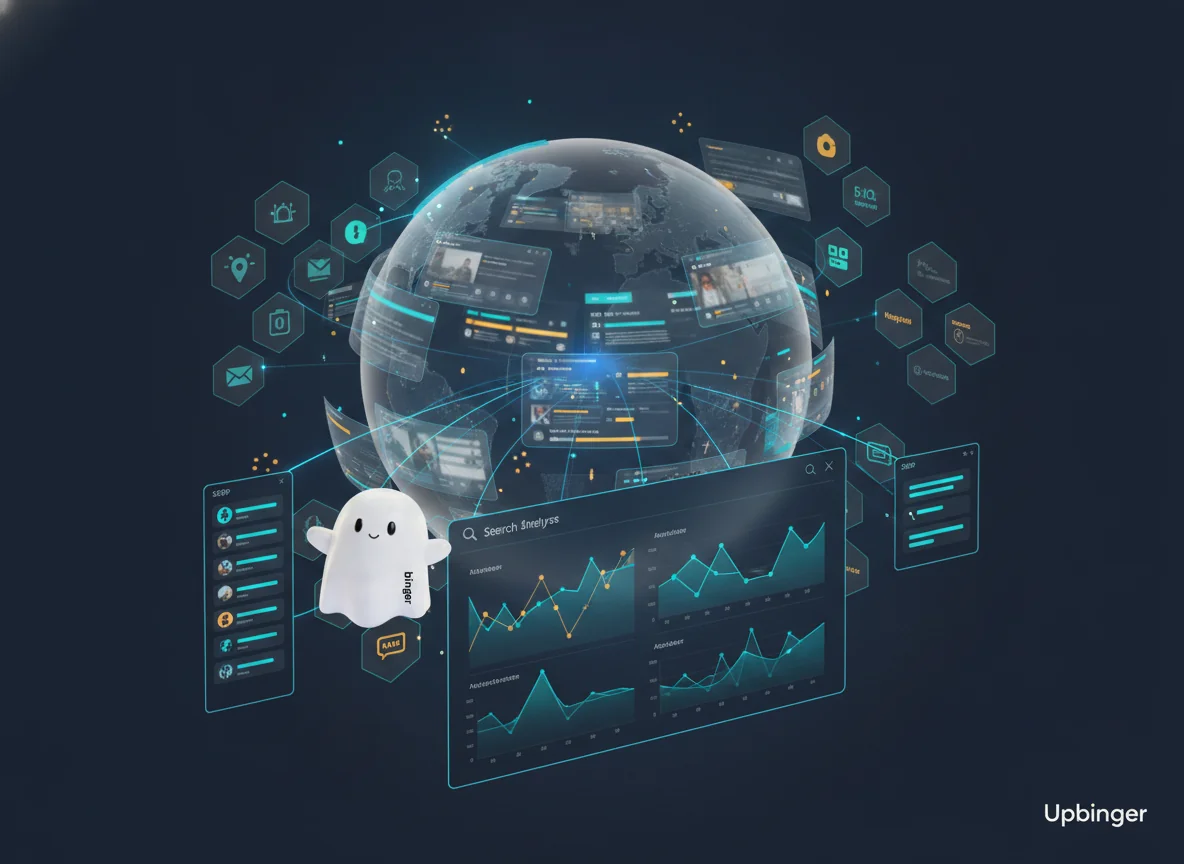
At enterprise scale, competitor analysis is not about a static list of “five rival brands.” It is about the constantly changing set of domains, publishers, marketplaces, and AI answer patterns that steal your clicks and mentions. AI systems can ingest keyword universes, crawl SERPs, and detect patterns that humans would never see.
Practically, a platform like UpBinger will: 1) cluster your keyword universe by topic and intent; 2) identify the true competitors per cluster (often different from your sales-defined competitors); 3) calculate share of voice across organic results, featured snippets, People Also Ask, and AI answer inclusions; and 4) benchmark content depth, structure, and authority signals.
The benefit is not just visibility, but precision. Instead of generic statements like “Competitor X is strong in product content,” you get: “Competitor X outranks us on 73% of transactional keywords in cluster ‘enterprise CRM pricing’ due to better coverage of implementation timelines and ROI benchmarks.” That level of specificity drives action.
Automated gap analysis compares your content footprint to competitors’ across topics, formats, and performance, then quantifies what is missing. An AI SEO platform does this continuously, turning competitor research into an operational signal rather than a quarterly report.
Traditionally, strategists took a few high-value keywords, opened the top-ranking pages, and manually noted what rivals covered that they did not. At 50,000+ keywords and hundreds of domains, this model collapses. AI can read at that scale. It parses headings, entities, FAQs, schema, and semantic relationships to build a granular content map.
UpBinger, for example, can benchmark your article against the top 10 competitors on more than 50 dimensions: length, depth by subtopic, use of statistics, E‑E‑A‑T signals, internal links, and more. It then scores competitive posture (leading/at-par/lagging) for each major theme.
This powers three enterprise use cases: 1) board-ready narratives (“we closed 40% of our critical gaps in 90 days”); 2) squad-level roadmaps (specific briefs and updates); and 3) budget rationalization (aligning spend with clusters where upside is highest and competition fiercest).
Key takeaway: AI turns content gap analysis from a subjective exercise into a quantified, repeatable metric that can be tracked like pipeline or NPS.
AI SEO software improves search rankings by decoding what current winners do on the SERP and in AI overviews, then generating content and on-page changes that align with those winning patterns faster than manual teams ever could.
Rankings move when content, technical health, and authority align with user intent and algorithmic priorities. AI excels at reading those priorities at scale. It can examine the top 20 results for each keyword cluster, evaluate content patterns, detect common schema types, analyze page speed and layout shifts, and synthesize what “good” looks like for that query type.
In the age of Answer Engine Optimization and Generative Engine Optimization, this extends beyond ten blue links. Platforms like UpBinger model which sources are most frequently cited by AI assistants, which questions are consistently surfaced in People Also Ask, and which content formats (guides, checklists, stats pages) are over-represented in AI answers.
The loop works as follows: 1) observe SERP and AI patterns; 2) generate or optimize content to match and exceed these patterns; 3) deploy structured data and technical improvements; 4) measure shifts in rankings, snippets, and AI citations; 5) refine. Enterprises that run this loop continuously often see 20–40% improvement in non-branded organic traffic over 12–18 months.
AI competitor analysis only creates value when it feeds real decisions—what to publish, where to defend, how to prioritize markets, and which bets to kill. The constraint in most enterprises is not data, but workflow and clarity.
A platform like UpBinger is most powerful when treated as an AI agent embedded into your content operations, not just a reporting layer. That agent can own three critical workflows:
First, prioritization. The AI ranks opportunities by incremental traffic, likelihood of winning based on competitive intensity, and strategic fit (e.g., ICP, geography, product lines). Product marketing and SEO leads can then approve or adjust, rather than build lists from scratch.
Second, briefing. Instead of vague titles, editors receive AI-enriched briefs that include query intent, competitor benchmarks, must-cover subtopics, required data points, and snippet/AEO opportunities.
Third, governance and reporting. Executives see dashboards framed around business questions—“Where are we gaining share from Competitor A?”; “Which topics are at risk from new entrants?”—instead of raw keyword dumps.
Quotable insight: The winning enterprises are not those with the most SEO data; they are those that let AI pre-digest that data into decisions humans can act on weekly.
Enterprise SEO leaders should treat AI SEO platforms as critical infrastructure. That means interrogating not just features, but risk, scalability, and data integrity. The right questions upfront can shorten procurement cycles and avoid painful rebuilds later.
On scale, ask: How many keywords and URLs can the platform track without performance degradation? Can it support multiple business units, languages, and regions with role-based access control? What are the SLAs for data freshness—daily, hourly?
On data integrity, verify: Which primary sources does it integrate with (Search Console, Analytics, ads, log files, third-party crawlers)? How does it deduplicate, normalize, and reconcile conflicting data? For India-focused brands, can it handle regional search engines, local-language SERPs, and mobile-first realities?
On risk and governance, probe: How is PII handled? Where is data stored (important for Indian and global compliance)? What guardrails exist to keep AI-generated content on-brand, factually grounded, and legally safe?
Finally, evaluate rate of innovation. AI and search are evolving monthly. Platforms like UpBinger that ship continuous enhancements for AEO, GEO, and AI assistant visibility will age far better than static dashboards built for a pre-generative era.
Enterprises that win with AI SEO treat it as a systematic playbook, not an experiment. A pragmatic approach with UpBinger or a similar platform follows five concrete steps.
1) Define competitive scope. Align marketing, sales, and product on: Which categories matter? Which geographies (e.g., India-first vs global)? Which digital-only competitors you must watch, even if they never appear in RFPs.
2) Run an AI visibility audit. Use the platform to baseline your share of voice across organic rankings, featured snippets, PAA, and AI-generated answers for each priority cluster.
3) Generate gap maps and opportunity lists. Let the AI cluster opportunities by impact and difficulty: quick wins (on-page fixes), strategic bets (new content hubs), and defensive plays (pages at risk of being overtaken).
4) Operationalize with briefs and agents. Turn prioritized gaps into AI-generated content briefs and, where appropriate, first drafts. Assign owners, SLAs, and review criteria.
5) Measure and iterate quarterly. Track competitive share shifts, AI citation counts, and traffic/revenue outcomes. Feed learnings back into the model and governance.
Key takeaway: An AI-first playbook is not about replacing strategists; it is about giving them an AI copilot that sees the entire battlefield and suggests the next three moves.
An AI SEO platform assists with competitor analysis by continuously crawling SERPs and AI-generated answers for your full keyword universe, then mapping which domains and pages compete with you by topic and intent. It benchmarks their content depth, structure, and authority signals against yours, surfaces content gaps, and quantifies share of voice across organic rankings, snippets, and AI overviews. Instead of manual, one-off audits, you get an always-on view of where you are winning, losing, and at risk—broken down by product line, market, and buyer journey stage.
AI SEO software improves search rankings by converting competitive and SERP data into precise on-page and content recommendations. It identifies what high-ranking pages consistently do—such as covering specific subtopics, using certain schemas, or addressing common questions—then guides you to match and exceed those patterns. Many platforms also generate optimized briefs or drafts aligned with user intent. When combined with technical fixes and internal linking improvements, organizations commonly see double-digit percentage gains in non-branded traffic and higher coverage of key SERP features within 6–12 months.
Traditional SEO tools focus on providing raw data: keyword volumes, backlinks, basic rankings. An AI SEO platform layers intelligence and automation on top of that data. It clusters keywords into topics, interprets SERP patterns, performs large-scale gap analysis, and generates content playbooks automatically. For enterprises, the difference is operational: instead of teams spending days assembling CSVs and slides, they start from AI-curated opportunity lists and briefs, making decisions and producing content faster, with clearer links to business outcomes.
The most effective approach is to embed AI outputs at the decision points your teams already have. For example, use AI-generated opportunity lists during quarterly planning, AI-created briefs in editorial workflows, and AI-driven competitive dashboards in leadership reviews. Design clear roles: the platform proposes, humans dispose. Establish guardrails for brand voice, claims, and compliance so editors and legal feel confident. Over time, shift from ad-hoc use to defined SLAs—for instance, every new strategic topic must go through AI competitor analysis before content is commissioned.
Yes, it is particularly relevant in India, where search behavior is highly mobile, multilingual, and price-sensitive. AI SEO platforms can detect how competitors perform across English and regional-language queries, how they appear in local SERPs and AI summaries, and which formats resonate in specific states or cities. This allows Indian enterprises to prioritize content for markets where they can quickly out-compete global players that have not localized deeply. It also helps allocate budgets across languages and regions based on real search demand and competitive intensity.
Enterprise SEO is no longer just about improving rankings on a set of core keywords. It is about shaping how your brand appears across search results, featured snippets, People Also Ask, and AI-generated answers—at a scale and speed humans alone cannot manage.
An AI SEO platform like UpBinger converts competitor analysis from a static research slide into a dynamic advantage. It reads the entire landscape, quantifies where you stand, and points directly to the moves that will shift market share in your favor.
The enterprises that win this decade will be those that operationalize this capability first: giving their teams an AI agent that never sleeps, never stops analyzing competitors, and keeps transforming raw data into better content, better rankings, and better answers.
If your organization is serious about market leadership in India and beyond, the next step is clear: design an AI-first competitor analysis playbook and put a platform like UpBinger at its core.