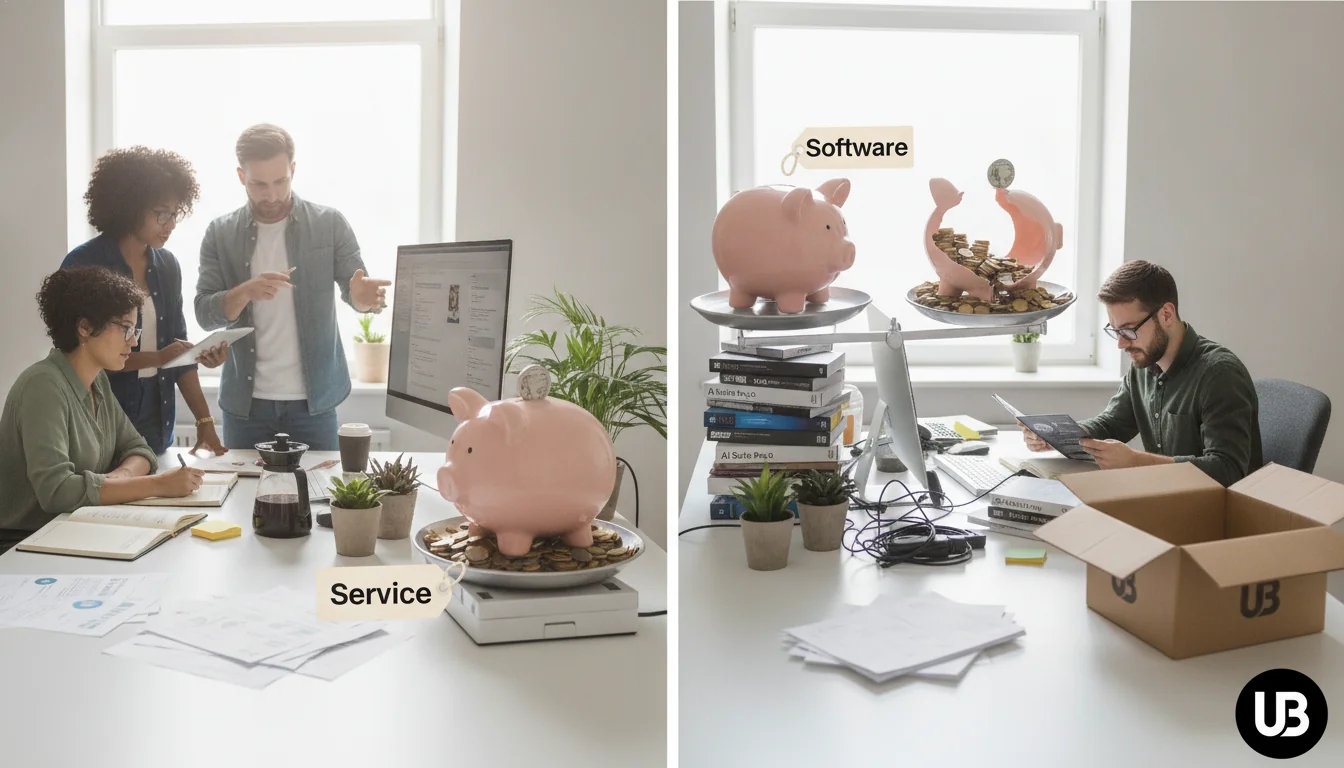
The most expensive content decision in 2024 isn’t whether to start using AI. It’s how you use it. Do you hire an AI content optimization service on retainer, or buy an AI content marketing platform and build capabilities in-house? For CMOs, Heads of Growth, and SEO leaders, this isn’t a theoretical debate. It’s a budget line that can swing ROI by 30–50% over 12 months.
This article quantifies that trade-off using realistic cost models for Indian and global teams. We’ll compare hiring agencies and consultants against licensing an enterprise AI platform like UpBinger, factoring in not just subscription fees but content volume, talent costs, ramp-up time, and the emerging demands of Answer Engine Optimization (AEO) and Generative Engine Optimization (GEO).
If you’re deciding whether to hire an AI content optimization service or invest in your own stack, you’ll leave with a clear, CFO-ready recommendation.
An AI content optimization service is a team of specialists (often an agency or consultancy) that uses AI tools on your behalf to research, create, and optimize content. You pay primarily for people plus process. An AI content marketing platform is software—like UpBinger—that your team uses directly to generate, optimize, and scale content for SEO and AEO. You pay primarily for licenses.
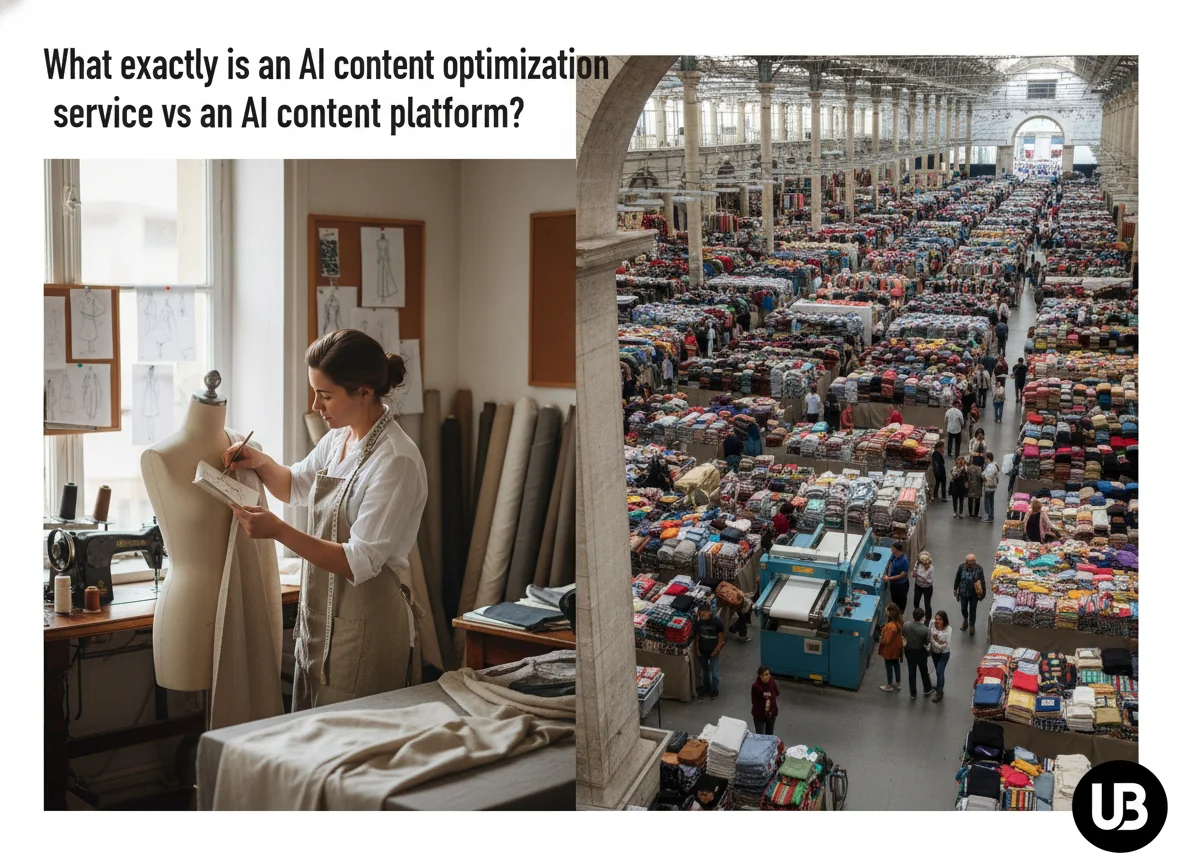
Most services combine three capabilities:
Platforms like UpBinger typically provide:
Key takeaway: Services give you “done-for-you” capacity; platforms give you “do-it-better-and-faster” capabilities. The smartest enterprises blend both, but weight spend differently depending on volume and maturity.
Understanding this distinction is crucial before you request any AI content platform quote or sign a retainer. Otherwise, you’ll compare headcount hours to license fees without equalizing for output and control.
To compare options, you must define “return” with ruthless clarity. For most enterprise teams, ROI from AI content comes from three levers: traffic gain, conversion lift, and cost savings.

Start with a simple formula:
Benchmark ranges from enterprise case studies and public tools:
For decision-making, the critical question is not “Does AI help?” but: Which operating model delivers those gains at the lowest blended cost per piece—and with the most control?
Quotable insight: The winning model isn’t the one with the lowest monthly fee; it’s the one that delivers the most incremental revenue per rupee or dollar of content created.
With this framework, we can now put numbers against hiring an AI content optimization service versus licensing an AI platform.
When you hire an AI content optimization service, you’re paying for a bundled outcome: strategy, content, and optimization. Pricing varies widely, but realistic ranges look like this for growth-stage companies.
Assume a mid-tier plan at ₹3 lakh/month delivering 25 SEO+ AEO-optimized articles and landing pages:
Assume $8,000/month for 15 assets (blogs, LPs, topic clusters):
The upside:
The downside is that marginal costs stay high as volume scales. Doubling content typically requires doubling or near-doubling spend.
When you license an AI-powered content marketing platform such as UpBinger, you shift from recurring service hours to a mix of software + internal team time. The economic magic happens when your team can produce 3–5× more content per person while improving quality.
While exact AI content marketing platform pricing varies, enterprise-grade tooling in India typically falls into these bands:
For global teams, equivalent pricing often ranges from $1,500–$5,000/month for serious usage.
Now layer in internal costs. Consider an India-based content/SEO pod:
Even with this team, AI can:
Key takeaway: A platform like UpBinger converts a fixed salary base into a far larger content output while embedding newer disciplines like AEO and GEO that most agencies are still retrofitting.
To decide whether to request an AI content platform quote, you should quantify this impact versus your existing or planned headcount.
Here is where the decision becomes data-driven. Let’s compare three realistic scenarios for an India-headquartered SaaS or marketplace brand with global ambitions.
Quotable insight: Below ~15 pieces/month, a service often makes sense. Above ~30–40 pieces/month, an AI platform almost always wins on cost per asset and speed of experimentation.
The inflection point is where your marginal cost per optimized piece on a platform drops below your best negotiated agency rate—usually faster than leadership expects.
Businesses should use an AI-powered content marketing platform because it compounds value over time: every brief, article, and optimization trains your internal AI agents and workflows, not your vendor’s muscle memory. Services can be powerful accelerators, but platforms become durable infrastructure.
Strategically, platforms like UpBinger unlock advantages that agencies alone struggle to match:
Operationally, platforms:
Key takeaway: If content is a core growth lever, renting AI expertise indefinitely via services is riskier than owning the AI infrastructure and selectively adding external specialists.
This is especially true for AEO and GEO, where speed of testing and internal knowledge capture are decisive advantages.
The most effective organizations don’t choose “services or software.” They choose the right sequence and mix. Use this framework:
Decision rule: If your 12‑month content plan includes ≥300 pieces across markets, requesting an AI content platform quote should be your next move—then layer services on top, not the other way around.
Hiring an AI content optimization service means contracting an external team—usually an agency or specialist consultancy—to plan, produce, and optimize your content using AI tools. They typically handle keyword research, topic clustering, briefs, drafting, and on-page SEO and AEO optimization. You pay a monthly retainer or project fee in exchange for a set number of content assets and strategic support. This model is ideal when you lack in-house expertise, have limited bandwidth, or need to validate content as a growth channel before building a permanent internal team and technology stack.
Start with three questions: 1) How many high-quality pieces do you need per month for the next 12 months? 2) Do you have, or can you hire, a content and SEO lead internally? 3) Is content a core growth lever or a support channel? If you plan <15 pieces/month and lack in-house leadership, an agency or AI content optimization service is usually safer. If you’re targeting 30+ assets/month or multi-market expansion, an AI content marketing platform like UpBinger will usually deliver lower cost per piece, better control, and stronger AEO/GEO capabilities—especially when paired with a small in-house team.
Answer Engine Optimization (AEO) and Generative Engine Optimization (GEO) require far more granular data and iteration than traditional SEO. You must understand which questions, entities, and formats AI assistants prefer, then structure your content accordingly. An AI-powered content marketing platform continuously analyzes SERPs, AI overviews, and People Also Ask data to surface those patterns and embed them in templates and AI agents. This is difficult and expensive to do manually or purely via agency workflows. Platforms make AEO and GEO systematic, repeatable, and measurable, which is why they become critical as AI-generated answers capture more user attention.
AI content marketing platform pricing in India usually starts around ₹40,000–₹60,000 per month for early-stage teams and can go up to ₹2–5 lakh per month for full-featured enterprise deployments with SSO, SLAs, advanced governance, and deep integrations. The exact quote depends on the number of users, content volume, domains, and required features such as custom AI agents, AEO/GEO modules, and analytics. When you request an AI content platform quote from a vendor like UpBinger, share your projected monthly content volume, target markets, and existing tech stack to get an accurate, ROI-grounded estimate.
Yes, and for many enterprises this hybrid model delivers the best ROI. A common pattern is to hire an AI content optimization service for initial strategy, pilots, and high-stakes campaigns, while simultaneously deploying an AI content platform like UpBinger as the core engine for day-to-day production and optimization. Over 6–12 months, you can internalize more execution into the platform and use agencies as specialized partners rather than the primary production engine. This approach protects institutional knowledge, lowers marginal content costs, and keeps you agile as search engines and AI assistants evolve.
Choosing between hiring an AI content optimization service and licensing an AI content platform isn’t a branding call—it’s a unit economics decision. Services shine when you need immediate expertise and limited volume. Platforms like UpBinger win when content is central to growth, volume is rising, and you want to own AEO and GEO capabilities in-house.
Next steps for a decision-ready plan:
The organizations that will dominate organic discovery in India and globally aren’t just “using AI.” They’re making deliberate, numbers-backed choices about how they deploy it—and building AI-powered content systems they truly own.