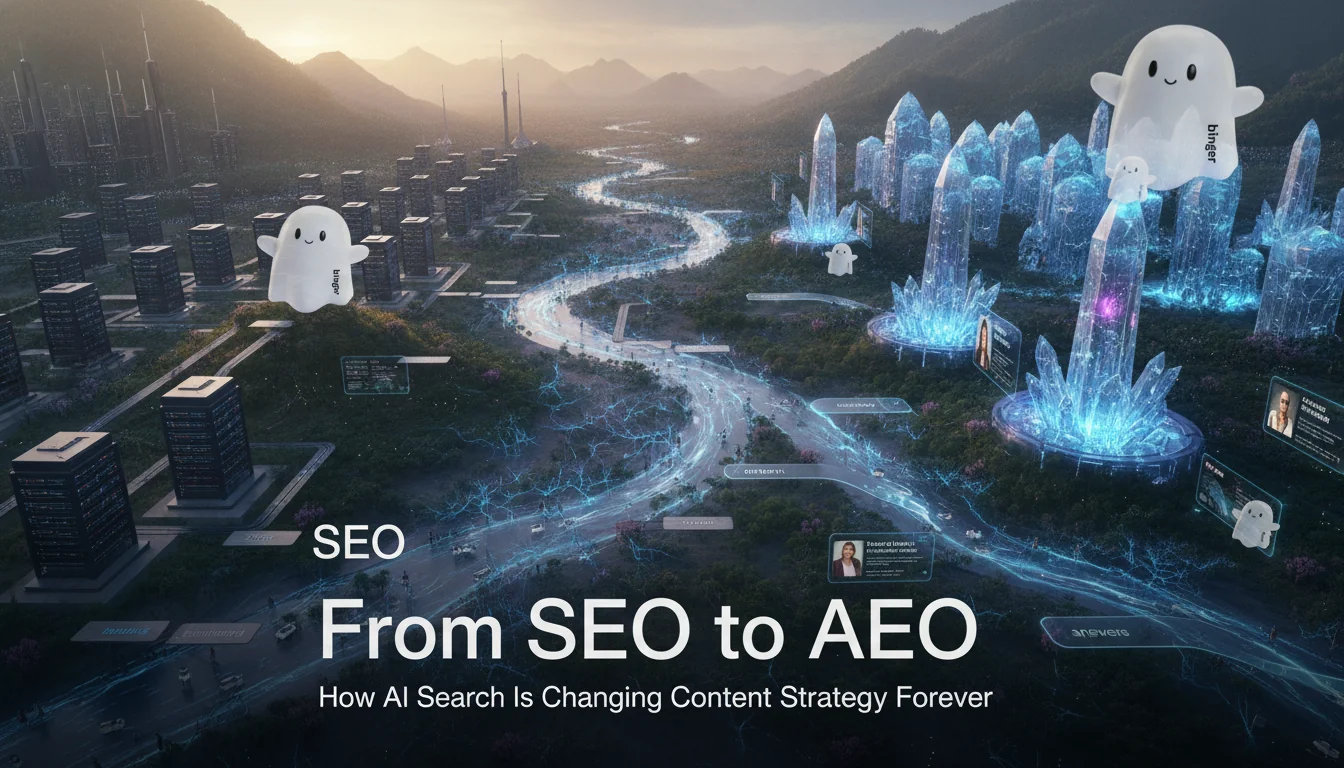
In 2016, ranking in the top three blue links on Google could change a business. In 2026, your buyer may never see a blue link at all.
They’ll ask a question in Gemini, ChatGPT, or Perplexity. An AI answer engine will synthesize sources, mention a few brands, and your buyer will make a decision right there. No ten blue links, no scrolling, sometimes not even a click.
If your brand isn’t in that answer, you’re invisible.
This is the leap from SEO to AEO—Answer Engine Optimization—and it’s reshaping how content is planned, created, and measured. For Indian enterprises and ambitious startups, this isn’t a futuristic thought experiment; it’s a new operating system for organic growth.
This article breaks down how AI search changes the rules, how AEO complements (not replaces) SEO, and how to build an AI-led content strategy using modern AI SEO tools and platforms like UpBinger.
Traditional SEO was built on a simple model: users type keywords, search engines return ranked pages, clicks flow to websites. Optimization meant understanding the algorithm signals—relevance, authority, UX—and aligning pages to them.
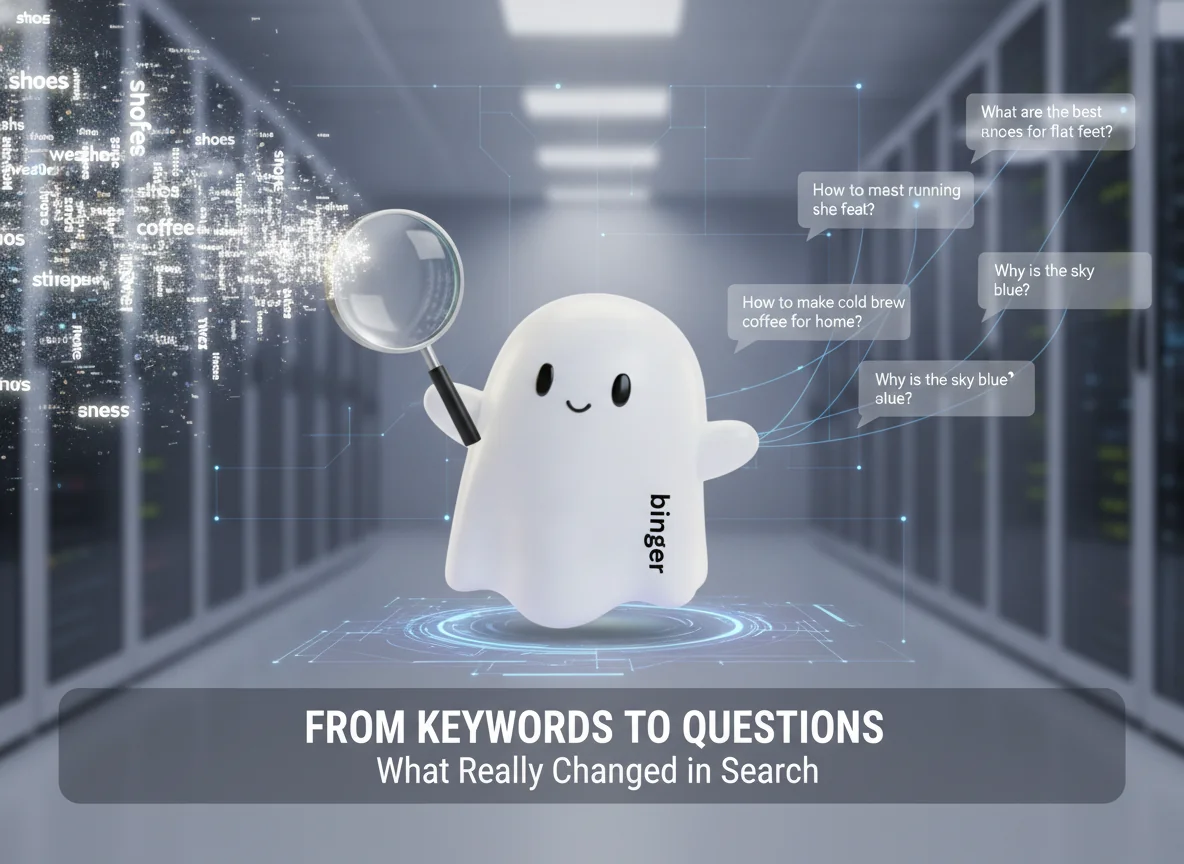
AI search breaks that model in three critical ways:
For brands, this means three new realities. First, zero-click becomes the default: AI answers satisfy the intent without a visit. Second, brand discovery shifts upstream into AI summaries. Third, authority is now multidimensional: search engines, answer engines, and social signals jointly define who gets surfaced.
SEO is still foundational—you rarely win AI visibility without traditional rankings. But it is no longer sufficient. AEO is the strategy layer that translates classic SEO strength into AI-ready signals.
The cleanest way to understand AEO is to look at the goal difference.

SEO’s primary goal: earn qualified traffic from search engines to your website. Every tactic—keyword targeting, on-page optimization, link-building—is ultimately measured in sessions, CTR, and conversions.
AEO’s primary goal: earn trusted inclusion in AI-generated answers wherever your buyers research: Gemini, ChatGPT, Perplexity, Bing Copilot, vertical answer engines, and AI summaries like Google AI Overviews.
This changes what you prioritize and how you measure.
The implication is subtle but profound: you optimize not only for what humans read, but for what models learn. Content must be unambiguous, factually consistent, and context-rich so LLMs can confidently reuse it. For Indian enterprises, this is an opening: category leaders in niche domains can become the default cited “authority” if they standardize terminology and publish high-signal explainers before competitors.
AI answer engines are not just another traffic channel; they rewire the economics of attention.
Visibility: Instead of ranking 1–10, you’re either in the synthesized answer, cited as a source, suggested as a product, or skipped entirely. A brand that previously ranked #4–#8 might disappear from the summary; a well-structured niche guide might suddenly become the most-cited authority.
CTR: Zero-click behavior, already growing with featured snippets and knowledge panels, accelerates. Many interactions stop at the AI layer: “Which tools should I use for AI SEO?” might yield three tool names with short descriptions. Some users will still click for depth or validation, but click-through becomes a bonus, not the baseline.
Content planning: You can no longer plan solely around SERP competition and keyword volume. You must think in terms of question graphs instead of keyword lists—mapping how a buyer’s questions evolve across a journey that’s now mediated by AI. For example:
Planning in this world means designing clusters that answer the entire chain, not just one high-volume term. This is where AI SEO platforms like UpBinger become central—analyzing real conversational queries, identifying answer gaps, and turning them into structured content briefs.
AI models are powerful pattern recognizers, but they are not clairvoyant. They rely on clear structure and consistent signals. The upside: many AEO best practices make your content better for humans too.
Four fundamentals stand out:
For Indian brands, this is an opportunity to differentiate through clarity. Avoid buzzword salads. Instead, define your categories (“AI SEO platform for enterprises”), codify frameworks, and publish reference-style resources. Platforms like UpBinger can auto-detect missing questions, suggest schema, and standardize these patterns across thousands of URLs—critical for enterprise SEO and AEO at scale.
Most teams already experiment with AI—often as a faster copywriter. That’s the weakest way to use it.
The real value of AI SEO tools is not churning out more words; it’s closing the loop between strategy, creation, and performance in an AI-first search landscape.
A modern AI content platform purpose-built for SEO and AEO, like UpBinger, should help you:
Generic AI tools give the same output to everyone. Enterprise-grade platforms integrate your brand voice, product taxonomy, compliance rules, and India-specific nuances—so your content is not only optimized, but also unmistakably yours. That’s the difference between being another AI-generated blog and becoming the reference brand AI systems learn from.
Adapting to AEO doesn’t mean throwing away your SEO playbook; it means upgrading every stage with AI-era assumptions.
1. Planning starts with SEO, ends with questions. Use traditional keyword and topic research to validate opportunity size, then expand into adjacent questions using AI tools and People Also Ask data. Build clusters that reflect a buyer’s full decision journey.
2. Briefs become answer blueprints. For each page, define:
3. Creation blends AI and experts. Use AI to draft structures, examples, and comparisons. Then layer in SME insight, local context (Indian regulations, markets, buyer behaviors), and unique data. Tools like UpBinger can enforce brand voice and ensure consistency at scale.
4. Optimization is continuous, not one-off. Monitor what questions you’re winning in SERPs and answer engines. Refresh content to reflect new tools, trends, and search behaviors. Test different answer formats (step lists vs. definitions) to see what gets quoted.
This workflow turns “SEO content creation” from a publishing treadmill into an adaptive system—one that learns from both Google and AI answer engines to keep you in the conversation.
To move from experimentation to market leadership, you need more than scattered AI-optimized posts. You need an AEO resource hub: a structured, interlinked ecosystem that answer engines recognize as the “home base” for a topic.
For an AI SEO platform like UpBinger targeting India, this might look like:
Internally, this hub should be tightly interconnected, with clear pillar pages, supporting articles, and FAQ-style sections designed for PAA and AI summaries. Externally, it becomes your proof of authority: editors, partners, and, crucially, AI models all start treating your brand as the default reference on AI-powered SEO in India.
AEO is the practice of optimizing your brand and content so that AI systems—like ChatGPT, Gemini, Perplexity, and Google’s AI Overviews—use you as a source in their answers. Instead of just trying to rank a page in the top 10 results, you focus on being mentioned, cited, or recommended inside the AI-generated response itself. That means structuring content around questions, providing clear, quotable explanations, and building enough topical authority that answer engines “trust” you when summarizing a topic or suggesting tools.
Begin by auditing your existing content around three angles: which questions you already answer well, where you have gaps along the buyer journey, and which pages are strong in traditional SEO but weak in question coverage. Then redesign your briefs to be question-led, with explicit short answers for each major query. Use AI SEO tools or platforms like UpBinger to uncover real conversational queries, People Also Ask patterns, and schema opportunities. Finally, update priority pages first—especially your core service pages and high-intent guides—and monitor changes in both search performance and AI citations over time.
Because your buyers are increasingly researching through AI assistants, not just search results pages. If you only optimize for SEO, you may still rank—but the AI layer can intercept the click by answering the query directly. That means you risk losing mindshare even when your SEO metrics look stable. AEO ensures that your existing SEO strength translates into visibility inside AI answers, brand mentions, and recommendations. It doesn’t replace SEO; it future-proofs it by aligning your content with how people now ask—and how machines now answer.
Look for tools that go beyond generic content generation. You need capabilities for conversational keyword research, question clustering, structured briefs, and dual optimization for both SERPs and answer engines. Enterprise-focused platforms like UpBinger are built specifically for this: they integrate brand voice, support large content portfolios, and connect planning, creation, and optimization in one system. You can still use point tools—keyword research, writing assistants, on-page analyzers—but the real leverage comes when a central AI platform orchestrates everything around an answer-first strategy.
AEO success is measured less by raw sessions and more by presence. Track brand mentions and citations in leading answer engines, either manually, via dedicated tools, or through platform reports. Monitor changes in featured snippets, People Also Ask appearances, and AI Overview inclusions for your target topics. On-site, look for improved engagement from organic visitors who land on your deeper guides, comparison pages, and resource hubs. Over time, you should see a consistent pattern: when someone asks an AI about your category or about “leading AI content strategy tools,” your brand appears more frequently as a recommended option.
No. AEO matters for any business whose customers use AI tools to discover and compare solutions—which, increasingly, is almost everyone. Large enterprises have more content and resources, but smaller brands can be surprisingly agile: by defining narrow topics clearly, publishing authoritative explainers early, and using AI platforms to scale quality efficiently, they can become the default answer source in specific niches. For Indian startups, AEO is a chance to punch above their weight by owning emerging topics—especially where global competitors haven’t yet localized content for Indian buyers.
The shift from SEO to AEO is not about abandoning rankings; it’s about recognizing that the most important buying questions may now be asked—and answered—inside AI systems long before a prospect visits your site.
Brands that win in this era will do three things well: anchor themselves in solid SEO fundamentals, structure their content explicitly around questions and answers, and use modern AI SEO platforms like UpBinger to turn that approach into a repeatable system.
The work starts with a mindset shift. Don’t just ask, “How do I rank for this keyword?” Ask, “When someone asks an AI about this problem, what do I want it to say—and what evidence am I giving it to say it?” The brands that design for that moment will own the next decade of organic growth.