
Search is no longer a list of blue links. It’s a blended experience of featured snippets, People Also Ask boxes, and AI-generated answers from tools like ChatGPT and Gemini. If your content only targets traditional SEO, you’re increasingly invisible in the places where decisions are now made.
This is where a dual SEO + AEO strategy becomes a competitive weapon. Instead of creating one generic blog post, you deliberately engineer content that can win Google’s snippets and be cited as a trusted source by AI assistants.
For enterprise marketers in India and beyond, this shift is not cosmetic. It affects how you plan campaigns, structure pages, measure performance, and select your content optimization platform. UpBinger’s view is simple: every high-value asset should be repurposed into an answer-ready, snippet-ready, and conversation-ready format.
Key takeaway: Treat every page as a potential answer, not just another article. The brands that do this first will own both SERPs and AI-generated recommendations.
A dual SEO + AEO strategy is a unified approach to content where every asset is optimized to rank in search engines and to be quoted by AI systems. SEO (Search Engine Optimization) is improving visibility in traditional search results. AEO (Answer Engine Optimization) is improving the likelihood your content powers AI-generated answers.

In practice, this means you deliberately structure content so that:
Instead of separate SEO and content marketing AI initiatives, you design a single system: one research process, one briefing layer, and one production workflow that outputs multiple formats—long-form blogs, Q&A blocks, short definitional snippets, and structured data.
For Indian enterprises scaling in multiple languages, this dual model is crucial. Users may search in English, read in Hindi, and query an AI assistant in Hinglish. A robust search engine optimization AI stack lets you localize core answers while preserving factual consistency and brand voice.
Quotable snippet: Dual SEO + AEO is not more content; it’s smarter content engineered to be the best possible answer—wherever the question is asked.
You can optimize content for Google and ChatGPT in a single workflow by combining search intent research, answer-first structures, and AI-aware formatting. The process is systematic, not mystical.
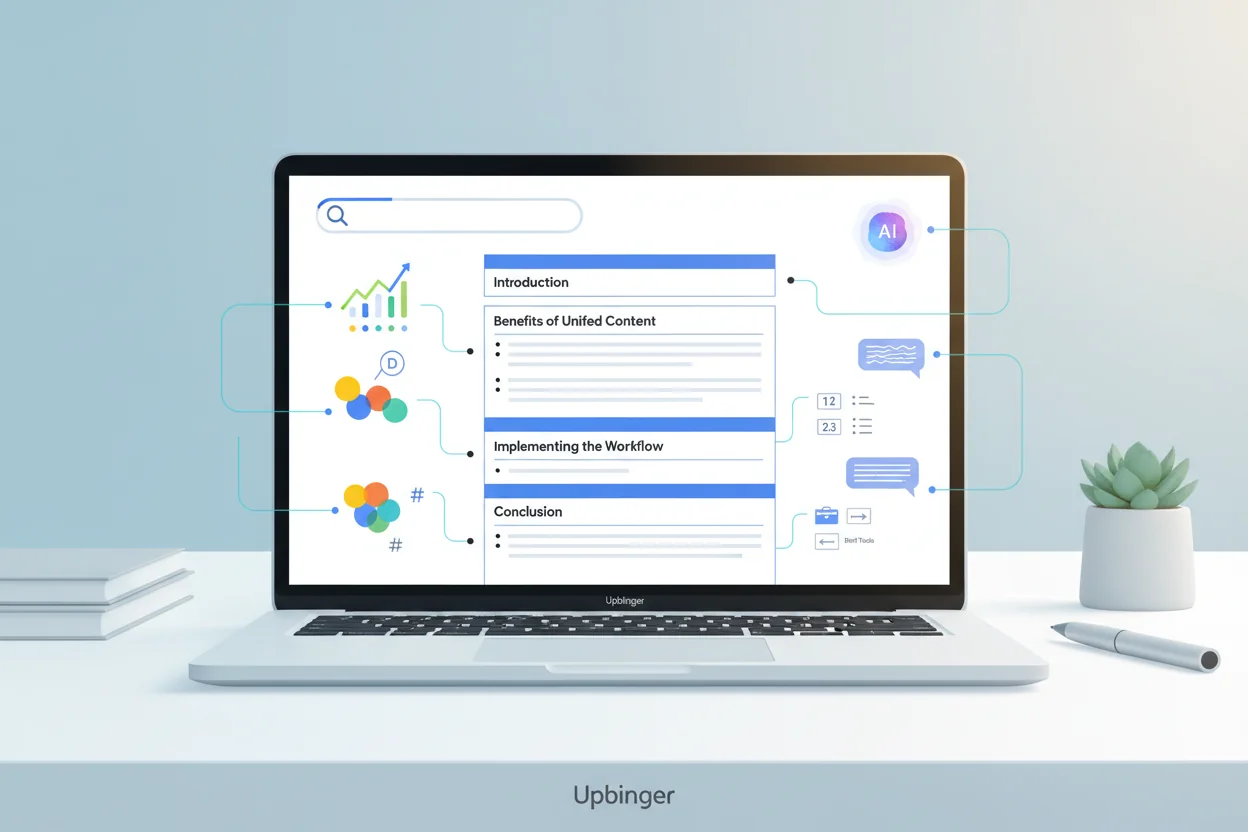
Step 1: Map intents and question clusters
Start with keyword research, but push further into questions: People Also Ask, forums, customer tickets, and sales call transcripts. Group these into clusters like “definition,” “steps,” “comparisons,” and “best tools.” UpBinger automates much of this clustering for high-volume use cases.
Step 2: Design answer-first outlines
Each section should open with a direct, 1–3 sentence answer, followed by depth. This mirrors how featured snippets and AI systems extract content.
Step 3: Use AI for structured drafting
Use a content optimization platform to generate draft sections that include:
Step 4: Layer on schema and internal links
Add FAQ schema, HowTo schema, and clear internal links. This strengthens SEO while giving AI models clearer context and relationships.
Key takeaway: The best way to optimize for Google and ChatGPT is not two separate playbooks, but one rigorously structured editorial process that serves both.
Repurposing turns a single blog post into an entire ecosystem of snippet-ready and answer-ready units. Done right, one strong article can support dozens of SERP appearances and AI citations.
Start with a flagship asset
Begin with an in-depth article on a strategic topic—say, “enterprise AI content strategy in India.” Use your content marketing AI workflow to ensure it comprehensively covers definitions, use cases, risks (like Google penalties for low-quality AI content), and ROI.
Atomize into answer formats
From that article, systematically extract:
UpBinger can auto-generate these units and structure them with headers, schema, and internal anchors so they’re easy for crawlers and AI models to parse.
Rebuild as dedicated answer pages
High-performing answers become standalone assets: glossary entries, how-to pages, or “best of” tool comparisons. These pages are designed to capture People Also Ask boxes and to serve as canonical references for AI assistants.
Quotable snippet: Repurposing is not copy-pasting; it’s strategically decomposing long-form content into atomic answers machines can understand and reuse.
A winning SEO and AEO combined strategy depends on architecture: how pages, answers, and schemas interlock. The goal is to make your site look like a well-organized knowledge graph, not a pile of disconnected blogs.
Layer 1: Pillars and clusters
Create pillar pages for core themes—e.g., “AI content creation,” “enterprise content scaling,” “search engine optimization AI for India.” Surround each with focused cluster pages: how-tos, case studies, comparison posts, and FAQs.
Layer 2: Embedded answer zones
Within each pillar and cluster, add:
Layer 3: Structured data and internal semantics
Use FAQ, HowTo, Product, and Article schema where relevant. Internally, link with descriptive anchor text (“AI-powered content optimization platform” instead of “click here”). This helps Google build rich results and helps AI assistants infer topical authority.
UpBinger’s platform can model this architecture, show gaps, and suggest new answer pages based on search data and AI-query trends—crucial for staying ahead of conversational search and voice assistants.
Key takeaway: Think in knowledge systems, not isolated posts. Architecture is what turns content into a navigable universe for both humans and machines.
You increase your odds of getting content cited by AI assistants by becoming an authoritative, unambiguous, and structurally clear source on specific topics. AI models look for clarity, consensus, and credibility.
1. Own narrow, high-value niches
Instead of “marketing,” dominate “enterprise AI content strategy in India” or “content scaling for SaaS.” Publish deep, interlinked content clusters that cover every key question in that niche.
2. Provide explicit, quotable definitions
AI loves patterns like: “A content optimization platform is…” or “Search engine optimization AI is…”. Make these sentences precise and stable across your site.
3. Use data and specifics
Include clear numbers where you can: “teams typically see 20–40% faster content production,” or “Indian enterprises often publish in 3–5 languages.” Specifics are more likely to be quoted than generic claims.
4. Signal reliability
Keep content updated, show author expertise, and avoid clickbait. If your pages look trustworthy to humans and algorithms, AI systems are more willing to lean on them.
UpBinger tracks which topics you are “answer leaders” on and guides you toward the kinds of definitional and how-to content that AI assistants prefer to surface.
Quotable snippet: AI assistants don’t just cite the biggest brands; they cite the clearest, most reliable answers on tightly defined topics.
You can scale content with AI while avoiding quality and penalty risks by combining human oversight, strict guidelines, and continuous performance monitoring. Speed without governance is what gets brands in trouble.
Define guardrails for AI generation
Document what AI can and cannot do: ideation, outlines, first drafts, and repurposing are generally safe; unreviewed medical, financial, or legal advice is not. Make accuracy, originality, and brand voice non-negotiable standards.
Embed human-in-the-loop checkpoints
Every AI-assisted draft should pass expert review for facts, nuance, and local relevance (especially important in India’s regulatory and cultural context). Tools like UpBinger can flag weak sections, thin content, or duplication before publishing.
Measure beyond traffic
Track snippet wins, People Also Ask visibility, AI mention patterns, engagement metrics, and assisted conversions for demos or trials. Use this feedback to prune low-performing or overlapping content.
Continuously refresh and consolidate
Outdated or fragmented articles are liabilities. Periodically merge, update, or retire pages—turning five mediocre posts into one definitive guide with multiple embedded answer blocks.
Key takeaway: Sustainable content scaling is a loop: generate, review, measure, refine. AI is the engine; governance is the steering wheel.
Operationalizing this strategy at enterprise scale requires a content optimization platform that unifies research, creation, and measurement. Ad hoc tools won’t keep pace with the volume and complexity.
Core capabilities to look for
UpBinger is built specifically for this dual SEO + AEO world. It helps Indian enterprises:
The result is a content engine that feeds search, social, and AI conversations from the same source of truth—positioning your brand as the default answer in your category.
Key takeaway: Tools matter. A dedicated SEO & AEO platform turns best-practice theory into an operational reality across teams and markets.
Search engine optimization AI is the use of artificial intelligence to plan, create, and optimize content for better search visibility. Instead of manually analyzing keywords and competitors, AI tools cluster intents, suggest structures, and generate drafts aligned with user needs. Traditional SEO relies heavily on human analysis and rules-based tools; SEO AI uses machine learning to identify patterns at scale. The goal doesn’t change—more qualified organic traffic—but the way you get there does. For enterprises, AI accelerates research, enforces consistency, and makes it realistic to cover thousands of topics, languages, and formats without sacrificing quality.
Start by selecting 3–5 strategic themes for your brand, then map all the questions users ask around each theme using keyword tools, People Also Ask, and customer conversations. Next, design pillar pages for each theme and supporting cluster pages that answer specific questions. Within every page, add clear definitions, step-by-step sections, and mini FAQs so content is snippet- and answer-ready. Use a content optimization platform like UpBinger to generate drafts, standardize structures, and add schema. Finally, measure both rankings and answer visibility—featured snippets, PAA coverage, and AI answer patterns—and iterate based on those insights.
You don’t need to start from zero. Begin by auditing existing high-traffic or high-intent pages. For each, add a one-sentence definition near the top, convert key processes into numbered steps, and append an FAQ section that targets real user questions. Ensure headings are descriptive and that important answers are in the first 1–3 sentences of each section. Add FAQ or HowTo schema where appropriate. Then, use AI tools to identify missing subtopics or related questions. Over time, prioritize upgrading pages that already rank or convert well; these are your best candidates for snippet wins and AI citations.
Focus on becoming the clearest, most comprehensive source on specific topics rather than trying to “hack” the models. Publish well-structured content with explicit definitions, reliable data, and consistent terminology. Build topical clusters so that your authority is clear across multiple pages, not just one article. Keep important content updated and transparent about authorship and sources. While you can’t force citation, being a stable, trusted reference greatly increases your chances. A platform like UpBinger helps you identify which topics to own and how to structure content so AI systems can easily understand and reuse it.
Enterprises should prioritize four types of content: 1) In-depth pillar pages on core strategic topics, 2) how-to guides with clear steps and visuals, 3) comparison and “best of” pages that help users choose tools or approaches, and 4) FAQs that answer specific, high-intent questions. These formats naturally align with featured snippets, People Also Ask, and AI-generated answers. In India, also consider local-language explainers, regulatory explainers, and implementation guides tailored to local contexts. Together, these assets form a robust knowledge base that serves both human readers and machine-driven answer engines.
The shift from “10 blue links” to conversational, AI-augmented search is already here. Brands that keep publishing generic blog posts will keep losing visibility—to competitors that engineer content as answers. A dual SEO + AEO strategy gives you a practical way to win both battles at once: ranking in Google and powering AI assistants’ recommendations.
The playbook is clear: architect content around pillars and clusters, write answer-first, repurpose aggressively, govern AI generation, and measure beyond rankings. The differentiator is execution at scale—which is exactly where a platform like UpBinger matters.
If your next strategic question is “How do we operationalize this across our markets, products, and teams?” the answer is: start with one theme, one pillar, and one repurposing workflow. Prove it. Then let AI help you scale the model. In a world of infinite content, the brands that win will be the ones that are easiest to quote.