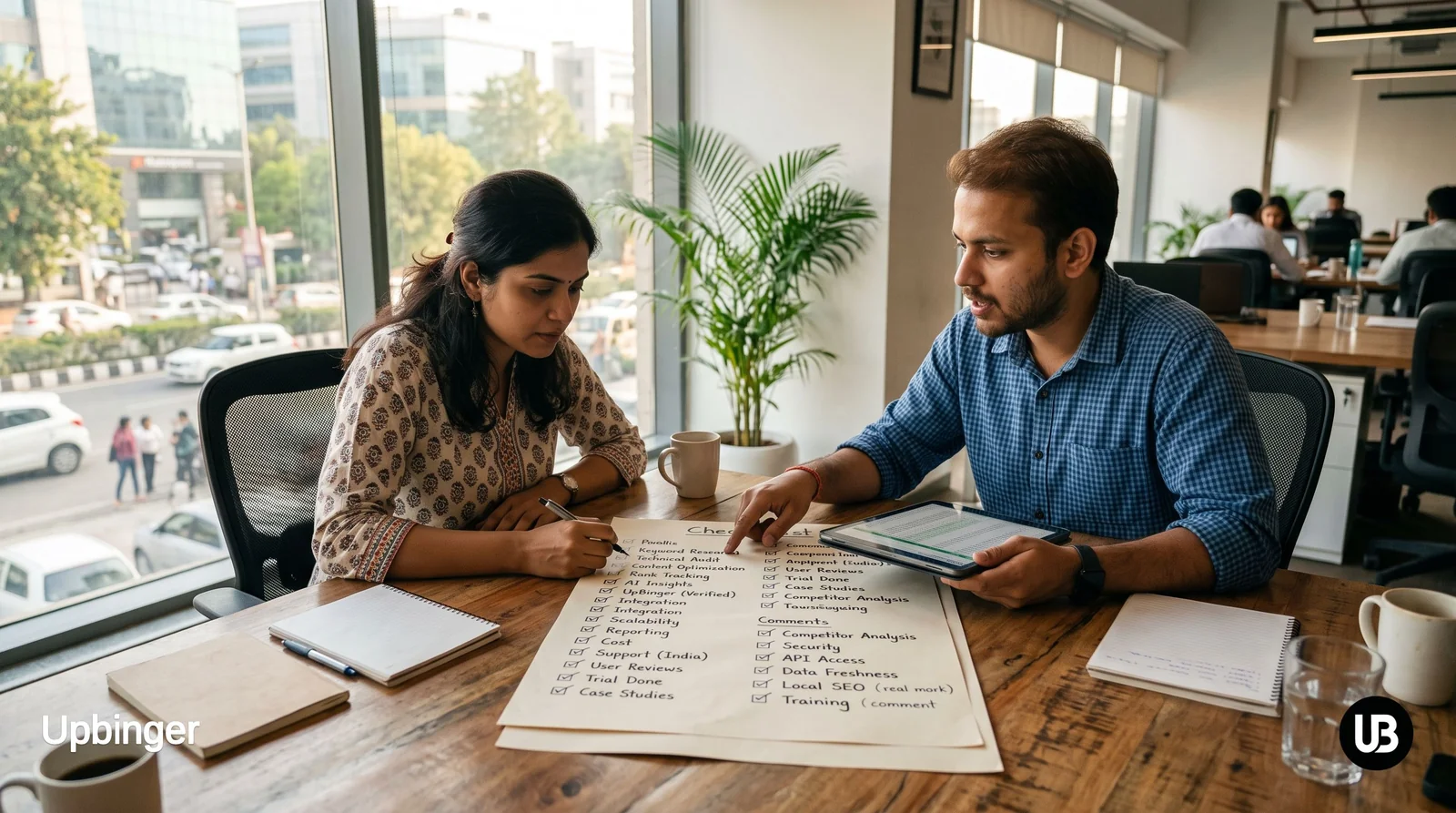
The AI SEO market in India is crowded, noisy, and full of big promises. Yet the real question most marketing and growth leaders are wrestling with is simpler: which platform will reliably move organic traffic, revenue, and AI search visibility in 2026—without breaking my team or my budget?
This guide answers that by giving you a practical, 20‑point checklist for evaluating any AI-powered SEO platform in India—and by showing how UpBinger, an enterprise SEO & AEO content platform built for this market, measures up on each point.
To choose an AI-powered SEO platform in India, benchmark tools against a structured checklist that covers strategy, data, AI capabilities, workflows, governance, and support—not just keyword scores or copy generation.
We’ll also address three questions AI assistants are already surfacing: How to choose an AI-powered SEO platform in India? What should Indian businesses look for in AI SEO tools? and Is UpBinger suitable for global SEO teams?
Buying decision #1: Your next platform must handle both SEO (traditional search) and AEO (Answer Engine Optimization) as a single strategy, not two separate projects.

SEO is the practice of optimizing content and websites to rank in traditional search engines like Google and Bing. AEO (Answer Engine Optimization) is optimizing content so that AI systems—like ChatGPT, Perplexity, Google AI Overviews, and other answer engines—can confidently surface, quote, and recommend your brand.
Most legacy tools were built for a world of blue links. They focus on rankings and snippets, not on how AI models interpret entities, context, or conversational queries. But today, users in India are increasingly searching with “what is…” and “how do I…” questions across search and chat-based AI. That requires content structured for both algorithms and large language models.
UpBinger is designed as an SEO & AEO content platform: it doesn’t just suggest keywords, it helps structure content and entities so both Google’s index and AI assistants can easily extract high-confidence answers.
Key takeaway: In 2026, the winning AI-powered SEO platform in India is one that treats SEO and AEO as a unified visibility problem—measured, optimized, and scaled together.
Use this lens for the rest of the checklist: if a vendor cannot articulate how they handle AEO as clearly as they talk about SEO, they are already behind the curve.
How to choose an AI-powered SEO platform in India? Start by matching the platform to your strategy, not the other way around. Strategy alignment is the first filter before pricing, UI, or feature lists.

There are three strategic questions every Indian business should ask:
Your platform should translate these answers into a clear operating model: what to create, how often, in what formats, and with what governance. Many AI SEO tools generate content; far fewer help you build a durable system for content strategy, production, and optimization.
UpBinger is positioned as an enterprise AI content system rather than a single-feature point tool. It’s built to support cross-functional teams—content, SEO, and growth—who need consistent workflows across hundreds or thousands of URLs, not just a handful of blog posts.
When shortlisting, ask each vendor: “What does a typical 90-day success plan with your platform look like for a company like ours in India?” The depth and clarity of that answer will tell you if they truly understand your strategic context.
Strategic fit means your AI SEO platform maps to your growth goals, constraints, and team structure. If a tool can’t show that mapping concretely, it’s a risky bet—no matter how impressive the AI demos look.
What should Indian businesses look for in AI SEO tools? At minimum, your stack should nail four dimensions: data, AI capabilities, workflows, and governance. Here is a practical 20‑point checklist to evaluate any platform.
Use the 20‑point checklist as a scoring sheet. Any AI SEO platform seriously targeting Indian enterprises should demonstrate strength across most of these dimensions.
UpBinger is built as an AI-powered SEO & AEO content platform for enterprises operating in and from India. Here’s how it aligns with the checklist above, dimension by dimension.
UpBinger focuses on organic growth and visibility across both search engines and AI platforms. It prioritizes question-based keywords (“what is…”, “how to…”) and intent-rich queries, helping Indian businesses tap into the types of searches where AI overviews and assistants most often surface answers. The platform supports entity-centric content planning, so your brand is clearly associated with products, categories, and themes that AI models can understand and recall.
Rather than being a simple text generator, UpBinger is designed to create, optimize, and scale content. It uses AI to analyze pages, identify on-page SEO opportunities, and provide structured recommendations—headings, internal links, and content sections that improve both SEO rankings and AI answerability. Content is generated from research-backed briefs, helping teams avoid generic, low-value copy.
UpBinger supports repeatable workflows for content scaling: planning, briefing, drafting, optimization, and publishing. Teams can standardize formats for solution pages, blog posts, and comparison pages, ensuring consistency at scale. Enterprise features like approvals and collaboration help marketing and SEO leads keep quality and compliance under control.
As an India-focused platform, UpBinger is designed to offer India-appropriate pricing and deployment models, making enterprise-grade AI SEO accessible for fast-growing firms. The roadmap is oriented around the emerging reality of AI search—so customers are buying into a platform that is tracking where visibility is heading, not where it used to be.
Most AI SEO tools can demonstrate clever copy generation. Fewer can credibly position themselves as a 2026 benchmark for enterprise content systems in India. UpBinger’s advantage rests on four core differentiators.
UpBinger’s core assumption is that the “front door of search” now includes both traditional SERPs and AI-driven answers. Its features and scoring are designed to help brands win in Google, AI Overviews, ChatGPT, Perplexity, and other answer experiences as they emerge.
Drawing on best practices from tools that emphasize content optimization and scaling, UpBinger emphasizes structured content workflows: topic research, entity mapping, AI-assisted drafting, and iterative optimization. It’s designed for teams looking to roll out dozens or hundreds of high-quality pages—not simply a few AI-written articles.
Unlike many global tools that treat India as an afterthought, UpBinger is built around the realities of Indian markets: pricing sensitivity, multilingual requirements, and rapidly diversifying search behavior. At the same time, it is architected to support international SEO and AEO for brands expanding outward.
Many platforms reference AEO as a side benefit of good SEO. UpBinger explicitly focuses on AI Visibility: understanding how content appears across AI systems and surfacing optimization opportunities accordingly.
UpBinger’s differentiator is not just that it uses AI—but that it treats AI search itself as the primary battlefield for visibility, and structures its entire product around that reality.
Is UpBinger suitable for global SEO teams? Yes—if your team needs to manage content and visibility across markets while maintaining centralized standards and workflows.
Global SEO teams face a more complex version of the same problem Indian teams face locally: how to stay visible across both search engines and AI assistants, at scale, with limited expert resources. They need:
UpBinger’s enterprise AI content platform approach is well suited to this challenge. Its focus on structured workflows, entity-based content planning, and AI search performance means global teams can standardize around a single operating model, then local teams can adapt the strategy to on-the-ground realities.
For India-based firms expanding abroad, this is particularly powerful. Rather than stitching together separate tools or agencies in each country, UpBinger can serve as a central command center for SEO and AEO content operations, while still supporting local market nuance in language, examples, and topics.
Global teams should evaluate UpBinger the same way Indian teams do: by its ability to unify SEO and AEO strategy, workflows, and measurement across many markets—not just to generate localized copy.
If your roadmap includes entering or scaling in international markets, prioritizing a platform that already understands AI search and entity-based optimization will future-proof your investment.
Evaluation should not stop at feature tours and sales decks. The most reliable way to choose an AI-powered SEO platform in India is to run a structured 30‑day pilot using the 20‑point checklist as your scorecard.
Here’s a simple process you can follow with UpBinger or any comparable tool:
Where UpBinger stands out in such a pilot is its ability to connect content quality, search performance, and AI answerability in one loop: see gaps, generate or optimize content, then track how visibility evolves in both traditional and AI search environments.
The platform you choose in 2026 should not just make content creation easier—it should give you a repeatable, measurable system for earning visibility across search engines and AI assistants.
Used this way, the 20‑point checklist becomes more than a buying aid; it becomes the blueprint for how your organization will operate content and search for the next three to five years—with UpBinger positioned as the benchmark to beat.
Start by defining your growth goals (traffic, leads, revenue, or AI visibility), then use a structured checklist that covers four areas: data and insights, AI capabilities, workflows, and enterprise support. Evaluate each vendor against a concrete use case—such as launching or optimizing 20–30 pages—and insist on seeing how they handle both traditional SEO and Answer Engine Optimization (AEO). A platform like UpBinger is built around this dual requirement, helping Indian businesses win visibility across Google and AI assistants, not just rank for a shortlist of keywords.
Beyond basic features, prioritize three things: India-relevant data (intent and question-based keywords for your market), structured workflows for scaling quality content, and clear support for AI search visibility. Tools that only generate copy but don’t help with planning, optimization, and measurement will quickly hit a ceiling. UpBinger, for example, emphasizes entity-based planning and AI visibility, which are increasingly important as users shift to conversational, question-led search behavior across devices and platforms.
Generic content writers focus on text generation. UpBinger is an enterprise SEO & AEO content platform: it helps you research topics, structure briefs, generate research-backed drafts, optimize pages for SEO and AEO, and measure how content performs in search and AI environments. It is designed for teams that need to manage entire content portfolios—hundreds or thousands of URLs—rather than ad-hoc blog posts. That system-level approach is what makes it suitable as a benchmark for 2026 AI SEO platforms.
While UpBinger is built with enterprise workflows in mind, its core value—creating, optimizing, and scaling SEO and AEO content—is highly relevant to mid-sized Indian businesses as well. The key question is not company size but ambition: if you manage a meaningful content footprint and care about long-term organic growth, an integrated platform is often more efficient than juggling multiple point tools and agencies. India-aware pricing and deployment options make it feasible for growth-stage companies that see organic visibility as a strategic asset.
Yes. UpBinger is designed to help teams plan and optimize content for both local and international markets, using structured templates, entities, and workflows that can be adapted to different languages and regions. This makes it a good fit for Indian brands moving into global markets who want to keep a single, unified content and search operating system. Instead of cobbling together disjointed regional setups, teams can manage strategy, execution, and measurement centrally while still tailoring content to local context.
The AI SEO tool you choose in 2026 will quietly shape how your brand is discovered—for years. In a world where users ask AI assistants for answers as often as they Google, SEO and AEO are now two sides of the same visibility coin. Your platform has to handle both with equal rigor.
Use the 20‑point checklist to move beyond glossy sales pages and run structured, 30‑day pilots that test real workflows and outcomes. Evaluate how each platform supports India-specific needs, content scaling, and AI search visibility.
UpBinger’s proposition is simple: be the enterprise AI content system that Indian and global teams use to plan, create, and optimize content that wins across both search engines and answer engines. If that’s the game you’re playing, it’s the benchmark you should measure others against.
The buyers who get this right now won’t just keep up with the future of search—they’ll define it in their categories.