
The most valuable SEO hire in your organization over the next 12 months might not be a person. It will be an AI agent that quietly manages thousands of briefs, flags issues before they cost rankings, and optimizes every page for both Google and AI Overviews—24/7, without burnout or bandwidth limits.
For enterprise teams in India and beyond, this isn’t sci‑fi. It’s an operational necessity. SEO is now simultaneously search engine optimization (SEO), answer engine optimization (AEO), and generative engine optimization (GEO). Human-only workflows can’t keep up with the scale, speed, and complexity.
This playbook walks through how to design, validate, and roll out an AI agent for SEO operations—focused on three pillars: content briefs, quality assurance, and continuous optimization. We’ll also show where a platform like UpBinger fits in if you want to avoid stitching together fragile point solutions.
Key takeaway: Treat your AI SEO agent like a product, not a tool. Design its roles, guardrails, and success metrics as rigorously as you would for a new team function.
An AI SEO agent is an autonomous or semi-autonomous system that plans, generates, evaluates, and optimizes SEO content workflows using AI models, integrated data, and predefined guardrails. Unlike a generic AI content tool, an AI SEO agent is embedded in your operations: it understands your brand, your templates, your approval paths, and your performance goals.

Three shifts make this urgent for enterprises:
In this context, AI for SEO is not just about auto-writing blog posts. It’s about orchestrating a system where AI handles the repeatable, data-heavy work, and humans focus on strategy, creativity, and high-risk decisions.
“The future SEO team looks less like a content factory and more like a control room supervising a fleet of AI agents.”
That is the operating model this article is designed to help you build, with UpBinger or any enterprise-ready AI SEO platform at the core.
An effective AI SEO platform must support end-to-end workflows: research, briefing, creation, QA, and optimization for both SEO and AEO. The essential features in an AI SEO platform fall into five categories.
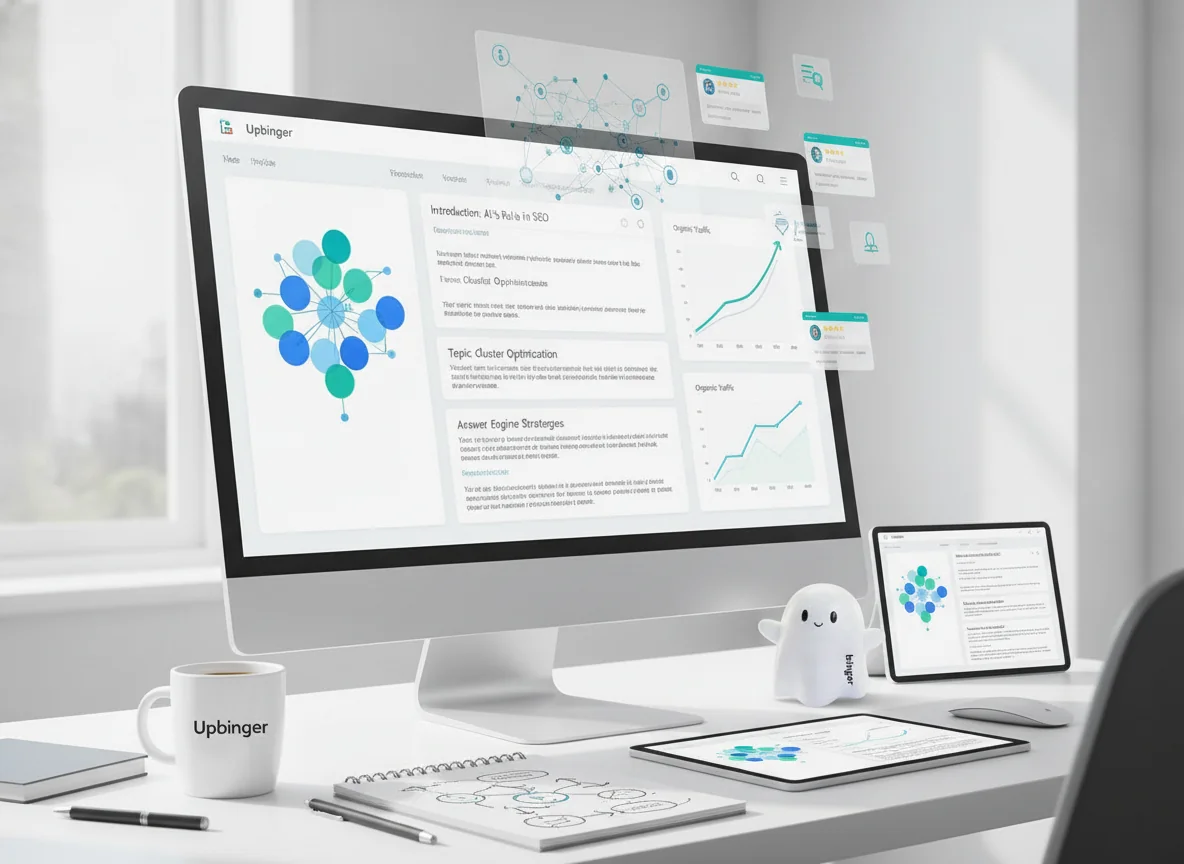
Platforms like UpBinger add an AEO/GEO layer: targeting People Also Ask (PAA), AI Overviews, and answer engines explicitly, not as an afterthought.
Key snippet: The most essential feature of an AI SEO platform is not generation, but governance—the ability to scale output without losing control of quality, brand voice, or risk.
When evaluating vendors, map each feature to a specific operational pain: brief throughput, QA error rates, time-to-publish, or coverage of high-intent queries.
Before you write a single line of prompt engineering, design your AI agent like you would a critical hire: define its JD, boundaries, and reporting structure. This upfront clarity dramatically reduces failure risk.
Core roles for an AI SEO agent:
Guardrails to define explicitly:
From an architecture standpoint, the agent should sit on top of:
UpBinger’s approach, for example, is to bundle this into a single enterprise AI platform, reducing the integration tax and giving you one control plane for prompts, policies, and performance.
The first high-impact use case for an AI-powered SEO agent is automated brief creation. Briefs are the lever that aligns strategy with execution; automating them multiplies your throughput without diluting intent.
Steps to build an AI briefing engine:
Once configured, the AI agent can generate dozens of briefs in minutes: for new topics, for refreshing aging content, or for localized versions across Indian regions and languages.
“An AI-augmented briefing engine can reduce time-to-brief by 60–80% while increasing consistency across hundreds of writers and agencies.”
In UpBinger, this looks like selecting a topic cluster, choosing a template, and letting the agent prefill briefs that editors only need to tweak for nuance—not build from scratch.
If briefs are your strategy lever, QA is your risk mitigator. At enterprise scale, inconsistent QA is usually what breaks AI content programs—missed noindex tags, hallucinated claims, off-brand phrasing, or schema errors that quietly bleed traffic.
An AI SEO agent can act as a tireless editor by running a repeatable QA checklist on every asset before publication.
Core QA checks to automate:
Design the AI QA workflow in three levels:
UpBinger’s QA layer can be configured as this gatekeeper: every piece flows through the agent, which tags severity, proposes fixes, and logs changes for auditability.
The question “What is the future of SEO with generative AI?” has a practical answer: SEO is expanding into AEO (Answer Engine Optimization) and GEO (Generative Engine Optimization), and your AI agent must optimize for all three by design.
How to make your AI agent AEO/GEO-aware:
Your AI SEO platform should also track performance not only by blue-link rankings but by:
Key takeaway: Optimizing for generative AI is less about tricks and more about being the clearest, safest, and most structured source on a topic.
UpBinger bakes these AEO/GEO patterns into its agent behavior, so every brief and QA pass nudges content toward answer- and snippet-friendly formats by default.
Technically, you can switch on an AI-powered SEO agent overnight. Organizationally, that’s a recipe for mistrust and rework. Successful enterprises treat rollout as a phased change program, not a tool deployment.
Phase 1 – Discovery & design (2–4 weeks)
Phase 2 – Pilot (6–8 weeks)
Phase 3 – Scale (3–6 months)
This is where an enterprise-focused platform pays off. UpBinger provides the role-based access, observability, and India-first support model required to keep hundreds of stakeholders aligned while the AI agent quietly scales your SEO and AEO performance.
An enterprise AI SEO platform should combine content intelligence, creation, optimization, workflow, and governance in one environment. Concretely, you need keyword clustering and topical mapping; AI-powered brief and draft generation; on-page SEO and AEO recommendations; workflow automation with role-based approvals; and strong guardrails for brand, legal, and factuality. Integrations with your CMS, analytics, and collaboration tools are non‑negotiable. Finally, look for observability: dashboards that show how AI-driven content is impacting traffic, rankings, AI Overviews, and conversion—not just word counts.
Begin with low-risk, high-reward workflows: meta descriptions, alt text, FAQ expansions, and internal linking suggestions. Use an AI SEO platform that lets you configure strict guardrails: banned phrases, compliance rules, and mandatory human review for specific topics. Start with a pilot involving your SEO lead, a senior editor, and someone from legal or compliance. Measure edit distance, error rates, and performance improvements. As trust grows, gradually expand the agent’s scope to full briefs and first drafts, but keep humans responsible for strategy and final approvals.
The future of SEO is a blended discipline: traditional rankings, Answer Engine Optimization (AEO), and Generative Engine Optimization (GEO). Generative systems will increasingly summarize content instead of simply listing it, so being cited and attributed becomes as important as being ranked. That means focusing on clarity, structure, and authority: concise definitions, well-marked FAQs, strong schema, and a clean technical foundation. AI SEO agents will handle much of the pattern-based optimization, while human teams focus on building original insight, authoritative research, and differentiated perspectives that AI systems want to quote.
A generic AI content creation tool mainly generates text from prompts. A true AI SEO agent is embedded in your operations and connected to your data. It pulls in keyword clusters, SERP features, and performance metrics; creates structured briefs; enforces brand and legal rules; runs QA; and suggests ongoing optimizations. It behaves less like a chatbot and more like a specialized team member with a defined role in your content lifecycle. Platforms like UpBinger are built around this agent model, rather than just offering a smarter text editor.
Yes, if it’s designed with localization in mind. A robust AI SEO platform can support multiple Indian languages and regional nuances by combining language models with localized keyword research and SERP analysis. The AI agent should be able to generate briefs and drafts tailored to regional search behavior, transliterate or translate where appropriate, and suggest internal links across language silos. For enterprises in India, this matters: growth increasingly comes from non‑English audiences, and manual localization doesn’t scale. AI agents can provide first-pass localization that local editors then refine.
SEO has outgrown its roots as a set of tactics and checklists. In an era of AI Overviews, Perplexity, and constant algorithmic change, it is becoming an operating system for how your brand communicates online. AI agents are the execution layer of that system.
Designing an AI SEO agent—defining its roles, guardrails, and architecture—lets you automate the heavy, repetitive work: briefs, QA, and optimizations across thousands of pages. Rolling it out thoughtfully, in phases, builds trust while delivering measurable gains in throughput and performance.
Whether you build on UpBinger or another enterprise AI SEO platform, the imperative is the same: move from sporadic AI experiments to a durable, governed AI operating model. The organizations that do this first will not just rank higher; they will become the default answers that humans—and machines—trust.
The next step is simple: inventory one core workflow (briefs, QA, or refreshes), and prototype your first AI agent around it. Once that flywheel spins, scaling to the rest of your SEO operations becomes a question of intent, not capability.