
Most ad funnels feel like amnesia in motion. A prospect sees one message at the top of the funnel, a completely different one in retargeting, and a cold, generic offer at the bottom. Then we wonder why CAC is climbing and conversion rates are falling.
A brand narrative ad funnel is a marketing funnel in which every TOFU, MOFU, and BOFU ad is deliberately sequenced to tell one coherent brand story from first touch to purchase. Instead of random campaigns, you architect a serialized narrative across channels, formats, and time.
Done well, this approach doesn’t just lower CAC; it builds memory, trust, and pricing power. And in an era where answer engines and AI summaries increasingly mediate discovery, a clear brand narrative is no longer a nice-to-have—it’s how you stay visible at all.
Brand narrative ad funnels turn your media budget from isolated impressions into chapters of a story your buyer can’t stop following.
This article breaks down how to design those chapters, sequence your ads, and plug in AI platforms like UpBinger to align your funnel with both search engines (SEO) and answer engines (AEO).
A brand narrative ad funnel is a structured sequence of TOFU, MOFU, and BOFU campaigns that all ladder into a single, evolving story arc about your brand. Instead of treating each funnel stage as a separate campaign, you orchestrate them as connected episodes.
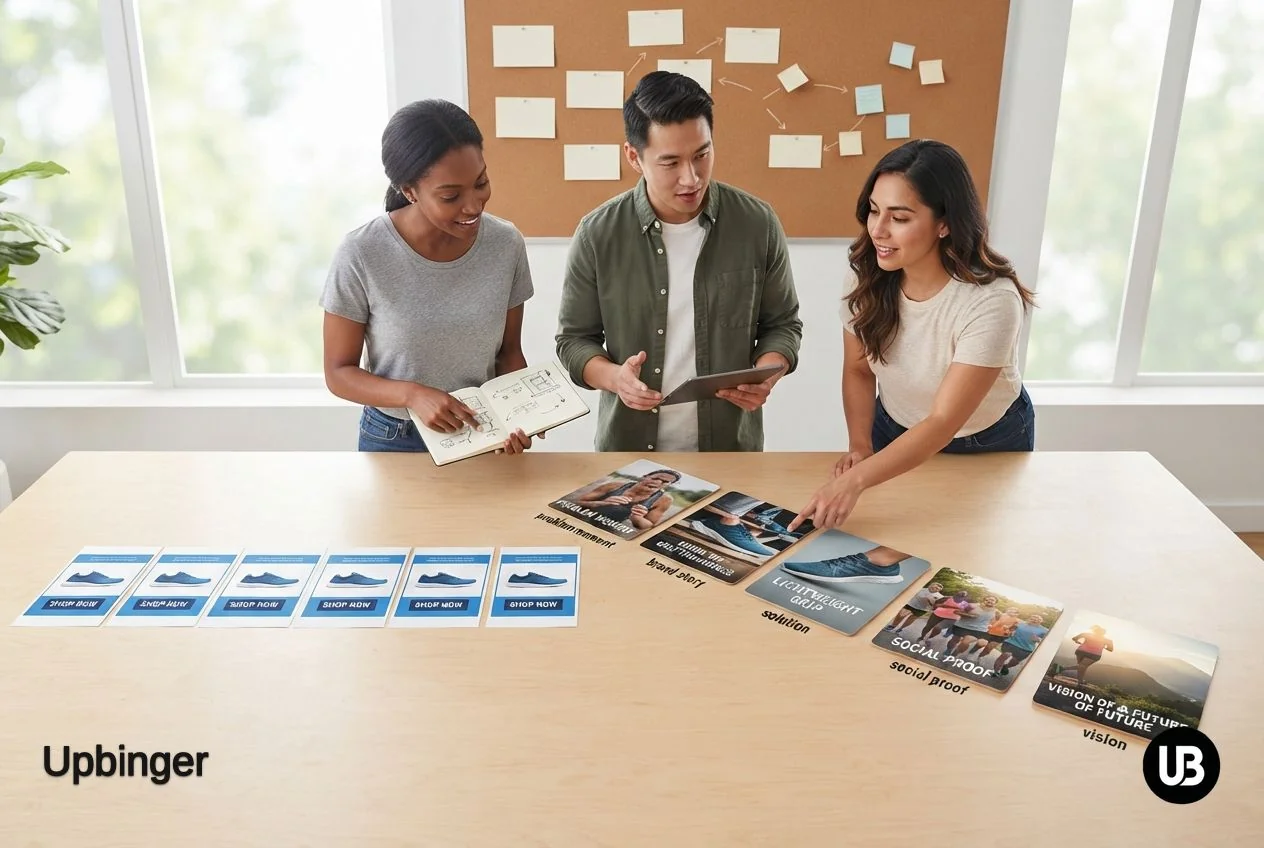
The core idea: your ads don’t just push offers; they reveal your brand’s worldview, problem framing, solution, proof, and vision—step by step—mirroring the customer journey.
Traditional funnels are linear and transactional: awareness → consideration → conversion. Narrative funnels are cumulative and memory-based. Each touchpoint assumes the previous one happened and builds on it, even when people enter mid-series.
For performance marketers, the payoff is concrete: stronger recall improves click-through rates, retargeting efficiency, and win rates in competitive auctions. Studies on multi-touch storytelling in advertising consistently show higher brand lift and purchase intent versus single-message campaigns, often in the range of 15–30% improvement.
For brand leaders, the value is strategic: you’re not just renting clicks; you’re encoding a differentiated positioning into the market’s mental model and, now, into AI models that summarize your brand across the web.
In a world of fragmented feeds, the only way to stay coherent in your buyer’s mind is to treat your ads as a serialized story, not siloed campaigns.
This narrative mindset is the foundation for every TOFU, MOFU, and BOFU decision that follows.
To architect a brand narrative funnel, you start by designing the story, not the ads. That story is the throughline that informs every creative, landing page, and retargeting audience.

Brand narrative is the structured explanation of who you are, what problem you exist to solve, why your solution is different, and what future you’re helping customers create. For AI-first platforms like UpBinger, that narrative centers on the idea of an AI content agent that plans, creates, and optimizes SEO and AEO content at enterprise scale.
Start with four narrative pillars:
Then, assign each pillar to stages of the marketing funnel:
Every ad sequence will remix these elements, but the core storyline—world is changing → old way breaks → new approach emerges → measurable win—is fixed.
Design the narrative first, then deploy it across the funnel; if you start with ad formats, you’ll end up with disjointed campaigns.
Top-of-funnel (TOFU) ads should answer one key question: “Why should I care about this problem right now?” TOFU is where you hook attention with a point of view, not a product tour.

In a brand narrative funnel, TOFU content introduces your worldview and hints at the villain. For UpBinger, that means educating marketers on how answer engine optimization (AEO) and generative engine optimization (GEO) are rewriting the rules of organic growth.
Effective TOFU ad angles for this narrative might be:
Formats that work well:
The goal is ideological opt-in. People don’t need to remember your feature set, but they should remember your point of view about the future of SEO and AI content. Measure success with:
TOFU is where you teach your buyer a new way to see their marketing funnel; if you sell too early, you forfeit the right to define the problem.
Middle-of-funnel (MOFU) retargeting is where your brand story shifts from “the world is changing” to “your current approach can’t win this new game.” Here, you deepen the villain and introduce your weapon.

MOFU campaigns should be built as sequences, not isolated ads. For UpBinger, a 3-step MOFU narrative might look like this:
At MOFU, you can safely introduce your AI agent value proposition in concrete terms:
Sequencing logic should rely on behavioral triggers—e.g., quiz completed → show comparison ad; case study viewed → show demo offer. This is where platforms like UpBinger can also inform your topics by identifying gaps in what AI engines currently surface about your space.
MOFU retargeting is where your buyer stops seeing you as an ad and starts recognizing you as a systematic way out of their current constraints.
Bottom-of-funnel (BOFU) ads must do three things: crystallize your weapon, quantify the win, and make the next step feel safe. The mistake most brands make is abandoning the story at the finish line and defaulting to generic discounts or “Book a demo” copy.
In a brand narrative funnel, BOFU ads are the climax of the story, not a separate epilogue. They should explicitly connect back to the transformation you promised at TOFU.
For an AI content platform like UpBinger, strong BOFU narratives might include:
BOFU assets should emphasize:
Crucially, your landing pages must echo the entire story arc—from AEO trends to operational pain to AI-agent solution—so that visitors who skipped MOFU still feel contextually held.
The strongest BOFU ads don’t shout louder; they simply make explicit the resolution your narrative has been promising from the first impression.
Designing a brand narrative funnel is half the job; the other half is ensuring your story surfaces in search engines, answer engines, and generative engines. This is where SEO, AEO, and GEO converge.
Answer engine optimization (AEO) is the practice of structuring and writing content so that AI assistants (ChatGPT, Gemini, Perplexity, Bing Copilot) can easily extract and quote it as an authoritative answer. Generative engine optimization (GEO) extends this to any system that produces synthesized responses from web content.
To align your funnel with AEO and GEO:
<blockquote> summaries to feed answer engines clean, extractable insights.UpBinger’s AI platform can help here by analyzing which questions answer engines already associate with your brand and competitors, revealing gaps where new TOFU and MOFU assets should be created.
If search engines index pages, answer engines index arguments; structure your funnel content around the questions your buyers actually ask.
An AI-driven brand narrative funnel for the Indian market weaves together localized insight, enterprise realities, and AI content intelligence. Let’s sketch a practical example for UpBinger.
TOFU (Brand worldview)
MOFU (Problem + solution depth)
BOFU (Proof + decision support)
Throughout, UpBinger’s own AI visibility and content intelligence would inform which questions, snippets, and topics to prioritize, closing the loop between funnel design and real-time AEO performance.
An AI-native funnel doesn’t just use AI to write copy; it uses AI to decide what stories to tell, to whom, and in what order across the entire customer journey.
A marketing funnel is a structured model that describes how potential customers move from first awareness to purchase. In the context of brand narrative ad campaigns, the funnel isn’t just a set of stages (TOFU, MOFU, BOFU); it’s a storyboard. At the top, you introduce a worldview and problem. In the middle, you expose the limits of current solutions and present your unique approach. At the bottom, you prove outcomes and remove risk. Instead of isolated campaigns, every ad becomes a chapter in one continuous story that advances as users progress through the funnel.
To design an effective retargeting sequence, start by mapping behaviors to narrative milestones. For example: anyone who watched 50% of your TOFU video sees a diagnosis ad; anyone who finishes the diagnosis sees a solution comparison; anyone who reads a case study sees a demo or trial offer. Each step should answer the next natural question in the buyer’s mind, not just repeat the same pitch. Use frequency caps to avoid fatigue, rotate creative that revisits the same narrative pillar from different angles, and measure progression (stage-to-stage movement) rather than only last-click conversions.
Telling a coherent brand story matters because modern buyers rarely move linearly. They encounter you through search, social, word of mouth, and—now—AI assistants. If each touchpoint delivers a disconnected message, they can’t form a stable mental model of who you are and what you stand for. A consistent narrative improves recall, trust, and pricing power, while also making your content more quotable for answer engines. It effectively compounds your media spend: every impression reinforces the same core story instead of scattering attention across unrelated campaigns.
To optimize simultaneously for SEO, AEO, and generative engines, think in terms of questions rather than just keywords. Build pillar pages and supporting content that directly answer the questions your ads raise at each stage of the funnel. Use clear definitions, structured headings, and concise quotable summaries. Target People Also Ask queries and featured snippets with dedicated sections. Maintain strong technical SEO so crawlers can index everything cleanly. Finally, analyze how AI assistants currently describe your brand and competitors, then create content that fills missing angles or corrects misconceptions—this is where an AI visibility platform like UpBinger is especially valuable.
Track a blend of narrative, behavioral, and commercial metrics. Narrative metrics include brand recall, message association, and lift in branded search volume. Behavioral metrics cover stage-to-stage progression rates, engagement depth with MOFU content, and retargeting response. Commercial metrics include CAC, sales cycle length, and close rates, ideally segmented by exposure to your narrative sequences. For AI-era performance, add AEO indicators: share of voice in People Also Ask boxes, featured snippet coverage, and how often AI assistants surface your content for target queries. Together, these show not just whether people convert, but whether your story is actually landing.
If you treat TOFU, MOFU, and BOFU as separate campaigns, you’ll keep getting what most brands get: expensive, fragile performance that collapses when budgets tighten or channels shift. If you treat them as chapters in a single brand narrative, you start accumulating something rarer—story equity that persists across channels, devices, and even into AI models that summarize your category.
The path forward is clear:
The brands that win the next decade won’t just buy more reach; they’ll tell better, more coherent stories at scale, to humans and to machines alike.