By 2026, marketing teams won’t just brief “SEO specialists.” They’ll brief AI agents, answer engine optimizers, and content intelligence platforms. The language you use will directly shape the strategy you get back. If your team, leadership, and vendors don’t share the same AI SEO vocabulary, you’ll ship the wrong roadmap.
This cheat sheet gives you a concise, enterprise-ready glossary of 50+ terms across SEO, AEO, and AI content operations—designed for Indian and global teams working with platforms like UpBinger. Use it to write clearer briefs, evaluate vendors, and align everyone around a 2026 search and answer engine strategy.
Key takeaway: Shared terminology is now a competitive advantage. Teams that speak fluent “AI for SEO” execute faster and choose better tools.
AI for SEO is the practice of using artificial intelligence to research, create, optimize, and measure content to improve visibility in both traditional search engines and AI-driven answer engines. Before you debate tools, align on these baseline concepts.

AI SEO is SEO that uses machine learning models to automate or augment keyword research, content creation, internal linking, and technical audits. It doesn’t replace SEO fundamentals; it accelerates and scales them.
AI content generation is the use of generative models (LLMs) to produce text, images, or multimedia assets based on prompts, brand rules, and data. Enterprise-grade tools add guardrails: fact-checking, tone control, and approval workflows.
AI-powered SEO refers to SEO programs where AI assists across the lifecycle—strategy, execution, and optimization—not just writing copy. Think entity mapping, intent clustering, and automated content refreshes.
AI SEO platform is a unified system (like UpBinger) that integrates AI content generation, optimization, workflow, and reporting for both SEO and Answer Engine Optimization (AEO).
Content intelligence is the layer that turns raw data—keywords, SERP features, AI citations—into actionable insights and recommendations at scale.
Key takeaway: The shift isn’t “AI instead of SEO”; it’s AI as the operating system for modern SEO and AEO programs.
The key differences between SEO and AEO are their primary surfaces, success metrics, and content formats, even though they share the same foundation of relevance and authority.
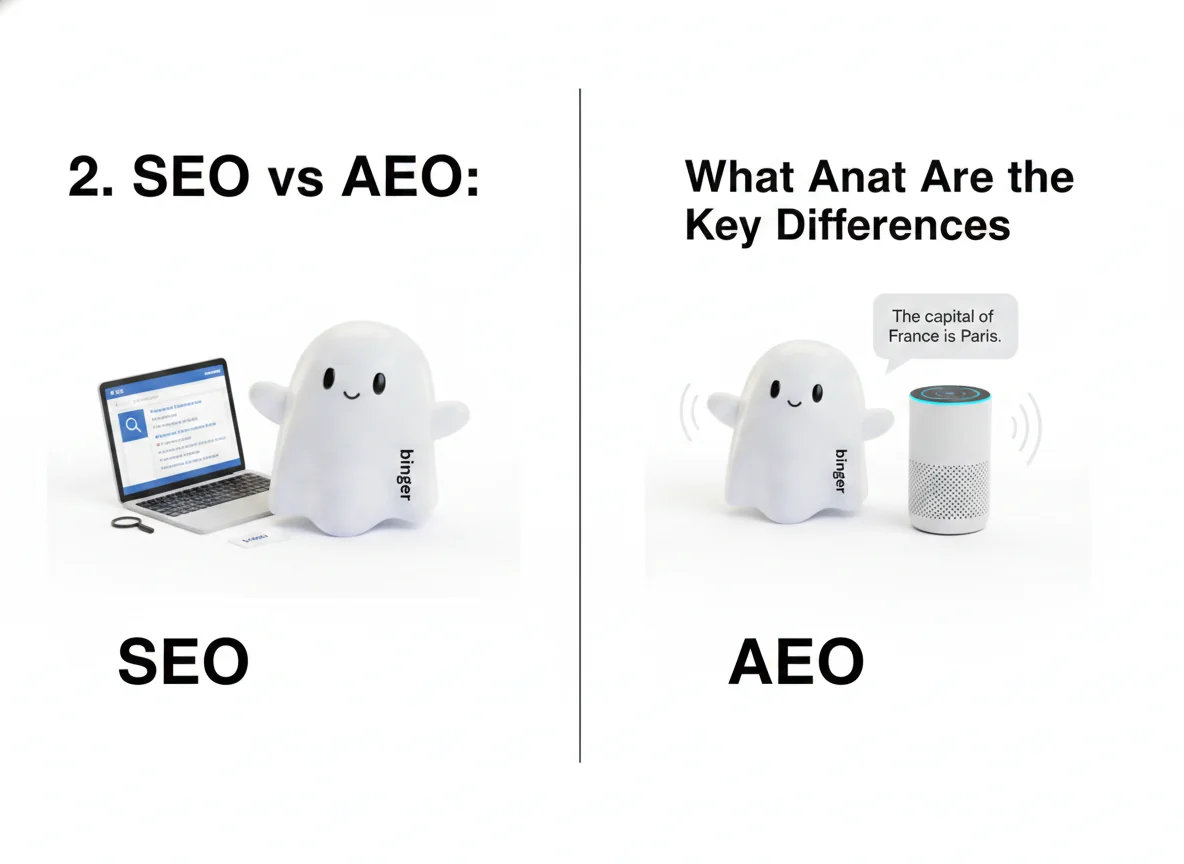
Search Engine Optimization (SEO) is the practice of improving your visibility on search engine results pages (SERPs) like Google or Bing. Its core goal is to drive clicks and organic sessions. You optimize for rankings, impressions, and CTR.
Answer Engine Optimization (AEO) is the practice of optimizing content to be retrieved, selected, and cited by AI answer engines such as ChatGPT Search, Perplexity, Google AI Overviews, Gemini, and Claude. Its core goal is to win citations and influence answers, even when users never click through.
Practically, SEO focuses on SERP features (blue links, featured snippets, People Also Ask) while AEO focuses on structured, quotable, and trusted content that large language models can easily parse.
Recent data suggests that over one-third of AI Overview citations still come from pages already strong in traditional SEO, confirming that AEO extends—rather than replaces—SEO.
Key takeaway: SEO optimizes for ranking and traffic; AEO optimizes for being quoted inside AI-generated answers users increasingly trust.
Answer engines and generative engines reshape how users discover information, so marketers need precise language for these new surfaces.
Answer engines are systems that return synthesized, conversational answers instead of (or before) a list of web links. Examples include ChatGPT Search, Perplexity AI, Google AI Overviews, Google AI Mode, Claude, and Gemini.
Answer Engine Optimization (AEO) is, as defined earlier, the process of making your content easy for those answer engines to find, trust, and quote.
Generative engines are AI systems that generate content—text, images, or video—on demand, often grounded in web or proprietary data.
Generative Engine Optimization (GEO) is the practice of influencing what generative engines produce about your brand, products, or category. GEO strategies overlap with AEO but focus more heavily on how your information is represented in long-form generated outputs.
AI Overviews are Google’s synthesized summaries that appear above traditional results on some queries, blending snippets from multiple sources.
AI citations are the clickable references (URLs, brands) that answer engines use to support their summaries—essentially the new “position zero.”
Key takeaway: The new battle is for answer engine mindshare: if you’re not in the training and grounding data, you’re not in the conversation.
An AI SEO platform is essential when it combines AI content generation with deep SEO and AEO intelligence, governance, and automation. The non-negotiable features fall into five categories.
1) Research & strategy: AI-powered keyword and topic research, intent clustering, entity analysis, SERP/AEO landscape analysis, and competitive gap detection.
2) Content generation & optimization: Briefing tools, on-brand AI writing, multilingual support (critical for India), SEO scorecards, schema markup suggestions, and AEO-optimized structures for FAQs and snippets.
3) AEO & GEO capabilities: Tracking AI citations across engines, surfacing answer gaps, and recommending structures that increase your chance of being quoted.
4) Workflow & governance: Role-based access, approval flows, versioning, brand style controls, and compliance (for regulated industries).
5) Measurement & automation: Rank tracking, AI overview monitoring, content decay alerts, automated refresh recommendations, and integrations with analytics tools.
Platforms like UpBinger focus on this full stack: from AI brief generation to monitoring performance in both traditional SERPs and AI answer surfaces.
Key takeaway: The most important features in an AI SEO platform are those that turn AI from a copywriting toy into an orchestrated, measurable growth engine.
For AEO and GEO, how you structure content often matters more than how creatively you write it. AI systems need clarity, consistency, and explicit signals.
Entity is a clearly identifiable thing—person, organization, product, place, or concept—that AI systems recognize and connect in a knowledge graph.
Entity optimization is the practice of making your brand, products, and topics machine-recognizable: consistent naming, structured data, and contextual linking.
Knowledge graph is the network of entities and their relationships that search and answer engines maintain to understand the world.
Schema markup (structured data) is code that explicitly labels content types (Article, Product, FAQ, HowTo) and attributes so machines can interpret them reliably.
Featured snippets are concise excerpts that appear above standard results; well-structured answers here are strong candidates for AI Overviews.
People Also Ask (PAA) boxes are question-based SERP features; their questions are valuable prompts to structure AEO-friendly FAQs.
Content parsing is how AI systems break your page into headings, lists, and answer blocks. Clean HTML, semantic headings, and bullet lists make parsing easier.
Key takeaway: AEO success depends on being unambiguous to machines—through entities, schema, and question-led structures.
AI content operations is the end-to-end system that uses AI agents and tools to plan, create, optimize, and refresh content at scale, with human oversight.
AI-powered keyword research uses models to cluster massive keyword sets by intent, topic, and stage of journey—far beyond manual spreadsheets.
Topic clustering is grouping related keywords and concepts into hubs (pillar pages plus supporting content) to build topical authority.
Content brief generation is the AI-driven creation of structured outlines: target persona, search intent, headings, entities, FAQs, and AEO opportunities.
Automated SEO content creation is when AI tools generate first drafts tailored to those briefs—optimized for both SEO and AEO—from day one.
Content optimization involves AI suggesting improvements: missing entities, internal links, snippet-ready sections, and readability tweaks.
Content refresh workflows trigger when performance drops: the platform flags decay, proposes new angles or queries (e.g., updated 2026 terms), and regenerates sections for review.
Enterprise platforms like UpBinger orchestrate this as a repeatable workflow rather than one-off prompts, giving CMOs predictable throughput and quality.
Key takeaway: The real ROI of AI for SEO comes from industrial-grade content operations, not isolated AI-written articles.
As AI search matures, strategy conversations increasingly reference concepts beyond basic SEO and AEO. These terms help you brief vendors like an expert.
Personalization at scale is tailoring content and experiences for segments or individuals using AI-derived behavior, location, and interest signals—without manually writing endless variants.
Search intent classification is AI-driven labeling of queries as informational, transactional, navigational, or commercial research, and mapping them to funnel stages.
Content scoring is the use of models to rate how well a page satisfies intent, covers entities, and matches top-ranking or top-cited patterns.
AI agent in SEO is a semi-autonomous system that can research, draft, and even ship changes within defined guardrails—e.g., an agent that monitors AI Overviews for your brand and suggests schema or FAQ updates.
Indexing & crawlability describe how easily search engines discover and store your pages. Even the best AI SEO strategy fails if your site cannot be efficiently crawled.
Rate of innovation in enterprise SEO platforms is how quickly engineering teams ship updates as search and AI engines change—critical in a landscape that shifts weekly.
Key takeaway: By 2026, leading marketers speak not only of rankings, but of agents, citations, knowledge graphs, and answer share.
An enterprise AI SEO platform should offer five core feature sets: 1) advanced research tools (keyword clustering, entity analysis, SERP and AEO intelligence), 2) AI content generation tightly integrated with SEO and AEO best practices, 3) specific AEO and generative engine optimization capabilities such as citation tracking and FAQ/snippet optimization, 4) workflow and governance including roles, approvals, and brand controls, and 5) measurement and automation that monitor rankings, AI Overviews, and content decay. Without this full stack, you’ll end up stitching together point tools and losing both speed and accountability.
In practice, SEO optimizes for rankings and organic traffic from traditional search engine result pages, while AEO optimizes for being quoted inside AI-generated answers. SEO work prioritizes metadata, internal links, and SERP features like featured snippets and People Also Ask. AEO focuses more on structured, unambiguous answers, entities, and schema that answer engines can easily parse and trust. Both rely on relevance and authority, but AEO success is measured in citations and answer share, not just clicks and sessions.
Start by using AI as an assistant, not an autopilot. First, use AI for research and briefs—intent clustering, outline creation, and FAQ discovery. Second, let AI create draft content following those briefs, but have experts edit for accuracy, nuance, and local context (especially important in India’s multilingual market). Third, use AI for optimization: suggesting entities, schema, and better headings. Finally, set up guardrails in your platform—brand guidelines, fact-checking steps, and approval workflows—to ensure AI accelerates quality, not dilutes it.
To optimize for AI Overviews and answer engines, begin with strong traditional SEO: pages that already rank well are more likely to be cited. Then, structure content with clear headings, concise definitions, and bullet lists that are easy to quote. Add FAQ sections based on People Also Ask questions, implement appropriate schema markup, and ensure entities (brand, products, locations) are explicit and consistent. Monitor which pages win citations and replicate their patterns across your content portfolio with the help of platforms like UpBinger.
AEO is critical because user behavior is shifting from “search and click” to “ask and trust the answer.” As AI Overviews and tools like Perplexity or ChatGPT Search gain adoption, a growing share of discovery and consideration happens inside AI-generated responses. If your brand isn’t present in those answers, you effectively disappear from a key part of the customer journey. For enterprises, AEO becomes a new channel with its own KPIs—answer share, citation volume, and brand representation—sitting alongside classic SEO metrics.
Terminology only matters if it changes what you do on Monday morning. Use this cheat sheet to rewrite your briefs, RFPs, and quarterly plans. Specify whether you’re targeting SEO, AEO, or GEO. Ask vendors how they handle entities, AI citations, and answer engine monitoring. Define what “AI agent” means inside your organization and what guardrails it must follow.
For Indian enterprises, platforms like UpBinger turn this vocabulary into software: AI agents for research, content generation, and optimization tuned for both search engines and answer engines. The organizations that win 2026 won’t just produce more content. They’ll run smarter AI-powered content systems, anchored in a shared language that makes strategy, execution, and measurement unambiguous.
Start by aligning your team on these 50+ terms. Then, design one pilot workflow—keyword research to published article to AEO monitoring—powered by an AI SEO platform. Measure, refine, and scale. The glossary is step one; the real advantage is how quickly you can turn words into compounded visibility.