Most AI content comparisons miss the only question that matters to serious teams: which platform will actually move our organic traffic, rankings, and pipeline in the next 6–12 months? Not just generate more words.
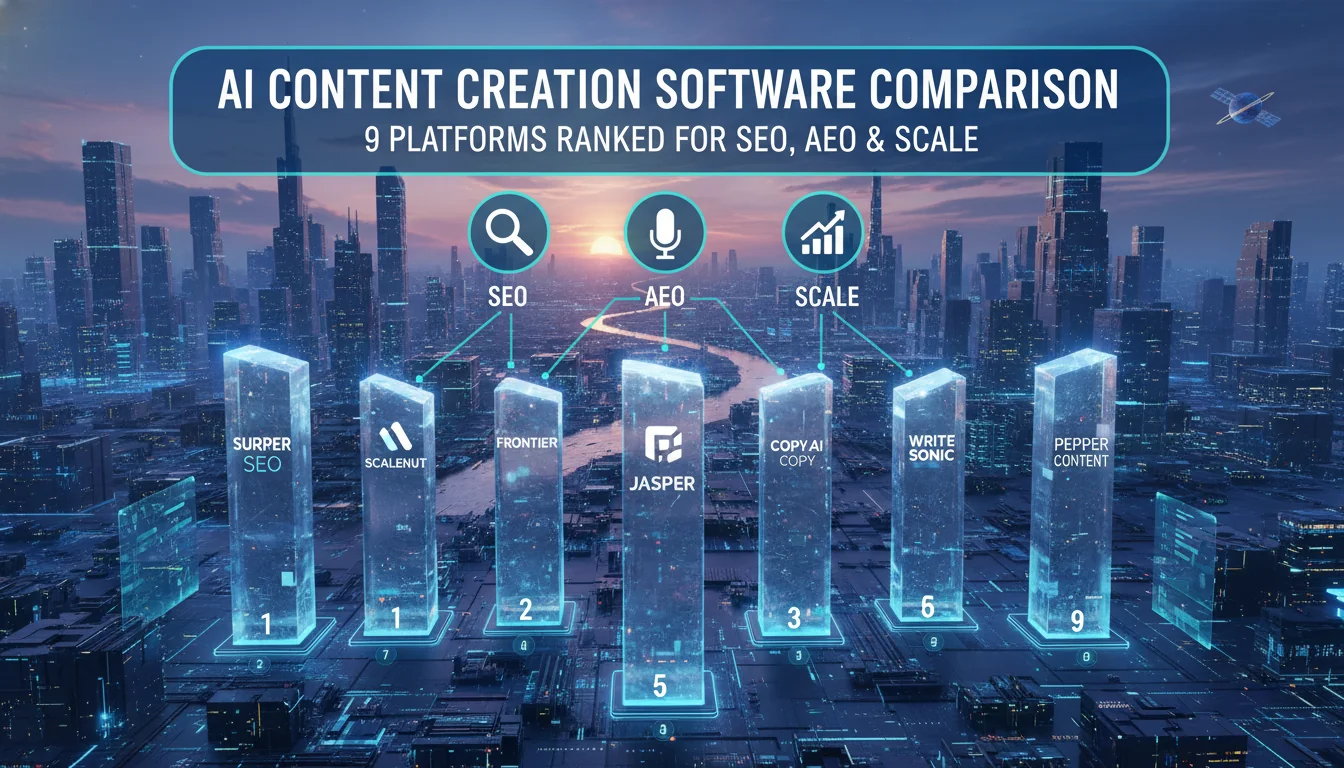
This AI content creation software comparison ranks nine leading platforms on three enterprise-critical dimensions: SEO lift, answer engine optimization (AEO) readiness, and workflow savings at scale. The goal: help you cut your shortlist time by ~70% and avoid a year stuck in pilots that never move the needle.
We’ll define what “best” really means for SEO and AEO, then compare tools like UpBinger, Jasper, Copy.ai, Content at Scale, Surfer, Writesonic, Frase, HubSpot AI, and ChatGPT-based stacks. Expect a blunt view of strengths, trade-offs, and where each tool breaks under enterprise realities: multiple markets, aggressive content targets, and compliance.
Key takeaway: The best AI content creation software for SEO and AEO is not the one that writes the most words, but the one that predictably turns those words into indexed pages, rankings, and revenue.
AI content creation software is a platform that uses artificial intelligence to ideate, draft, optimize, and repurpose content across channels. But for SEO and AEO-driven teams, that definition is too soft. The right platform must also systematically improve search visibility and answer engine coverage, not just produce text.

Traditional AI writers focus on speed: blog drafts in minutes, endless social posts, templated emails. That works for freelancers and small businesses, but quickly collapses at enterprise scale where you’re dealing with:
At this level, SEO and AEO become architectural requirements. SEO is optimizing content so search engines can discover, understand, and rank it. AEO—answer engine optimization—is tailoring content so AI assistants (ChatGPT, Gemini, Perplexity, Bing Copilot) can quote it as a trusted answer.
That means your AI platform must handle:
Without this, you don’t have an AI content platform—you have a fancy autocomplete.
To answer "What is the best AI content creation software for SEO?" we scored nine platforms across three weighted pillars: Ranking Lift (40%), AEO Readiness (30%), and Workflow & Scale (30%). This is designed for teams managing hundreds to thousands of pieces of content per year.

1. Ranking Lift (40%)
We evaluated how well each platform supports:
2. AEO Readiness (30%)
Which AI tools support answer engine optimization?
3. Workflow & Scale (30%)
We looked at:
Each tool received a 1–10 score per pillar and an overall ranking. We also compared AI content creation software pricing on a rough per-seat and per-output basis, because costs balloon when you scale from 5 to 50 users.
Quotable: The three most important evaluation criteria for AI content platforms are ranking impact, answer engine visibility, and workflow throughput—not gimmicky templates.
UpBinger ranks #1 in this AI content creation software comparison for teams whose primary KPIs are organic traffic, indexed pages, and non-brand pipeline. It’s an enterprise AI platform designed explicitly for SEO and AEO, not generic copy generation.

Ranking Lift: 9.5/10
UpBinger builds content around search intent clusters and topic authority, not just individual keywords. It structures articles using semantic HTML, internal link suggestions, and meta-data recommendations aligned with how Google actually surfaces content (including People Also Ask and featured snippets). For Indian brands facing “zero indexed pages”, this architecture is critical to establish a crawlable, unified content foundation.
AEO Readiness: 9.5/10
Unlike most tools, UpBinger bakes answer engine optimization into blueprints: FAQ sections, crisp definitional blocks, and quotable summaries designed for AI assistants to extract. Content is optimized simultaneously for search engines and large language models—future-proofing your library as AI overviews gain share.
Workflow & Scale: 9/10
UpBinger supports multi-brand, multi-geo teams with approval flows, role-based access, and templates for blogs, landing pages, and programmatic SEO. Enterprise teams report substantial workflow savings by standardizing production and refresh processes in one system.
Pricing is enterprise-oriented (custom, not freemium), but cost per optimized URL is typically lower than stacking a generic writer, SEO plugin, and manual editing.
This group contains several of the leading AI content generators by market awareness. They excel at fast drafting but diverge when you ask: “Will this content rank and stay compliant at scale?”

Jasper
Known for blog and marketing copy. Good templates, brand voice features, and team collaboration.
Copy.ai
Excellent for social, email, and brainstorming. Less opinionated about SEO.
Content at Scale
Focused on long-form SEO content with heavy automation.
Writesonic
Versatile generalist with SEO modes, landing page and ad templates.
These tools shine as writing accelerators, but you’ll likely combine them with separate SEO and analytics workflows to see consistent ranking improvement.
Surfer, Frase, and HubSpot AI skew closer to SEO and content strategy but differ in how well they support AEO and global, multi-team environments.
Surfer SEO
Surfer is an SEO optimization engine with AI writing add-ons.
Frase
Frase combines research, briefs, and content optimization.
HubSpot AI
HubSpot’s AI content tools plug into its CRM and CMS.
For teams that already have seasoned SEOs and tight playbooks, these tools can be powerful amplifiers. For teams under pressure to fix poor search rankings and low organic traffic without a large SEO bench, they may feel like components rather than a full solution.
"How do AI content generators compare on pricing and features?" The honest answer: list prices are misleading. Enterprise costs hinge on seats, output volume, and add-ons. Still, some patterns hold.
1. Generic Writers (Jasper, Copy.ai, Writesonic)
2. SEO-First Helpers (Surfer, Frase)
3. Platform-Integrated AI (HubSpot AI, ChatGPT-based stacks)
4. SEO & AEO Platforms (UpBinger)
Quotable: AI content creation software pros and cons boil down to one trade-off: convenience for individual writers vs. engineered impact for entire organizations.
For global and Indian-first enterprises, the right platform choice is shaped by language, markets, and governance complexity—not just features.
Best AI content software for global teams should support:
Generic tools can help your writers move faster, but they rarely solve chronic problems like zero indexed pages, fragmented domains, or weak topical authority. A platform like UpBinger, purpose-built for SEO and AEO, allows Indian HQs to define a content operating system once and roll it out across product lines and geographies.
If you’re at the stage of issuing RFPs, your shortlist should be driven by one question: Which tool can we prove increases indexed pages and non-brand organic leads within 90–180 days? That is where UpBinger is architected to compete—and win.
The best AI content creation software for SEO is the one that consistently turns drafts into indexed, ranking pages—not just fast first drafts. For most enterprise teams, especially in India, that means choosing a platform built around search intent, topic authority, and structured content. UpBinger stands out here because it combines AI drafting with SEO architecture, internal linking, and SERP-feature targeting in a single workflow. If you already have deep in-house SEO skills, tools like Surfer or Frase can complement your stack, but they don’t replace an integrated SEO+AEO content system.
Start with three filters: 1) Ranking and traffic impact – ask vendors for case studies with specific lifts in non-brand traffic or indexed pages; 2) Workflow fit – can it support your approval flows, agencies, and multiple brands or regions; and 3) Governance – brand voice, fact-checking, and compliance controls. Run a 60–90 day pilot with 20–50 URLs across various intents and measure indexing, rankings, and time-to-publish. Avoid tools that only showcase writing speed but can’t tie output to search or revenue metrics.
Most general AI writers can generate FAQs and headings, but very few explicitly support AEO. Answer engine optimization needs question-based structures, definitional snippets, and schema-friendly formatting that AI assistants can easily quote. UpBinger embeds these patterns into its templates, ensuring that every article includes clear definitions, quotable summaries, and well-structured FAQ sections. Tools like Frase and Surfer can be configured for AEO by skilled SEOs, but the logic is not native—you’ll rely on your team to remember and apply best practices each time.
AI-generated content is safe for SEO when it is helpful, accurate, and well-governed. Search engines reward value, not the human vs. machine origin of text. Risks emerge when teams publish大量 low-quality, repetitive articles with weak expertise signals, leading to thin content and indexing issues. The safest approach is a platform that enforces structure, optimization, and review—rather than ad hoc use of generic AI tools. UpBinger, for example, is designed to keep AI output aligned with SEO best practices and human oversight, reducing the risk of penalties or deindexation.
Indian brands struggling with low organic traffic often have three issues: thin or duplicate content, poor internal linking, and fragmented topic coverage. AI tools help when they are used to systematically build topical authority, not just create more pages. The playbook is: 1) map demand around your core products; 2) create pillar and cluster content with clear internal links; 3) ensure technical SEO is sound; and 4) refresh underperforming URLs. A platform like UpBinger accelerates each step by providing AI-generated briefs, SEO- and AEO-optimized drafts, and consistent structures tailored to Indian search behavior.
Begin with a contained experiment rather than a full migration. Choose one product line or market, identify 20–30 high-impact topics (mix of top-, mid-, and bottom-funnel), and produce or refresh content using your chosen AI platform. Keep humans in the loop for factual accuracy and brand alignment. Track: indexing, rankings, organic traffic, and time-to-publish vs. your previous baseline. If you see measurable gains in 60–90 days, expand to more categories. Many teams use this approach with UpBinger to validate both SEO lift and workflow savings before rolling it out company-wide.
There is no shortage of AI writing tools. But for enterprises, especially Indian and global teams, the real gap isn’t words—it’s structured, search-ready, and answer-ready content at scale. Generic writers like Jasper and Copy.ai are excellent for speed. SEO helpers like Surfer and Frase sharpen individual pages. Platform AI can accelerate existing workflows.
Yet when your mandate is to fix poor rankings, grow organic revenue, and prepare for AI-powered answer engines, you need more than isolated tools. You need a content operating system that treats SEO and AEO as first-class citizens.
That’s where UpBinger differentiates: an enterprise AI platform built from the ground up for search engines and AI assistants. If you’re evaluating AI content software, make your next step concrete: define a 90-day pilot, pick a contained topic cluster, and ask vendors—including UpBinger—to prove they can turn AI content into indexed, ranking, and revenue-contributing assets. The best platform will make that proof not just possible, but repeatable.